Naval system · UUV
Orca XLUUV
Submarine Warfare / Mine Laying
Also known as: Orca / XLUUV / Extra Large Unmanned Undersea Vehicle
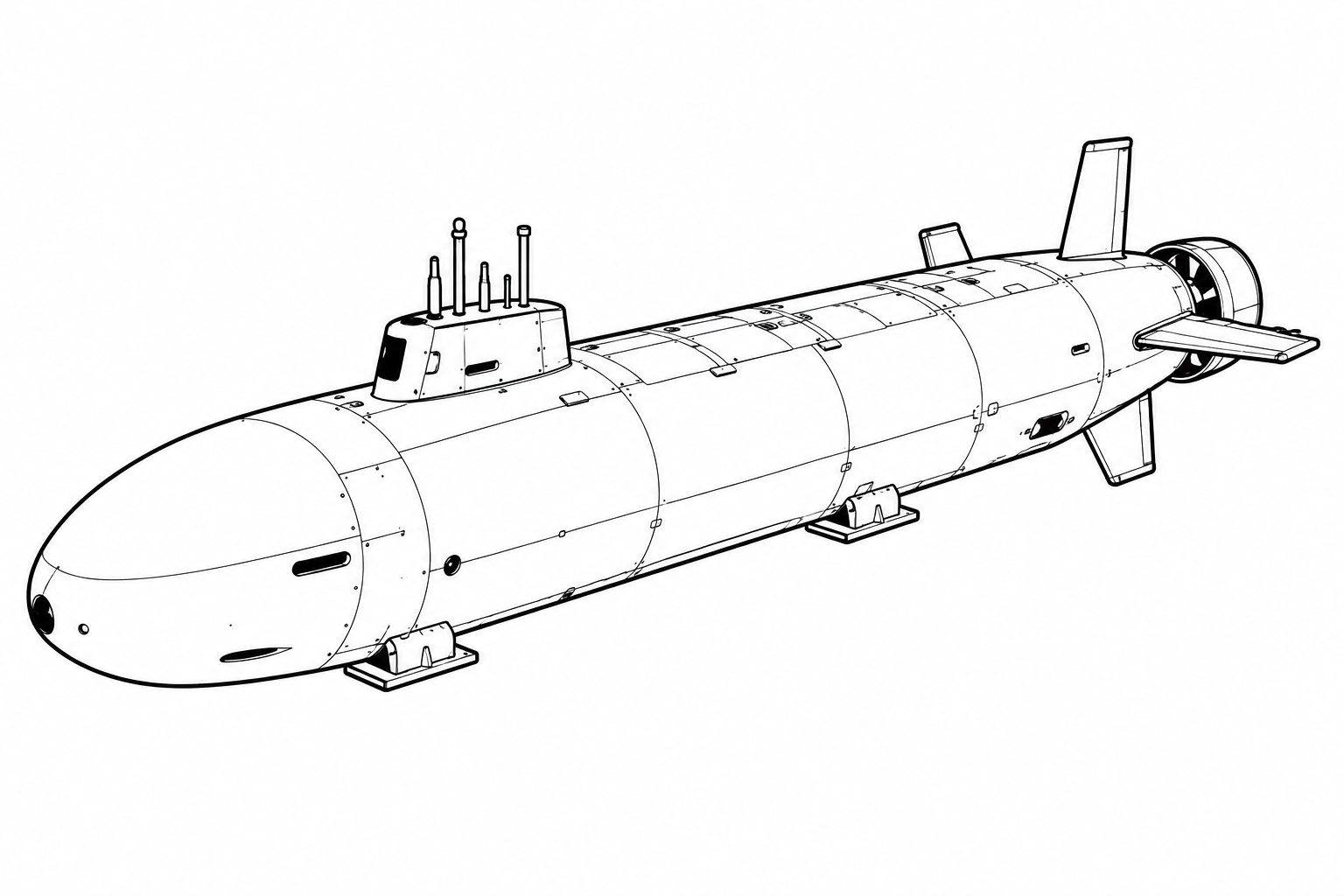
Orca XLUUV overview
The Orca XLUUV (Extra Large Unmanned Undersea Vehicle) is a large autonomous submarine developed by Boeing for the U.S. Navy, representing the most ambitious unmanned undersea vehicle program in American naval history. Built on lessons from Boeing's Echo Voyager technology demonstrator — itself a world record for the largest unmanned undersea vehicle built to that point — the Orca stretches approximately 26 meters in length and displaces around 50 tons, giving it a size comparable to a World War II submarine while being entirely crewless. The hull accommodates a large modular payload section of approximately 34 feet that can be reconfigured with different mission packages including mine laying, mine countermeasures, anti-submarine warfare sensors, anti-surface warfare weapons, and intelligence collection payloads, making it the most versatile unmanned undersea vehicle ever fielded.
The strategic rationale for the Orca centers on contested-environment operations where the risk of losing a manned submarine — with its crew and classification costs — would be prohibitive. A crewed submarine entering a heavily mined strait or operating within range of an adversary's undersea detection network accepts enormous institutional and human cost if it is detected and sunk. An Orca performing the same mission removes the crew risk entirely and costs a fraction of a Virginia-class submarine, allowing the Navy to accept greater operational risk in pursuit of critical objectives. The vehicle is powered by a diesel-electric system with battery reserves for silent submerged operation, communicates through acoustic modems when submerged and satellite when surfaced, and navigates using a combination of inertial navigation, Doppler Velocity Log, and terrain correlation.
The U.S. Navy awarded Boeing a $274 million contract in February 2019 for five Orca vehicles, with the intention of beginning at-sea testing in 2020. The program subsequently experienced significant schedule delays and cost growth, with the first vehicle not delivered until 2022 and in-water testing pushed into 2023. The Navy has remained committed to the program despite these challenges, recognizing that the Orca represents a foundational capability for the service's distributed maritime operations concept, in which networks of unmanned vessels extend fleet reach and complicate adversary targeting. As of 2025–2026, Orca testing continues at Navy range facilities on the West Coast, with the program working through operationally representative mission scenarios ahead of a planned initial operational capability declaration.
Armament
Mk 46 sea mines, torpedo tubes (planned), modular payload bay
Development and operational timeline
- Boeing delivers Echo Voyager technology demonstrator — largest unmanned submarine ever built
- Navy awards Boeing $274M contract for five Orca XLUUV vehicles
- Construction begins on first Orca hull; COVID-19 supply chain disruptions cause initial delay
- First Orca vehicle delivered to U.S. Navy at Port Hueneme, California
- Orca begins in-water testing at West Coast naval range facilities
- Navy conducts extended autonomous submerged operations trial with Orca
- Navy continues Orca program; mine payload and anti-submarine sensor integration tested
- Orca program advancing toward operational evaluation; IOC planning underway