Naval system · UUV
REMUS 600
Mine Countermeasures / Survey
Also known as: REMUS 600 AUV / REMUS 600M / Yellow Moray
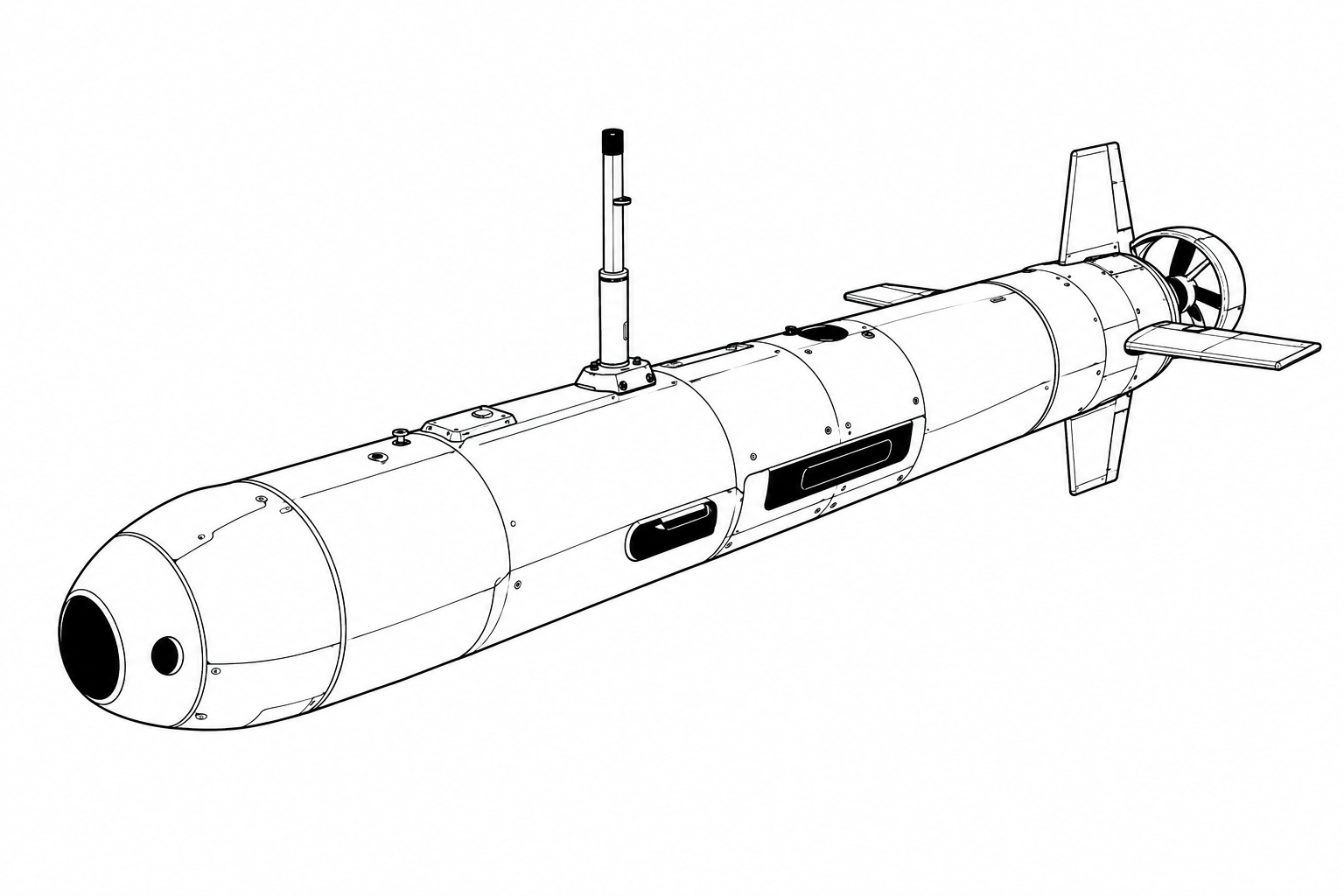
REMUS 600 overview
Last reviewed:
REMUS 600 is a medium-class autonomous underwater vehicle whose name identifies a 600 m operating-depth class, not a 600 km range. The design grew from Woods Hole Oceanographic Institution research and became part of the commercial and military REMUS family now produced by HII. It is used for underwater surveying, mine-countermeasure work, environmental sensing, and other missions where an autonomous vehicle can collect data without an onboard crew.
WHOI describes the research REMUS 600 as approximately 32.4 cm in diameter and 240 kg in weight, with nearly 70 hours of endurance, speeds up to five knots, and a range of about 286 nautical miles. Those figures describe a research configuration. Military 600M data sheets and different battery or sensor fits can give substantially different endurance values. It is misleading to choose the largest figure from each configuration and present the combination as a guaranteed operational performance envelope.
The modular body can accommodate different sonar and environmental payloads. Underwater navigation is fundamentally different from aerial navigation because satellite-positioning signals do not provide continuous access beneath the sea. AUV missions use combinations of onboard navigation, acoustic references, and other position updates appropriate to the configuration. Communications bandwidth and access are constrained underwater, so an autonomous survey plan and recovery arrangements are central to practical operation.
REMUS 600 is not a torpedo merely because it has a torpedo-shaped hull or can fit within a submarine-related handling system. Its documented missions focus on collecting information, and there is no need to invent an explosive weapons load to explain its military value. A detailed survey can help a navy understand hazards and routes without placing a diver or crewed platform at the same point. Data quality, endurance, and reliable recovery are therefore major measures of usefulness.
A significant new operational milestone came in June 2025, when the Navy and WHOI conducted a forward-deployed torpedo-tube launch and recovery of an HII-built REMUS 600 from USS Delaware under the Yellow Moray effort. On April 27, 2026, HII announced a Defense Innovation Unit contract for a submarine Torpedo Tube Launch and Recovery system building on that work. The release also discussed REMUS 620 tests, but the 620 is a newer separate vehicle and its endurance must not be relabeled as a REMUS 600 specification.
Through October 2026, REMUS 600 remains important both as an established AUV and as part of experiments extending the reach of crewed submarines. The new contract is evidence of continued integration work, not proof that every Navy submarine has received the same launch system. Readers should distinguish the WHOI research vehicle, military 600M configurations, Yellow Moray integration, and the successor REMUS 620. Family-wide delivery totals also do not establish the fleet size of a single model.
Armament
None in documented survey configurations; not a torpedo
Development and operational timeline
- WHOI develops the first REMUS 600, according to its Oceanographic Systems Laboratory
- Early sea testing establishes the larger vehicle's research and survey role
- REMUS 600 and military configurations support survey and mine-related missions with different payloads
- HII introduces REMUS 620 as a separate successor; its figures are not REMUS 600 specifications
- HII reports the first forward-deployed REMUS 600 torpedo-tube launch and recovery from USS Delaware
- HII announces a DIU contract for submarine Torpedo Tube Launch and Recovery development
- Status review: distinguish the research REMUS 600, military configurations, and newer REMUS 620