Naval system · UUV
Echo Voyager
Autonomous Undersea Operations
Also known as: Echo Voyager / Boeing Echo Voyager / XLUUV demonstrator / Orca predecessor
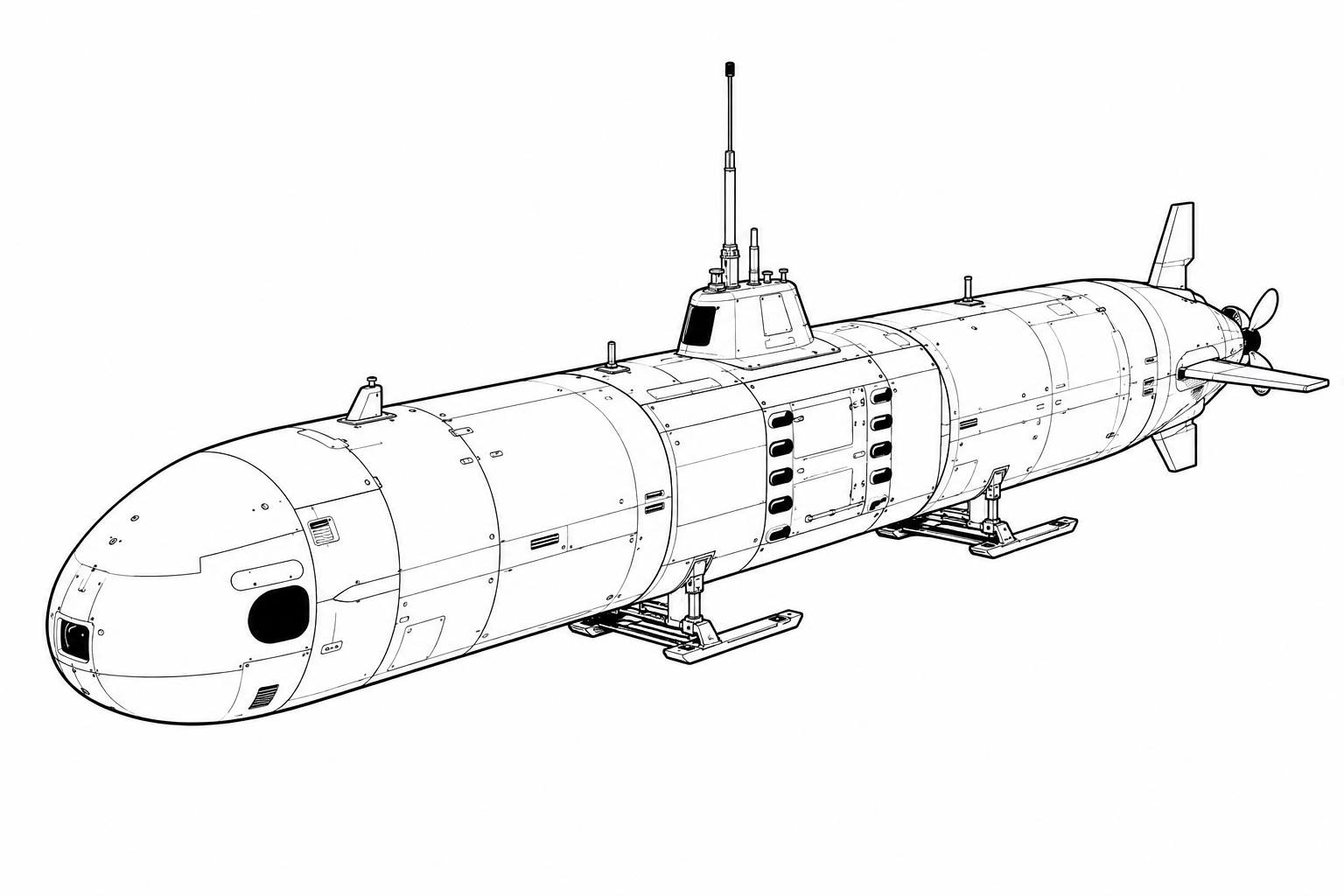
Echo Voyager overview
The Echo Voyager is a large autonomous underwater vehicle (AUV) developed by Boeing Defense, Space & Security as a technology demonstrator for extra-large unmanned undersea vehicle (XLUUV) concepts. Unveiled in March 2016, the approximately 15.5-meter (51-foot), 50-ton vehicle represented a dramatic leap in autonomous undersea technology at the time of its introduction. Unlike previous large AUVs that required dedicated surface support ships to deploy and recover them, the Echo Voyager was designed to be fully self-deploying — transiting independently from port to operating area under its own power, conducting its assigned mission, and returning autonomously, all without a support vessel shadowing it.
The Echo Voyager's hybrid propulsion system is a key innovation that underpins its exceptional endurance. The vehicle uses diesel generators while snorkeling at shallow depth to charge a large lithium-ion battery bank, which then powers quiet electric propulsion during submerged operations. This combination allows range measured in thousands of nautical miles and endurance measured in months rather than days — capabilities that far exceeded any previous AUV when introduced. The modular payload bay positioned amidships can accommodate a variety of mission packages for mine countermeasures, anti-submarine warfare, intelligence gathering, or electronic warfare payloads, giving the platform adaptability across mission types with a relatively quick turnaround between deployments.
In 2017, the Echo Voyager completed its first autonomous mission in the Pacific Ocean, operating off the coast of Southern California and demonstrating sustained autonomous navigation, sensor employment, and communications relay over an extended period. The test results validated the core design concept and proved that a large unmanned submarine could operate reliably without a dedicated human support presence. Boeing conducted multiple subsequent test programs refining the vehicle's autonomy software, power management algorithms, and payload integration interfaces through 2018 and into 2019.
The U.S. Navy took direct notice of the Echo Voyager's performance. In 2019, Boeing was awarded the Navy's Orca Extra Large Unmanned Undersea Vehicle (XLUUV) contract — a $274 million award for five production vehicles that directly leveraged Echo Voyager technology at scale. The Orca, based on a militarized and expanded Echo Voyager design at approximately 26 meters in length, is intended for missions ranging from mine laying and mine countermeasures to anti-submarine warfare and intelligence collection in contested environments where risking manned submarines would be operationally or politically unacceptable. The Orca program has experienced schedule delays and cost growth through 2023–2025, with GAO oversight reports highlighting software and integration challenges, but the first vehicles have been delivered for operational testing.
As of 2025–2026, the Echo Voyager demonstrator program has concluded its active role, but its technical and conceptual legacy endures. It proved that large, truly autonomous submarines are technically and operationally feasible — shifting U.S. Navy undersea warfare planning to seriously incorporate unmanned vessels alongside traditional nuclear submarines for the first time in history. The Echo Voyager's most lasting contribution is conceptual: demonstrating the self-deploying, long-endurance unmanned submarine as a credible operational tool, a paradigm now being pursued by China, Russia, the United Kingdom, and Australia as well.
Armament
None (technology demonstrator)
Development and operational timeline
- Boeing publicly unveils Echo Voyager 51-foot autonomous UUV
- Echo Voyager completes first autonomous Pacific Ocean mission without support ship
- Extended endurance tests validate hybrid diesel-electric power system
- Autonomous navigation and payload integration trials completed
- Boeing awarded $274M Orca XLUUV contract based on Echo Voyager technology
- First Orca vehicle (based on Echo Voyager) delivered to Navy for testing
- GAO report flags Orca schedule delays; Boeing works through software challenges
- Orca undersea testing program advances; Echo Voyager design validated in successor
- Echo Voyager legacy cited as foundation of Navy's XLUUV operational doctrine