Land system · Hybrid-Electric Logistics UGV
General Dynamics MUTT
Dismounted Load Carriage / Exportable Power
Also known as: MUTT / Multi-Utility Tactical Transport / S-MET Increment I / SMET / Small Multipurpose Equipment Transport
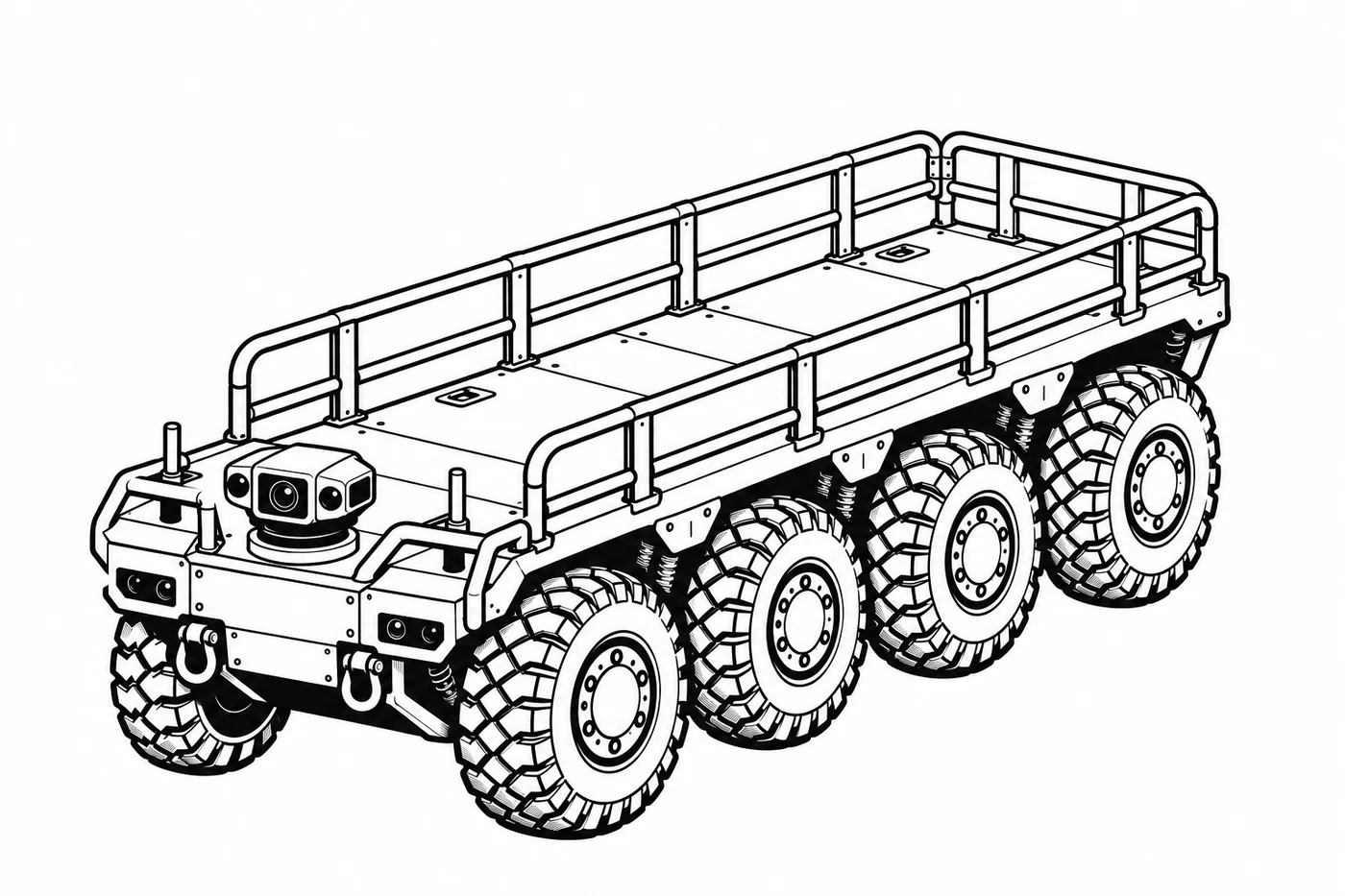
General Dynamics MUTT overview
Last reviewed:
General Dynamics Land Systems' Multi-Utility Tactical Transport, or MUTT, is a family of robotic load carriers best known for the eight-wheel platform behind the U.S. Army's S-MET Increment I program. Its basic purpose is to reduce the weight carried by dismounted soldiers and provide mobile electrical power. This entry focuses on that logistics role and the eight-wheel family illustrated here, rather than treating every experimental armed MUTT, tracked version or later MUTT XM as the same production vehicle.
The Army's June 2020 account describes an extensive soldier assessment involving 80 systems from four vendors and two infantry brigades during 2019. The tested requirements included carrying at least 1,000 lb, operating over 60 miles during a three-day period, and exporting 1 kW while moving or 3 kW while stationary. These are program-level assessment requirements and reported outcomes. They are not proof of 72 hours of uninterrupted driving at maximum speed, nor a guarantee that every terrain and payload combination delivers the same distance.
Historical technical reporting describes the eight-wheel MUTT as about 116 inches long and 70 inches wide, approximately 2.95 m by 1.78 m. That family reference lists a 1,200 lb payload and a 3,500 lb gross vehicle weight for the wheeled configuration. Gross weight includes the vehicle and its load; it is not an empty chassis mass. The Army's 1,000 lb requirement and the manufacturer's broader 1,200 lb family figure are therefore shown separately instead of silently replacing one with the other.
General Dynamics describes the S-MET powertrain as hybrid-electric, with hand-controller, teleoperation and tether modes. Following a soldier by tether and driving from a remote controller can reduce cognitive burden, but these modes are different from unrestricted autonomous navigation. Exportable power allows the carrier to support unit electronics as well as transport supplies. Its practical utility still depends on charging or fuel support, load security, obstacle negotiation and how quickly a unit can recover a disabled robot.
The procurement history includes a 2019 selection reported at the time and a July 2020 S-MET award identified by the manufacturer. Contemporary reporting then described initial deliveries completed in April 2021. Early Army plans called for 624 vehicles by the middle of fiscal 2024, but a planned quantity and date are not themselves evidence that every delivery occurred. This profile preserves those distinctions and does not convert a contract ceiling, schedule or reassessment into a verified current inventory.
The S-MET name also spans later competitions and should not be treated as a permanent synonym for one MUTT version. September 2024 reporting identified American Rheinmetall Vehicles and HDT as prototype contractors for Increment II. The manufacturer's current presentation separately markets MUTT XM as an expanded-mobility development drawing on the S-MET architecture. Higher future payloads, weapons options or autonomy proposals should not be retroactively assigned to the baseline Increment I carrier simply because the products share a family name.
At the November 21, 2026 review, MUTT remains an important reference for an Army-supported robotic logistics program rather than just a demonstration vehicle. Hanwha Arion-SMET provides a useful comparison in electric robotic transport, but its U.S. testing did not make it the Increment I winner. Mission Master and THeMIS provide other modular ground-system contexts. Meaningful comparisons separate carrying capacity, support equipment and control mode from weapons demonstrations or maximum performance figures belonging to different variants.
Armament
Unarmed S-MET load carrier; weapons demonstrations and MUTT XM are distinct configurations
Development and operational timeline
- Contemporary technical reporting records U.S. Marine Corps load-carrying trials of MUTT
- Defense reporting identifies the eight-wheel MUTT as the Army's initial SMET selection
- Army details the 2019 multi-vendor assessment and the 1,000 lb, 60-mile and export-power requirements
- Manufacturer identifies July 2020 selection for the S-MET program
- Initial S-MET deliveries reported completed; later reporting describes production ramp-up
- Reporting names separate Increment II prototype contractors; Increment I MUTT is not automatically the next-increment vehicle
- Editorial status review: baseline S-MET, historical MUTT family figures and MUTT XM marketing are kept distinct
Sources & further reading
- General Dynamics Land Systems — S-MET, MUTT and MUTT XM
- U.S. Army — assessment requirements and planned fielding
- Army Technology — historical MUTT configurations and dimensions
- Shephard — initial S-MET delivery and production report
- Defense News — Increment II prototype awards, September 2024
- Defense News — initial eight-wheel MUTT selection, October 2019