Land system · UGV
iRobot PackBot
EOD / Reconnaissance
Also known as: PackBot / PackBot 510 / iRobot military robot
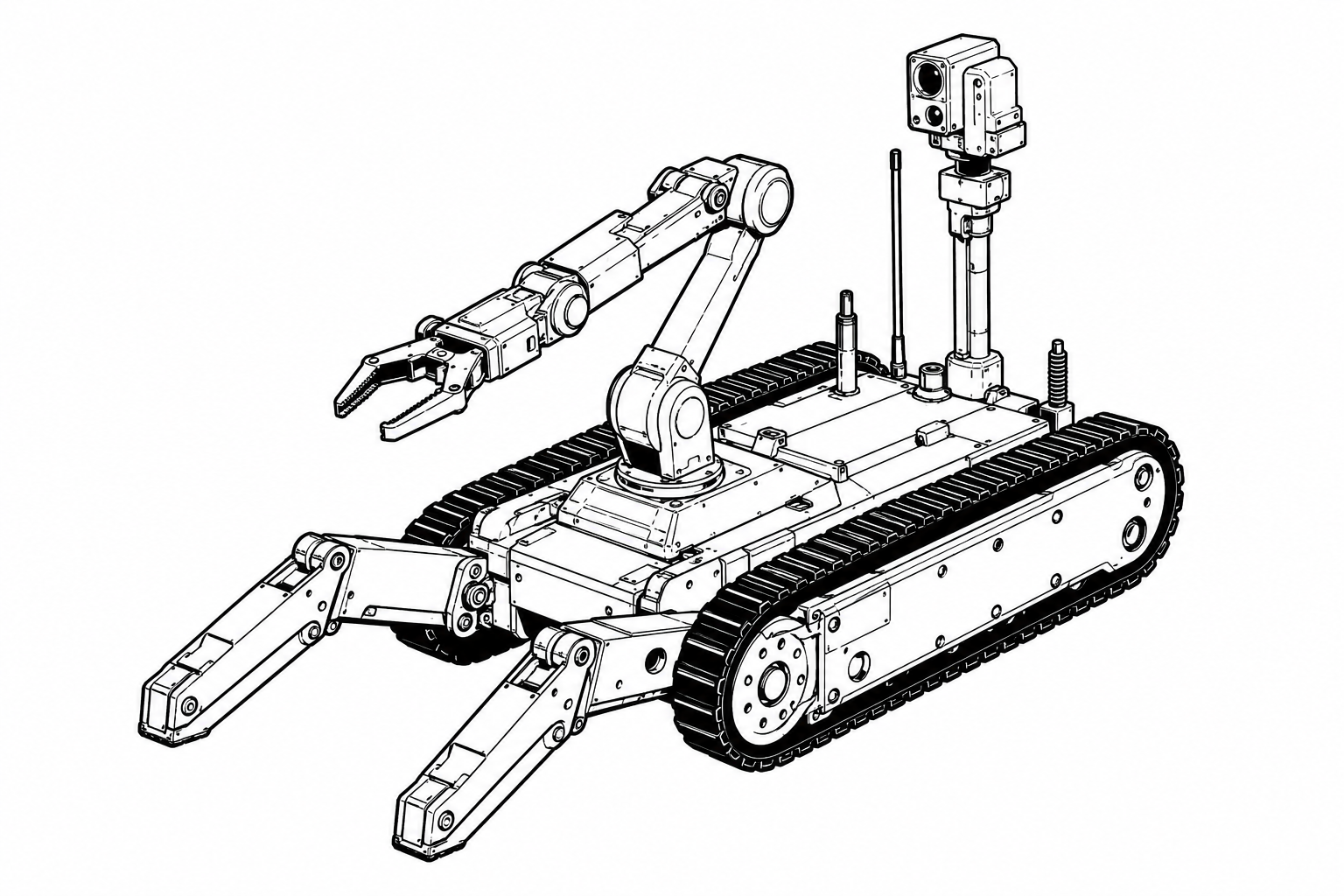
iRobot PackBot overview
The iRobot PackBot is a small, tracked unmanned ground vehicle that became the most widely deployed military robot in history, with over 4,500 units delivered to defense and law enforcement customers across more than 30 countries. Developed by iRobot Corporation and first sent to the rubble of the World Trade Center within days of the September 11 attacks, the PackBot was initially used for search-and-rescue reconnaissance in environments too dangerous or confined for human responders. The military significance of the platform became clear within months: the same ability to enter spaces humans could not safely access translated directly into a life-saving capability for explosive ordnance disposal, where the PackBot's manipulator arm could examine, move, and disrupt improvised explosive devices without placing a technician in the blast radius.
The PackBot 510 — the most produced variant — weighs approximately 13 kilograms and uses a flipper-assisted tracked chassis that can climb stairs, traverse rubble fields, and right itself after being tipped over. The articulated manipulator arm has six degrees of freedom and can lift up to 10 kilograms, sufficient to open vehicle doors, cut wires, and manipulate most IED components encountered in theater. Multiple sensor packages were developed over the PackBot's service life including the FOCUS system with pan-tilt EO/IR cameras, the HAZMAT chemical detection payload, and various SIGINT collection modules. The system uses a fiber optic tether for highly reliable communication in urban environments where radio frequency signals are often blocked or jammed by adversaries.
The PackBot saw its most intensive operational use during the wars in Iraq and Afghanistan between 2003 and 2014, where it is credited with safely examining or neutralizing tens of thousands of IEDs that had been placed along routes, inside vehicles, and in buildings. Soldiers who operated the PackBot developed a notable psychological attachment to their robots — naming them, mourning their destruction in action, and in some cases requesting damaged units be repaired and returned to their unit rather than replaced with a new platform. This human response to working robots foreshadowed later debates about the psychology of human-robot teaming. iRobot sold its defense and security division to form Endeavor Robotics in 2016, which was subsequently acquired by FLIR Systems in 2019 and then by L3Harris Technologies. As of 2025–2026, L3Harris continues to support legacy PackBot fleets while developing next-generation EOD platforms incorporating AI-assisted threat classification and improved autonomous navigation.
Armament
None (EOD/reconnaissance only)
Development and operational timeline
- PackBot deployed to World Trade Center rubble for search-and-rescue reconnaissance
- PackBot deployed to Afghanistan cave complexes for reconnaissance ahead of clearance forces
- PackBot enters large-scale EOD deployment in Iraq; IED disposal missions begin
- Over 1,000 PackBots deployed across Iraq; credited with thousands of IED disposals
- PackBot deployed to Fukushima Daiichi nuclear plant for radiation-environment reconnaissance
- iRobot sells defense division; Endeavor Robotics formed to continue PackBot production
- FLIR Systems acquires Endeavor Robotics; PackBot integrated with FLIR thermal cameras
- L3Harris acquires FLIR Systems; PackBot fleet now under L3Harris stewardship
- L3Harris fields next-generation Hybrid EOD robot alongside legacy PackBot fleet