Land system · UGV
Vision 60 Q-UGV
Autonomous Patrol / ISR
Also known as: Ghost Robotics Vision 60 / Vision 60 / V60 Q-UGV
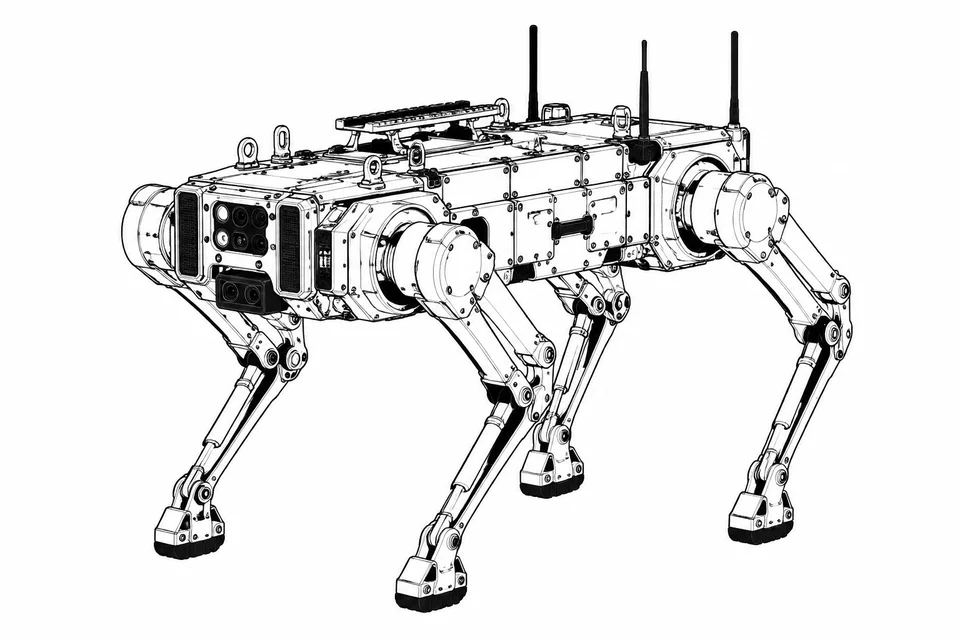
Vision 60 Q-UGV overview
Last reviewed:
Vision 60 Q-UGV is Ghost Robotics' four-legged unmanned ground vehicle, designed to carry sensors and other mission equipment through environments that can be difficult for conventional wheeled patrol robots. Its name means quadrupedal unmanned ground vehicle, not an airborne drone. The platform's best-documented defense role is reconnaissance and installation security, where cameras and communications equipment let personnel investigate an area without walking directly into it. Autonomous movement and remote operation are complementary functions: the robot can assist with mobility while people remain responsible for interpreting observations and deciding what to do.
The practical argument for legs is access. Uneven ground, debris and changes in surface height can complicate a wheeled vehicle's route, while a quadruped can adjust its individual footholds. That does not make it capable of crossing every obstacle or operating indefinitely without assistance. Terrain, footing, load and battery state all affect performance. Compared with the tracked THeMIS or wheeled Mission Master, Vision 60 addresses a smaller-payload mobility problem; the larger platforms are better references for substantial cargo or heavier mission equipment rather than direct substitutes for every legged patrol task.
The current manufacturer product page gives a maximum speed of 2.5 metres per second, approximately 9 kilometres per hour, a 10-kilogram payload capacity and more than three hours of continuous walking or over 20 hours on standby. Standby endurance is not walking endurance. The page also describes an IP67-rated design and modular field-replaceable components. These are manufacturer claims under unspecified operating conditions, not guarantees that the robot simultaneously achieves maximum speed, maximum load and maximum endurance in mud, heat or steep terrain.
Payload selection defines much of the useful mission. Cameras, low-light sensors, thermal equipment, lidar, speakers and communications integrations can support inspection and security, but a photographed attachment is not proof that every delivered robot has the same autonomy or sensor package. Data links and supervisory software also matter: a patrol robot must transmit useful information, remain controllable and fit into the operator's security procedures. The baseline platform should not be described as having a fixed three-kilometre control range when communications depend on the actual radio and network installation.
Official Air Force reporting in May 2021 described work to introduce robotic dogs at Tyndall Air Force Base and referred to Vision 60 prototypes used during a September 2020 Advanced Battle Management System demonstration at Nellis. This evidence is stronger than simply treating a prototype photograph as a fleet-wide deployment. It shows an evolving force-protection use case involving security personnel, robotic mobility and remote awareness. It does not establish a universal number of robots in service or prove that an armed configuration became the standard security patrol model.
A substantial manufacturer-announced development followed on December 11, 2025: a top-mounted manipulator arm intended to open doors, retrieve objects and interact with equipment. The release specifies six degrees of freedom, a one-metre full extension and continuous handling of 3.75 kilograms at a 50-centimetre reach. Those are arm-specific ratings, not the robot's general carrying capacity. The arm's own published mass also means integration must be assessed as a particular configuration; simply adding every advertised payload to the base specification would be misleading.
October 2026 reporting by the Taipei Times described a Vision 60-based military quadruped exhibited at a Taipei technology forum. An exhibition demonstrates a configured example and local interest, not a disclosed national procurement quantity or verified operational deployment. More broadly, demonstrations of remotely operated weapon attachments should remain distinct from routine patrol missions. A rifle-bearing demonstration does not establish autonomous target engagement, and the catalog does not treat an optional weapon as a standard factory fit. This distinction is important both technically and when evaluating claims about armed robots.
As reviewed on November 8, 2026, Vision 60's depth comes from its modularity, mobility and documented integration work rather than unsupported claims of universal battlefield adoption. Its progression from supervised mobility demonstrations to security applications and physical manipulation is a useful development story. Readers comparing land systems should examine mission payload, ground conditions, communications and human supervision alongside speed. The timeline separates prototype tests, published security plans, a released accessory and a later exhibition so that trial, product availability and active service are not mistaken for the same milestone.
Armament
No standard weapon; optional armed demonstrations are separate payload integrations
Development and operational timeline
- Vision 60 prototypes participate in the Nellis Advanced Battle Management System demonstration, as documented in later Air Force reporting
- Air Force Materiel Command reports planned robotic-dog force-protection applications at Tyndall
- Ghost Robotics announces a six-degree-of-freedom manipulator arm for Vision 60, extending door-access and handling applications
- Taipei Times reports a Vision 60-based military quadruped exhibited at a Taipei technology forum; the display is not a fleet procurement announcement
- Editorial status review: use current manufacturer performance claims and separate standard patrol equipment, optional payloads and demonstrations