Land system · UGV
MAARS
Armed Reconnaissance / Force Protection
Also known as: MAARS / Modular Advanced Armed Robotic System / QinetiQ MAARS
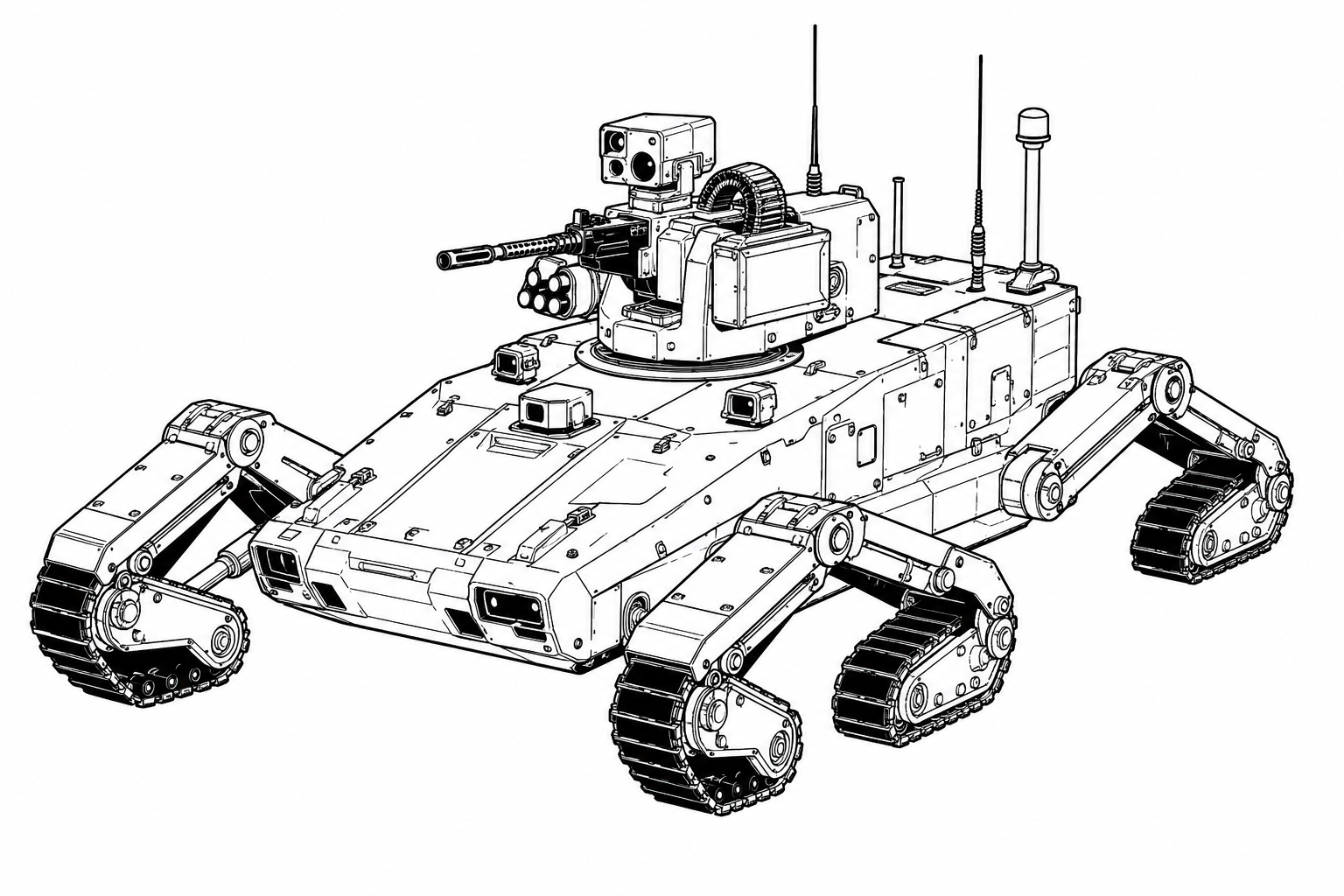
MAARS overview
The MAARS (Modular Advanced Armed Robotic System) is a tracked unmanned ground vehicle developed by QinetiQ North America as a direct successor to the TALON SWORDS, designed to preserve the armed robot concept while addressing every safety shortcoming that caused the SWORDS to be removed from Iraqi combat in 2008. Where the SWORDS had a weapon mount that reportedly moved on its own and lacked robust safeguards against accidental engagement, the MAARS was engineered from the first line of code and first bolt of construction with safety as the paramount constraint. The system weighs approximately 167 kilograms and can mount the M240B 7.62mm machine gun, a 40mm grenade launcher for both lethal and non-lethal munitions, or a loudspeaker and pepper spray system for non-lethal crowd control — a modular weapons architecture that gives commanders mission-appropriate responses across the full spectrum of force.
The core of MAARS's safety architecture is a GPS-defined exclusion zone system — the operator uses a mapping interface to define geographic areas in which the weapon is mechanically inhibited from rotating and firing, even if the operator mistakenly attempts to engage in that direction. This physical safeguard ensures that friendly positions defined on the operator's map cannot be inadvertently engaged regardless of operator error or system malfunction. Additional safety features include positive target identification lockout, an independent kill switch accessible to any team member, mechanical stops limiting weapon elevation and depression to prevent sky or ground engagement, and an encrypted data link that requires an authenticated command before any weapon release. The control system logs every weapon command with timestamp, GPS position, and operator identifier for after-action review — a documentation capability that provides accountability for every trigger pull.
The MAARS has undergone extensive military evaluation including assessments by the U.S. Marine Corps, Army Special Operations Command, and various other military customers who use the robot primarily in base security and force protection exercises. In practice, the MAARS has seen more deployment in the non-lethal configuration — the loudspeaker and warning system — than in the armed role, reflecting the enduring institutional caution about autonomous or semi-autonomous lethal systems. As of 2025–2026, L3Harris (which inherited the platform through its acquisition of QinetiQ's robotics division) continues to support the MAARS and is using lessons from the platform to inform next-generation armed UGV specifications, where improved computer vision and AI-assisted target verification are expected to make the human-robot command interface for armed UGVs both safer and more effective than the MAARS-era joystick-and-camera approach.
Armament
M240B 7.62mm MG or M203 40mm grenade launcher
Development and operational timeline
- QinetiQ North America unveils MAARS — designed to fix every TALON SWORDS safety failure
- MAARS completes initial live-fire testing; GPS exclusion zone system validated
- MAARS undergoes extended evaluation by U.S. Marine Corps at Quantico
- MAARS deployed in non-lethal configuration for base force protection exercises
- Updated MAARS variant with improved EO/IR sensors and extended battery demonstrated
- L3Harris acquires QinetiQ's robotic products; MAARS fleet now under L3Harris stewardship
- MAARS evaluated alongside newer platforms in DoD armed UGV requirements study
- MAARS safety architecture cited as foundational in Army's next-generation armed UGV specification documents