Land system · Large Tracked EOD Robot
L3Harris T7
EOD / Hazardous Materials / Remote Manipulation
Also known as: T7 / Harris T7 / T7 Robotic System / Project STARTER T7
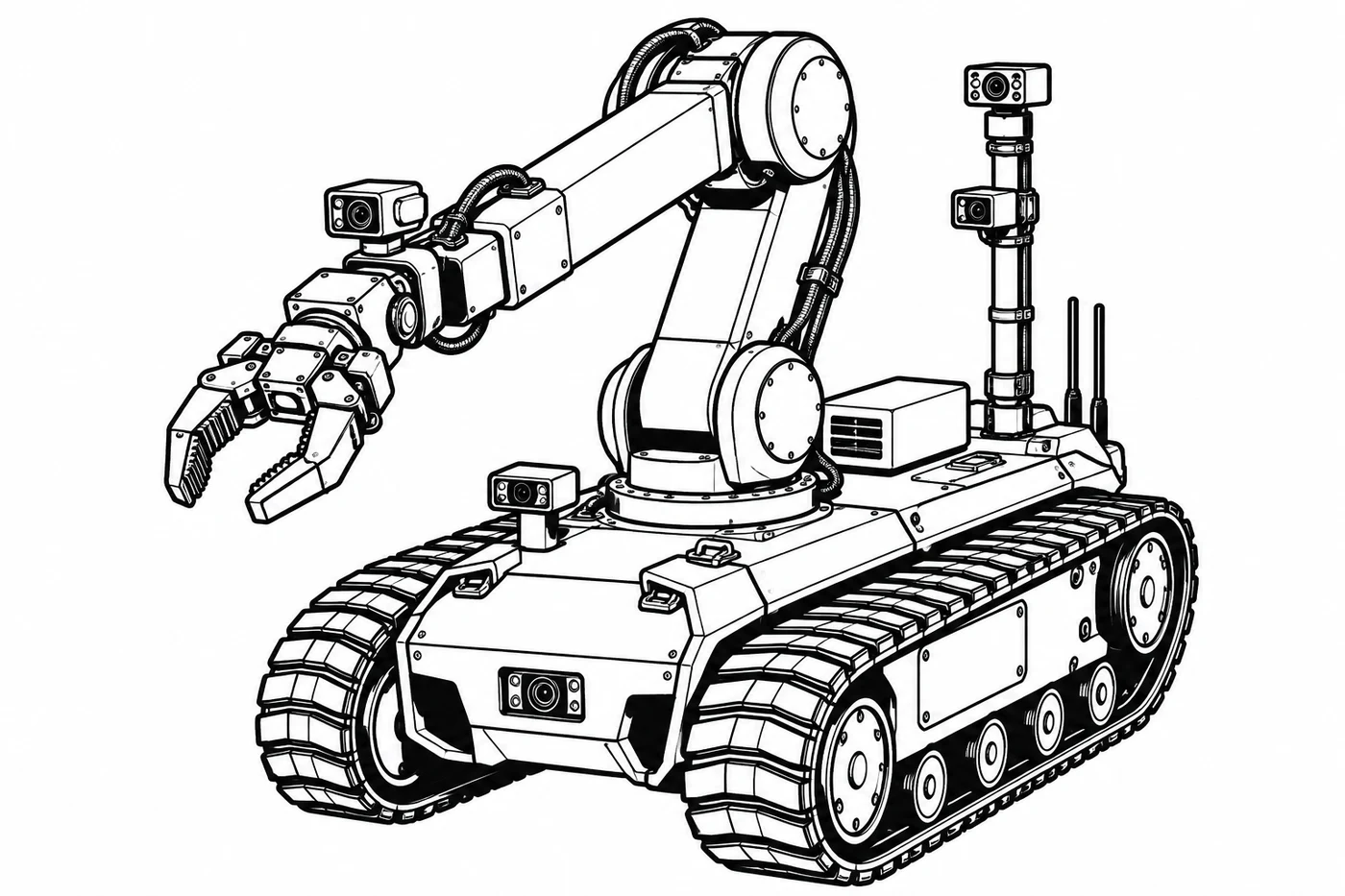
L3Harris T7 overview
Last reviewed:
L3Harris T7 is a large tracked remotely operated robot designed for explosive ordnance disposal and other hazardous military or police work. Its distinguishing feature is a force-feedback, or haptic, manipulator controller that lets the operator feel resistance through the handgrip. That is intended to make delicate remote handling more intuitive than relying on video alone. It does not turn the machine into an autonomous bomb-disposal technician: a trained operator still controls its movements and the professional decisions required by the task.
British procurement provides a well-documented introduction. The Ministry of Defence announced Project STARTER's deal in September 2017, and on December 23, 2018 reported delivery of the first four production-standard robots after acceptance trials. The public package was valued at £55 million for 56 robots and associated program support. It was intended to replace the Wheelbarrow Mk8B fleet. The package value should not be presented as the price of a bare T7, and the original delivery target should not be confused with proof of completion.
The current product page and the manufacturer's 2026 accessories sheet list a 322 kg weight with arm and batteries installed. Platform dimensions are approximately 1.201 m long, 0.701 m wide and 1.161 m high. Advertised speed is about 7 km/h, with eight or more hours of task-dependent runtime using twelve BB-2590 batteries. These figures describe the robot, not the total transport burden of the controller, spare batteries, accessories and support vehicle needed to deploy and sustain a complete EOD capability.
The arm's lifting envelope is more informative than a single payload headline. L3Harris lists more than 113 kg near the chassis but over 27 kg at full extension, with 2.2 m horizontal reach and roughly 3.1 m vertical reach. Those capacities occur at different geometries and should never be combined into a maximum-lift-at-maximum-reach claim. The force-sensing gripper and camera views help the operator judge interaction, while presets and motion-rewind functions support repeatable control. The supplied artwork is illustrative rather than a certified depiction of that exact envelope.
Published radio figures are over 1,000 m in line of sight and over 300 m non-line-of-sight under the manufacturer's conditions. Optional fiber tether, repeaters and antenna equipment support other communications arrangements. The tracked chassis is advertised for stairs and steep slopes, but practical stability changes with the arm position, load and surface. Cameras include driving views, a zooming mast unit and gripper imagery. Radio reach, runtime and climbing claims should be read as separate test-condition specifications rather than a universal operational guarantee.
The system supports a range of specialized EOD tools and chemical-hazard sensor mounts; these are payload options, not proof that all installations carry every tool. The current manufacturer page identifies use by forces in Britain, the United States and Australia. U.S. Air Force acquisition reporting in October 2021 documented the planned replacement of older Andros F6A systems. Subsequent industry reporting described first T7 handovers in 2022. Neither an acquisition announcement nor an initial delivery establishes the eventual size or availability of an entire service fleet.
The November 21, 2026 review emphasizes the available technical documentation and established procurement history rather than inventing a new deployment. Teledyne FLIR Centaur and iRobot PackBot offer useful comparisons in smaller remotely operated inspection and manipulation systems. DRDO Daksh provides another nationally developed EOD example. T7's substantially greater mass and reach can be advantages for some work, but transportability, maintenance, operator training and the actual manipulator geometry remain essential parts of any comparison.
Armament
No standard combat armament; configurable EOD tools and hazard-sensor mounts
Development and operational timeline
- British Project STARTER procurement announced at DSEI, as later recorded by the Ministry of Defence
- UK Ministry of Defence announces receipt of the first four production-standard T7 robots
- Industry reporting records delivery of the final Project STARTER robot to the UK MoD
- U.S. Air Force describes acquisition of T7 to replace older Andros F6A systems
- Air & Space Forces Magazine reports first U.S. Air Force T7 handovers, distinguishing initial deliveries from full-fleet replacement
- Manufacturer's accessories-sheet publication supplies current platform, controller and reach-dependent lifting specifications
- Editorial status review: technical specifications and known operator context checked; no new unsupported deployment asserted
Sources & further reading
- L3Harris — T7 specifications, control system and operators
- L3Harris — 2026 platform and accessories specification sheet
- UK Ministry of Defence — first four T7 deliveries and Project STARTER
- Shephard — final Project STARTER delivery report
- U.S. Air Force — T7 acquisition and EOD modernization
- Air & Space Forces Magazine — initial U.S. T7 handovers