Land system · Medium Tracked EOD Robot
Teledyne FLIR Centaur
EOD Inspection / Hazard Identification / CBRN Payloads
Also known as: Centaur / MTRS Increment II / MTRS Inc II / FLIR Centaur / Endeavor Robotics Centaur
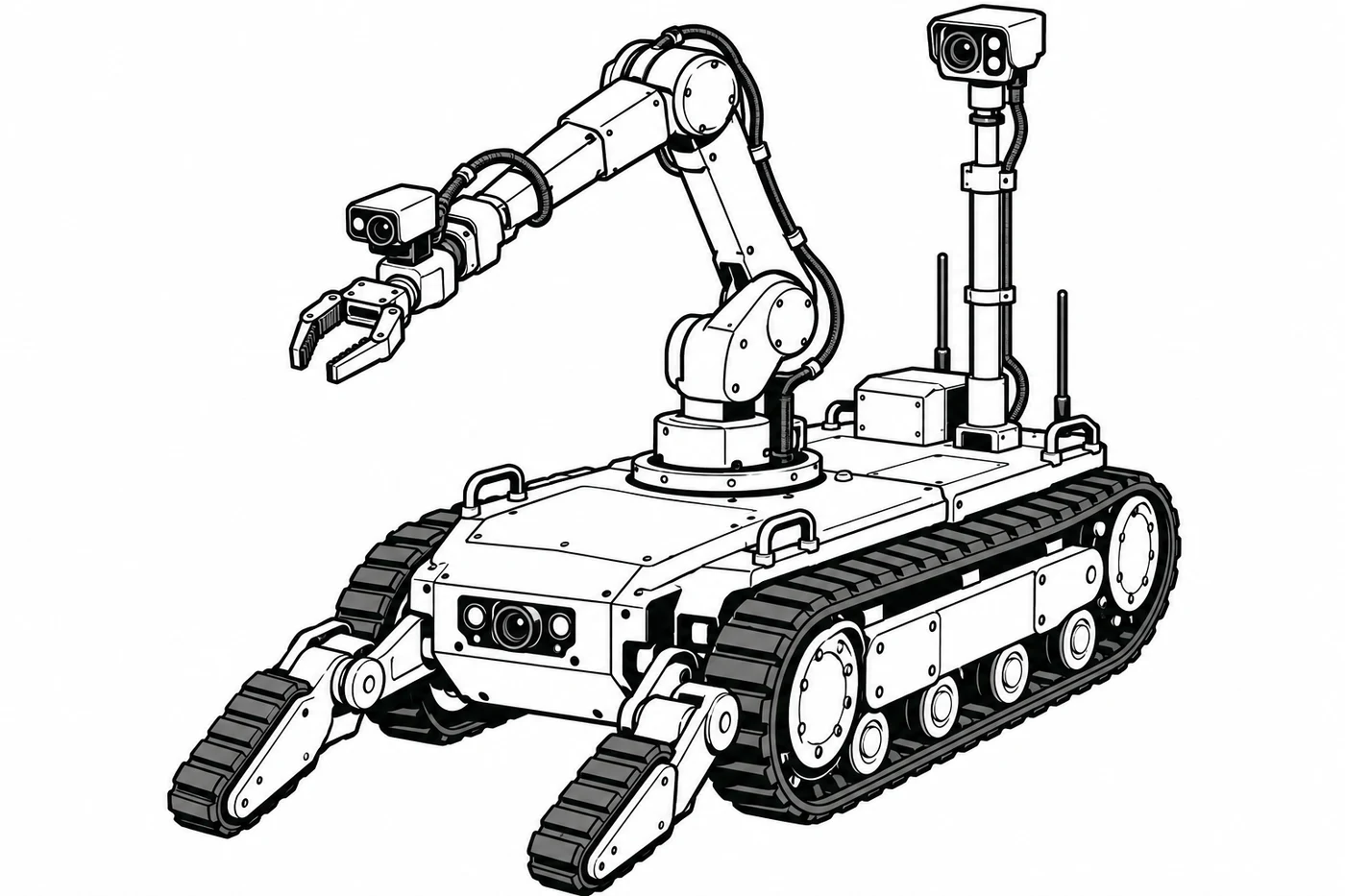
Teledyne FLIR Centaur overview
Last reviewed:
Teledyne FLIR Centaur is a medium-sized tracked unmanned ground vehicle best known as the platform selected for the U.S. military's Man Transportable Robotic System Increment II program. It lets explosive-ordnance-disposal teams inspect, identify and manipulate suspect objects from a stand-off position. The robot combines a camera suite, articulated arm and modular payload support rather than serving as a cargo carrier or an autonomous combat vehicle. Its purpose is to reduce direct human exposure while keeping trained personnel in control of hazardous decisions.
The Army selected the supplier, then Endeavor Robotics, for MTRS Increment II in 2017. By June 7, 2023, Teledyne FLIR announced delivery of the 1,000th robot under the contract and said orders across the Army, Navy, Air Force and Marine Corps exceeded 1,800 systems. The release associated those orders with more than $250 million in business. Ordered and delivered totals are not interchangeable, and dividing a program's value by its robots would not establish a reliable vehicle-only price because contracts also contain support and other obligations.
The manufacturer's June 2022 datasheet gives a robot weight below 164 lb, approximately 74.4 kg, and runtime up to eight hours. Advertised speed is greater than 2.5 mph, about 4 km/h, rather than a published exact top speed. It describes zero-radius turning, 30-degree slope traversal, six-inch obstacles and stairs up to 43 degrees. These are configuration and test-condition claims, not a promise that every obstacle is passable when an extended arm or heavy attached sensor changes the vehicle's balance.
Manipulator limits are particularly important. The datasheet lists lifting and carrying 32 lb, approximately 14.5 kg, but only 15 lb, about 6.8 kg, at full extension. It gives a vertical reach of 75.5 inches above the ground and five arm degrees of freedom. Maximum reach and maximum lift are therefore not simultaneous ratings. The supplied illustration shows the general tracked-arm arrangement, but it is not a dimensioned assembly drawing and does not verify the exact camera, gripper or payload installation of a fielded MTRS system.
The specified control options include an 800 m line-of-sight radio link, a 150 m non-line-of-sight figure and a 200 m fiber tether. Those communications distances are not the distance the tracks can travel on one battery, and local obstructions or interference can reduce usable radio coverage. The operator receives imagery from visible and infrared channels and controls movement and manipulation through the ground station. A tether can provide another communications path, but it introduces physical routing and handling constraints of its own.
Centaur supports chemical, biological, radiological and nuclear sensors as well as explosive-detection equipment. Its Interoperability Profile compliance is intended to make interfaces and payload integration more consistent. Compliance does not mean every sensor fits without qualification, nor that the platform can automatically classify all hazards. Mission preparation, calibrated payloads, operator training, spare batteries and maintenance determine much of the system's practical value. Published product-line applications should not be mistaken for evidence that every delivered robot carries every listed accessory.
At the November 21, 2026 review, the strongest documented milestones remain the program selection and supplier delivery record, supported by an available technical datasheet and current product listing. This profile does not invent an updated fleet total simply because more time has passed. iRobot PackBot offers a useful comparison with a smaller, established inspection platform, while L3Harris T7 provides a heavier manipulation-focused contrast. DOK-ING MV-4 performs mechanical ground preparation at a substantially different scale and should not be ranked as an equivalent portable EOD robot.
Armament
No standard combat armament; EOD tools and mission payloads
Development and operational timeline
- U.S. Army selects the supplier, then Endeavor Robotics, for MTRS Increment II
- Manufacturer revises the public Centaur datasheet documenting weight, runtime, communications and manipulator limits
- Teledyne FLIR announces delivery of the 1,000th MTRS Increment II robot
- Same release reports orders exceeding 1,800 across U.S. services; orders are not completed deliveries
- Editorial status review: current product listing checked; no unsupported new fleet-total or deployment claim added