Land system · Remote-Controlled Demining System
DOK-ING MV-4
Mechanical Ground Preparation / Mine Clearance / Engineering
Also known as: MV-4 / MV4 / MV-4 Scorpion / DOK ING MV-4 / M160
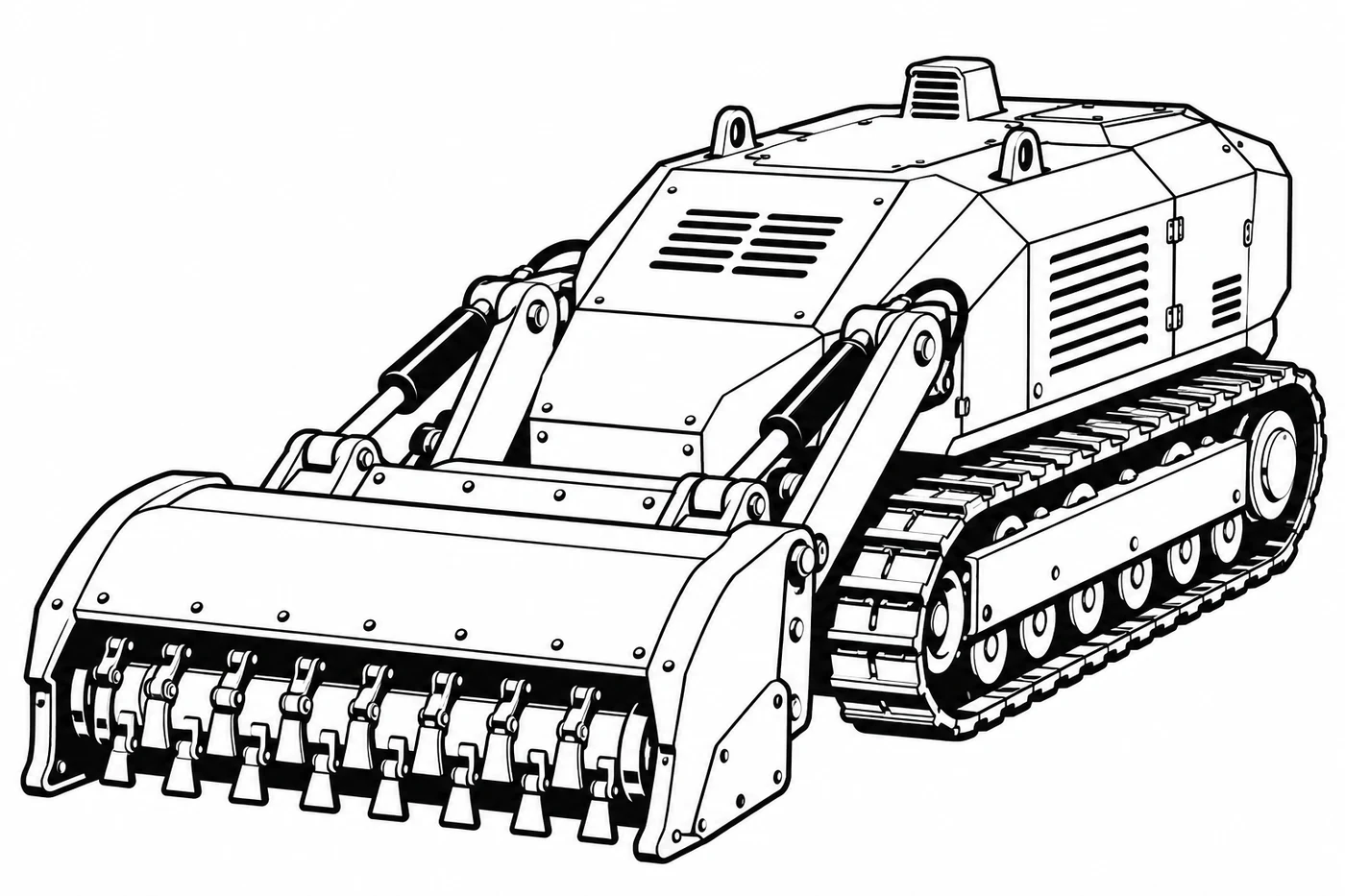
DOK-ING MV-4 overview
Last reviewed:
DOK-ING MV-4 is a Croatian remote-controlled engineering vehicle used for mechanical mine clearance, ground preparation and related explosive-hazard tasks. It combines a tracked prime mover with interchangeable tools rather than relying on a single fixed manipulator. The system is known internationally for humanitarian and military demining, while the related U.S. M160 configuration has its own service context. This is a protective engineering machine, not an unmanned tank, an autonomous mine detector or a guarantee that every treated area is safe for unrestricted use.
The manufacturer's history dates the improved MV-4's construction and delivery to its first customer, Croatia's Ministry of Defence, to 2000. It identifies a major U.S. Army production contract in 2004 and subsequent international expansion. A January 5, 2024 announcement records the 300th MV-4's production and delivery to Ukraine during 2023. That means the 300th vehicle in the product's worldwide production history went to Ukraine; it does not mean Ukraine had received 300 machines by that date.
For the standard flail configuration, the reviewed manufacturer table lists length of 4.635 m, width of 2.030 m, height of 1.740 m and weight around 6,120 kg. It specifies a 186 kW Perkins engine, transport speed of 7.15 km/h and a much lower working speed of 0.5–1.26 km/h. These figures belong to the listed configuration and should not be applied to every tool combination. Transport speed, working speed and clearance productivity answer different questions and cannot be substituted for one another.
Tool selection is central to the design. The supplier offers flail and tiller attachments, rollers, blades and engineering manipulators for different tasks. Published flail working width is up to 1.8 m, while other attachments have their own dimensions and loads. The advertised 1,400–1,800 square meters per hour is a favorable-condition capacity claim, not a universal rate across contaminated land. Soil, vegetation, buried obstacles, maintenance and the required clearance standard affect practical output, and follow-on quality assurance remains part of professional mine action.
Ukraine's Ministry of Economy reported on May 9, 2024 that a locally assembled and partially localized MV-4 had obtained a conformity certificate under the country's mandatory mechanical-demining scheme. The ministry described prior tests on several soil types and in dense vegetation, and explained how local assembly could shorten repairs and improve access to equipment. This was a certification and industrial-support milestone. It does not establish that every locally produced component, attachment or later modification shares an identical qualification without additional evidence.
A further documented deployment appeared in DOK-ING's April 16, 2025 report on a rental-based technical-survey project with A3-Tech and SafeLane Global in Mykolaiv Oblast. The company reported 20,837 square meters treated over three days and described hazards encountered during the work. Those figures concern a specific project and are attributed to the supplier's account; they are not a continuous fleet productivity average. The episode also illustrates that logistics, local servicing and trained operators are as important as the mechanical platform itself.
The November 21, 2026 review retains the DOK-ING product name for recognition while noting that the supplier's current website identifies its business as Rheinmetall Unmanned Vehicles following a majority acquisition. It does not infer a new MV-4 model or fielding event from that corporate notice. Teledyne FLIR Centaur and DRDO Daksh provide useful contrasts in smaller inspection and manipulation robots, not direct replacements for a six-tonne ground-preparation machine. Goliath offers historical remote-control context but had the opposite, destructive mission.
Armament
None; mechanical demining and EOD attachments
Development and operational timeline
- Manufacturer dates improved MV-4 construction and first delivery to Croatia's Ministry of Defence
- DOK-ING identifies its first major U.S. Army MV-4 production contract
- Manufacturer records production and delivery of the 300th worldwide MV-4 to Ukraine
- DOK-ING publishes its 300th-vehicle milestone; not 300 deliveries to Ukraine
- Ukraine's Ministry of Economy announces conformity certification for a locally assembled and localized MV-4
- Supplier reports completion of a rental-based technical-survey project with SafeLane Global in Mykolaiv Oblast
- Editorial status review: current standard-flail specifications and corporate naming notice reviewed without inventing a new deployment