Land system · Historical Tracked Demolition Vehicle
Goliath
WWII Wire-Controlled Demolition (Retired)
Also known as: Goliath tracked demolition vehicle / Goliath tracked mine / Leichter Ladungsträger / Sd.Kfz. 302 / Sd.Kfz. 303 / Sd.Kfz. 303a / Sd.Kfz. 303b
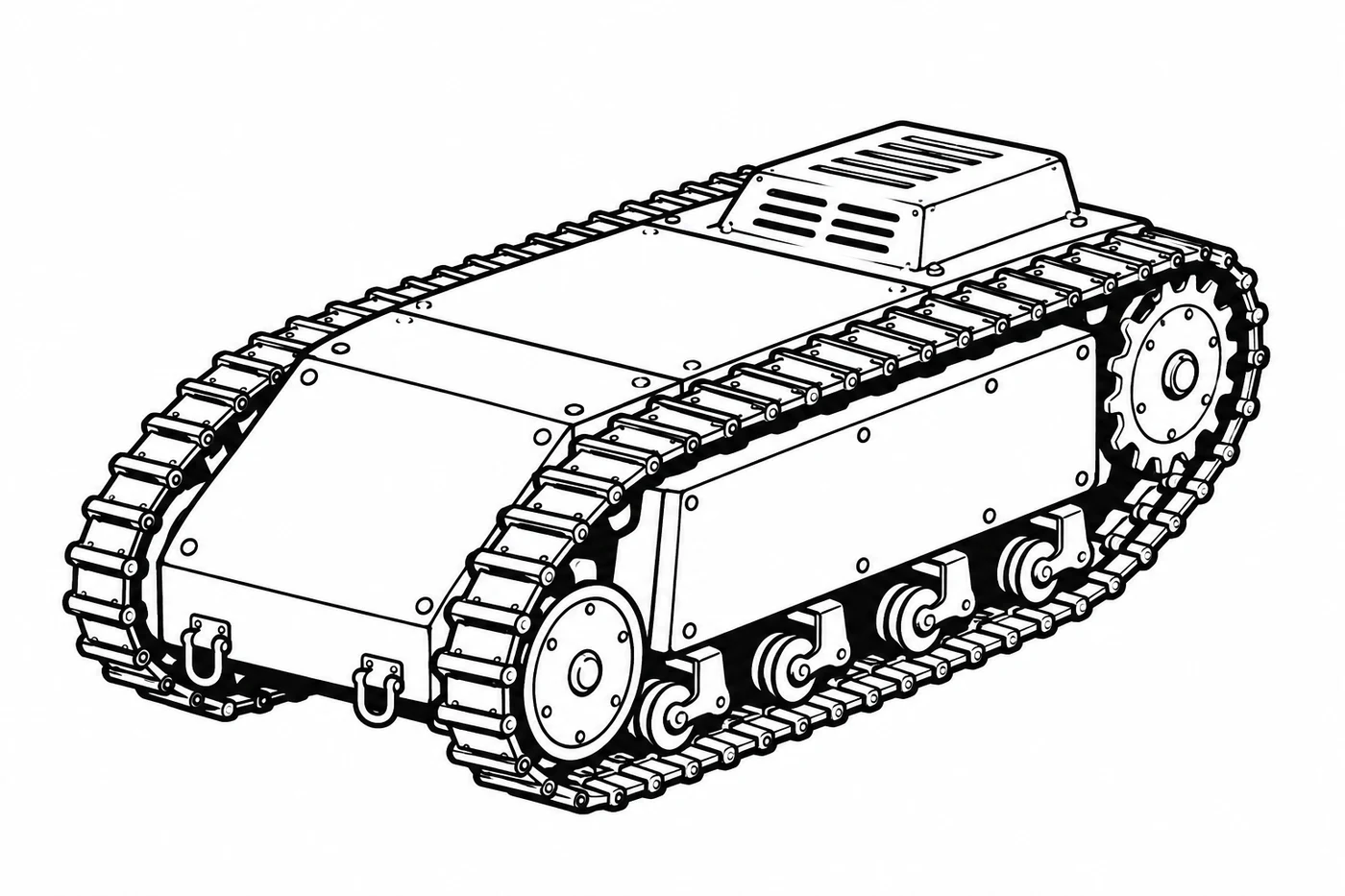
Goliath overview
Last reviewed:
Goliath was a German Second World War family of small, wire-controlled tracked demolition vehicles. It belongs in a history of unmanned ground systems because an operator directed it remotely, not because it possessed modern autonomy or artificial intelligence. The vehicle was intended to be destroyed when its carried charge detonated, unlike a reusable inspection or cargo robot. This is a historical catalog entry: it does not imply current service, new production or a revived Goliath program in 2026.
The family included the electrically powered Sd.Kfz. 302 and petrol-engined Sd.Kfz. 303 variants. Early production and use date to 1942, while the petrol-powered generation followed in 1943. The change in powerplant addressed cost and practical operating concerns, but it did not remove the limitations of a small tracked chassis and an exposed control connection. The attached illustration is labeled as a 303-style exterior; the page therefore distinguishes petrol-variant figures from the smaller electric model rather than treating the family as one unchanging machine.
Historical specifications vary by subvariant. Common secondary references give the later 303b as about 1.69 m long, 0.91 m wide and 0.62 m high, with a mass around 430 kg and a 100 kg carried charge. The earlier electric type is generally listed with a 60 kg charge, while accounts of 303a describe an intermediate 75 kg load. These are historical reported values, not modern certified payload ratings. Imperial War Museums' object record separately documents a surviving vehicle and the family's electric and petrol distinction.
Control depended on a trailing cable linking the vehicle to an operator, without the camera feeds, mapping or onboard perception found on modern systems. The operator needed to judge the route and vehicle position from outside the machine. Limited ground clearance, low speed, vulnerable connections and relatively light protection constrained its usefulness. A petrol vehicle's theoretical travel distance is not equivalent to a practical remote-control radius: cable length, visibility, terrain and enemy action imposed separate limits. The page avoids converting a powerplant range into guaranteed control reach.
The Warsaw Rising Museum provides primary institutional evidence of Goliath's use against the 1944 uprising. Its January 10, 2012 acquisition account identifies an Sd.Kfz. 303 exhibit and describes historical attacks and recovered examples. That record is important because it connects a surviving artifact to the human consequences of the weapon's employment rather than presenting the machine only as an engineering novelty. The museum's account does not establish a precise total of vehicles used throughout the uprising, and this profile does not invent one.
Goliath's significance is therefore broader than a claim that it was an early drone. It shows that remote control long predates today's navigation software, while also showing why removing a driver does not automatically solve mobility, observation or reliability problems. The family should not be conflated with the larger Borgward IV demolition carrier, which used a different configuration and delivery concept. Historical catalog coverage records those distinctions without offering construction, explosive-handling or employment instructions.
At the November 21, 2026 review, Goliath remains a retired historical system documented through museum collections and historical references; its timeline does not invent present-day operational milestones. Ratel S offers context for the very different circumstances of contemporary expendable ground systems. DOK-ING MV-4 provides an instructive contrast in remotely controlled equipment intended to reduce explosive hazards rather than deliver them. The shared absence of an onboard driver should not obscure the differences in purpose, control, reuse and consequences.
Armament
Integral demolition charge; historical, retired system only
Development and operational timeline
- Electric Sd.Kfz. 302 generation enters wartime production and use
- Petrol-engined Sd.Kfz. 303 generation follows; subvariants have different dimensions and carried-charge figures
- Warsaw Rising Museum documents Goliath use during the Warsaw Uprising
- End of the Second World War concludes the family's wartime service context
- Warsaw Rising Museum announces acquisition of a surviving Sd.Kfz. 303
- Editorial status review: historical, retired system; museum documentation reviewed without suggesting modern service or production