Land system · Wheeled EOD Robot
DRDO Daksh
Remote Inspection / IED Handling / Hazard Reconnaissance
Also known as: Daksh / ROV Daksh / DRDO ROV Daksh / Remotely Operated Vehicle Daksh
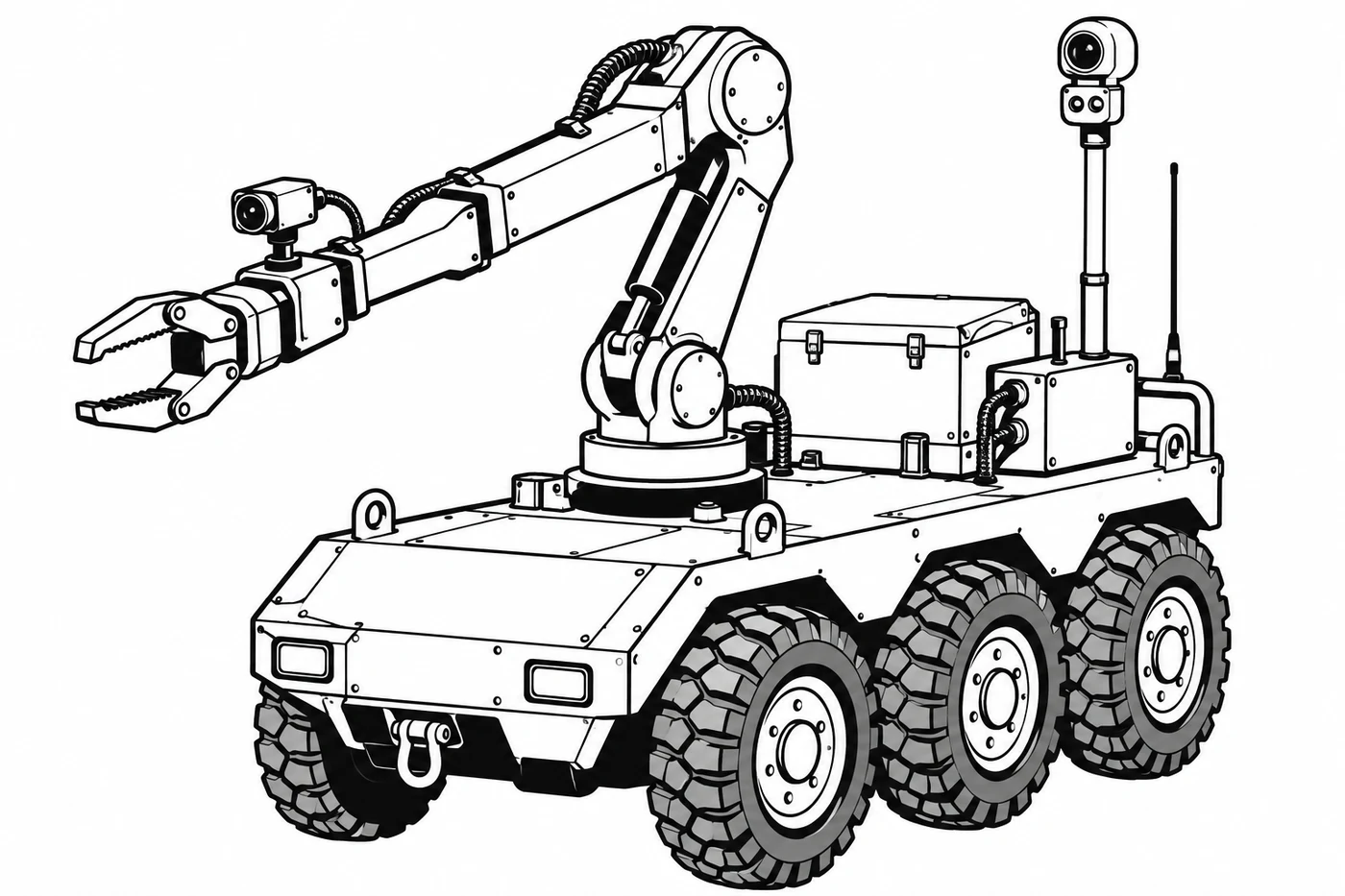
DRDO Daksh overview
Last reviewed:
DRDO Daksh is an Indian electrically powered remotely operated ground vehicle developed for identifying, inspecting and handling suspected explosive devices. The program originated at the Research and Development Establishment (Engineers) in Pune and involved Indian industrial partners in production and subsystem work. Unlike an autonomous combat vehicle, Daksh is operated from a separate master control station. Its main value is allowing personnel to observe and manipulate a hazardous object without standing next to it during the initial inspection.
An August 2022 engineering account by R&DE-associated authors dates the dedicated counter-IED development effort to 2002 and describes realization of the original vehicle over roughly 30 months. Army Technology records a limited-series order for 20 vehicles in 2010 and an initial handover in December 2011. Contemporary and retrospective reports disagree on whether that first batch comprised five or six robots. This profile therefore records the handover without treating either disputed batch count as established fact or assuming that every later planned order was fulfilled.
DRDO's public robotics description gives continuous operation of three hours, wireless control over 500 m line of sight and an optional 100 m fiber-optic link. These are operating and communications figures, not a 500 m limit on battery-powered travel. A radio link can be impaired by buildings and interference, while a fiber connection brings its own physical constraints. The associated master control station has independent equipment and power requirements that should be considered separately when assessing the complete system's field endurance and transport burden.
The 2022 engineering account describes a six-degree-of-freedom manipulator capable of handling up to 20 kg, multiple selectable camera views, a portable X-ray imager and specialized EOD equipment. The reported 20 kg arm figure is not a general cargo-bed rating and should not be assumed valid at every possible extension or slope. Cameras and imagery support an operator's assessment; they do not independently certify that an object is safe. The supplied illustration represents the wheeled manipulator concept without claiming to reproduce exact production geometry.
Mobility was designed around access to buildings, stairs and urban working areas, with the robot and control station brought to the site in a specially equipped carrier vehicle. Transport and deployment are therefore part of the capability, not incidental extras. The carrier also accommodates personnel, charging and support equipment. Stairs, narrow passages, ground clearance and arm position impose different constraints from the open-terrain cargo work performed by larger logistics robots, so superficial comparisons based only on the number of wheels are misleading.
The Daksh name later broadened into a family. Public reporting describes Daksh Mini and Daksh Scout, while the engineering retrospective also distinguishes a CBRNe-oriented vehicle and substantially larger unexploded-ordnance equipment. Those related systems do not share one mass, control range or lifting envelope. A smaller confined-space derivative's dimensions should not be assigned to baseline Daksh, and a heavy UXO handler's lift should not be used to inflate its arm capacity. Mission-specific sensor payloads similarly require their own configuration evidence.
At the November 21, 2026 review, the strongest sources describe the original vehicle's engineering, early handover and subsequent family development rather than a newly verified 2026 deployment. The timeline ends with an explicit editorial review instead of a fictional current-year induction. iRobot PackBot, Teledyne FLIR Centaur and L3Harris T7 provide useful comparisons in operator-controlled EOD work. DOK-ING MV-4 is relevant to the wider hazard-reduction field but performs mechanical ground preparation at a different scale and is not a direct substitute.
Armament
EOD equipment and specialized tools; not a standard combat weapon platform
Development and operational timeline
- R&DE engineering retrospective dates the start of dedicated counter-IED ROV development
- Approximately 30-month development effort leads to the original Daksh; not the same milestone as Army handover
- Contemporary reporting identifies a limited-series production order for 20 Daksh vehicles
- Initial Daksh vehicles handed to the Indian Army; sources disagree on the first-batch count
- Technical reporting records Daksh Mini and Daksh Scout developments as separate family members
- Engineering retrospective documents baseline communications, manipulation and related ROV programs
- Editorial status review: baseline specifications retained with variant boundaries; no unsupported 2026 induction or fleet total added