Land system · Electric Multipurpose UGV
Hanwha Arion-SMET
Logistics / Reconnaissance / Infantry Support
Also known as: Arion-SMET / ARION SMET / Arion SMET / Hanwha Arion
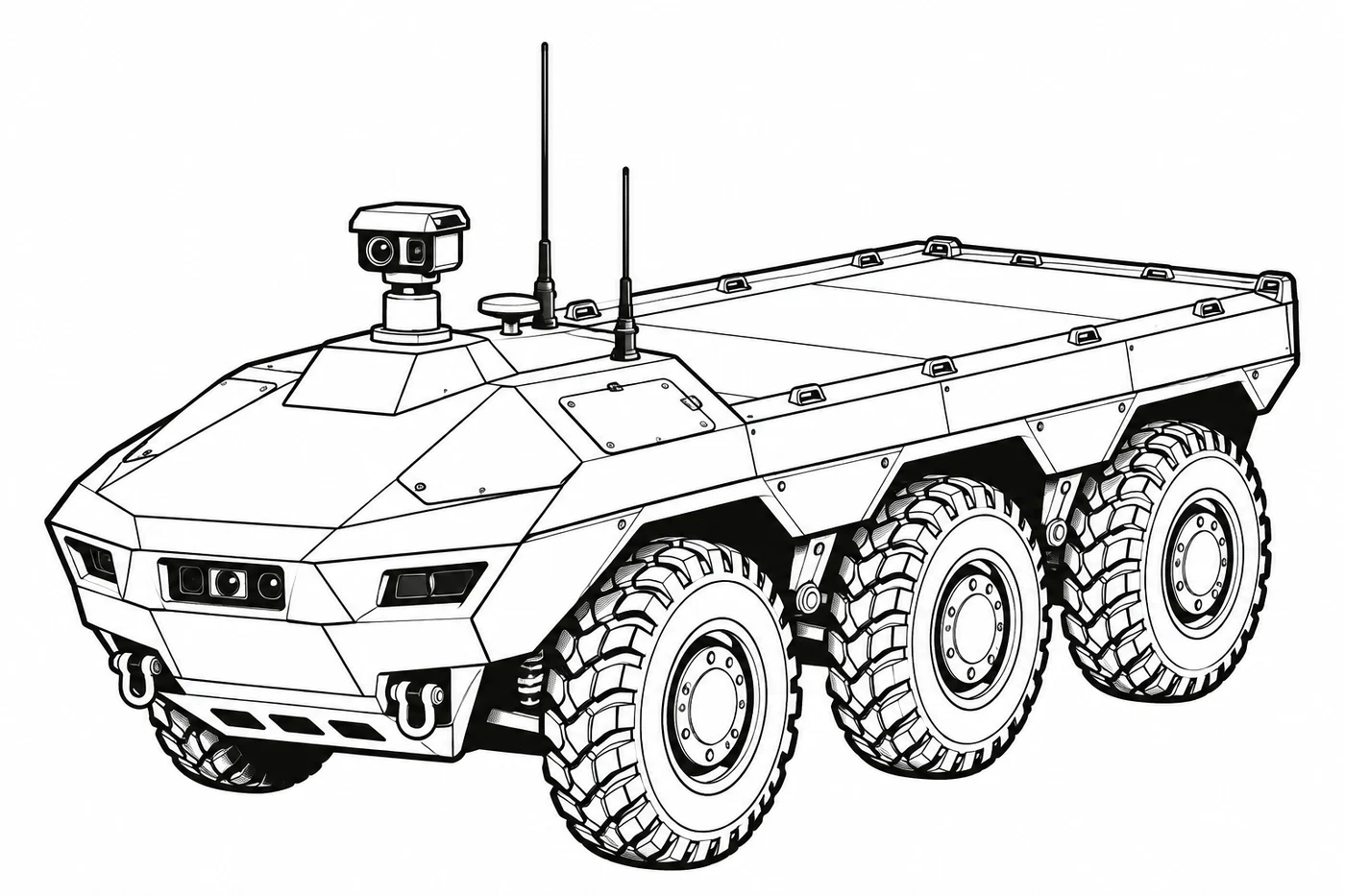
Hanwha Arion-SMET overview
Last reviewed:
Hanwha Arion-SMET is a South Korean robotic ground-system family developed for infantry support, reconnaissance, transport and other modular missions. This profile and its supplied illustration focus on the six-wheel electric vehicle that took part in U.S. Foreign Comparative Testing in December 2023. The name is associated with later Korean production developments as well, but those developments do not make every Arion-SMET generation mechanically identical. In particular, the newer four-wheel configuration should not inherit six-wheel test-vehicle dimensions and payload figures without qualification.
Hanwha's January 4, 2024 announcement provides a clear primary-source account of the U.S. evaluation. The company said the Marine Corps and Army completed testing at Marine Corps Training Area Bellows on Oahu from December 14 to 22, 2023. Personnel from III Marine Expeditionary Force and the Army's Ground Vehicle Systems Center participated. The activities included equipment transport, remote driving, waypoint navigation, exploratory maneuvering, soldier following and physical-tether following, after user familiarization on the roughly two-ton electric platform.
For that six-wheel test generation, Hanwha advertised a maximum payload of 550 kg, travel up to 100 km on a full charge, and speeds up to 43 km/h on paved roads or 22 km/h on unpaved surfaces. These are manufacturer claims for a defined test-era configuration, not guarantees of off-road distance at maximum load and speed simultaneously. The company also described multiple modes of control and a modular architecture. The actual sensor package, terrain, weather and chosen autonomy mode all influence performance and operator workload.
The optional remote weapon station described in the same release was a mission fit, not an unavoidable feature of the logistics platform. Hanwha discussed a 5.56 mm installation with a 7.62 mm growth option, alongside support roles such as ammunition transport and casualty evacuation. Navigation autonomy, target tracking and authority to fire are separate functions. For the cargo vehicle illustrated here, the catalog does not assume a weapon is installed or imply that following a soldier authorizes independent lethal engagement.
U.S. comparative testing is a technology-evaluation milestone rather than proof of U.S. Army procurement or Marine Corps operational adoption. Hanwha expressed interest in S-MET Increment II, but September 2024 reporting named other firms for that competition's prototype awards. General Dynamics MUTT remained the established Increment I reference. Treating a successful foreign test as an American production win would misstate the program history and obscure the actual value of the trial: gathering user feedback and evaluating a candidate technology.
Substantive new developments appeared in Korean reporting during 2026. The Korea Times reported on September 17 that Hanwha had signed a September 4 mass-production contract and expected staged Army and Marine Corps deliveries beginning in 2027. Its report describes a third-generation, four-wheel model with about 450 kg payload and speed up to 60 km/h. Those numbers differ from the older six-wheel demonstrator, so they are reported here as a separate configuration and future delivery schedule, not as completed 2026 fielding of the pictured vehicle.
At the November 21, 2026 review, Arion-SMET therefore connects an identifiable six-wheel U.S. test campaign with a later domestic production story while preserving the generation boundary. Mission Master and THeMIS offer useful comparisons for modular support vehicles, and General Dynamics MUTT illustrates a different procurement path. A useful assessment considers how much equipment can be moved, the maturity of operator controls, support arrangements and the exact contracted variant, rather than combining the fastest speed and largest payload from unrelated generations.
Armament
Optional remote weapon station; depicted six-wheel cargo platform and newer four-wheel production model differ
Development and operational timeline
- Korean reporting identifies the start of civil-military development work; not operational fielding
- U.S. Foreign Comparative Testing campaign begins at Marine Corps Training Area Bellows, Hawaii
- Hanwha identifies completion of the December U.S. test campaign involving Marines and Army representatives
- Hanwha publishes test results and six-wheel demonstrator performance claims
- Korea Times later identifies a Korean mass-production contract for the newer generation
- Korea Times describes the distinct four-wheel third generation and deliveries planned from 2027
- Editorial status review: six-wheel demonstrator and newer Korean production configuration remain explicitly separate