Naval system · Modular Unmanned Surface Vessel
Barracuda
FPV Drone Carrier / Reconnaissance / Logistics / Maritime Strike
Also known as: Barakuda / Barrakuda / Баракуда / Барракуда / Barracuda USV / Ukrainian Barracuda
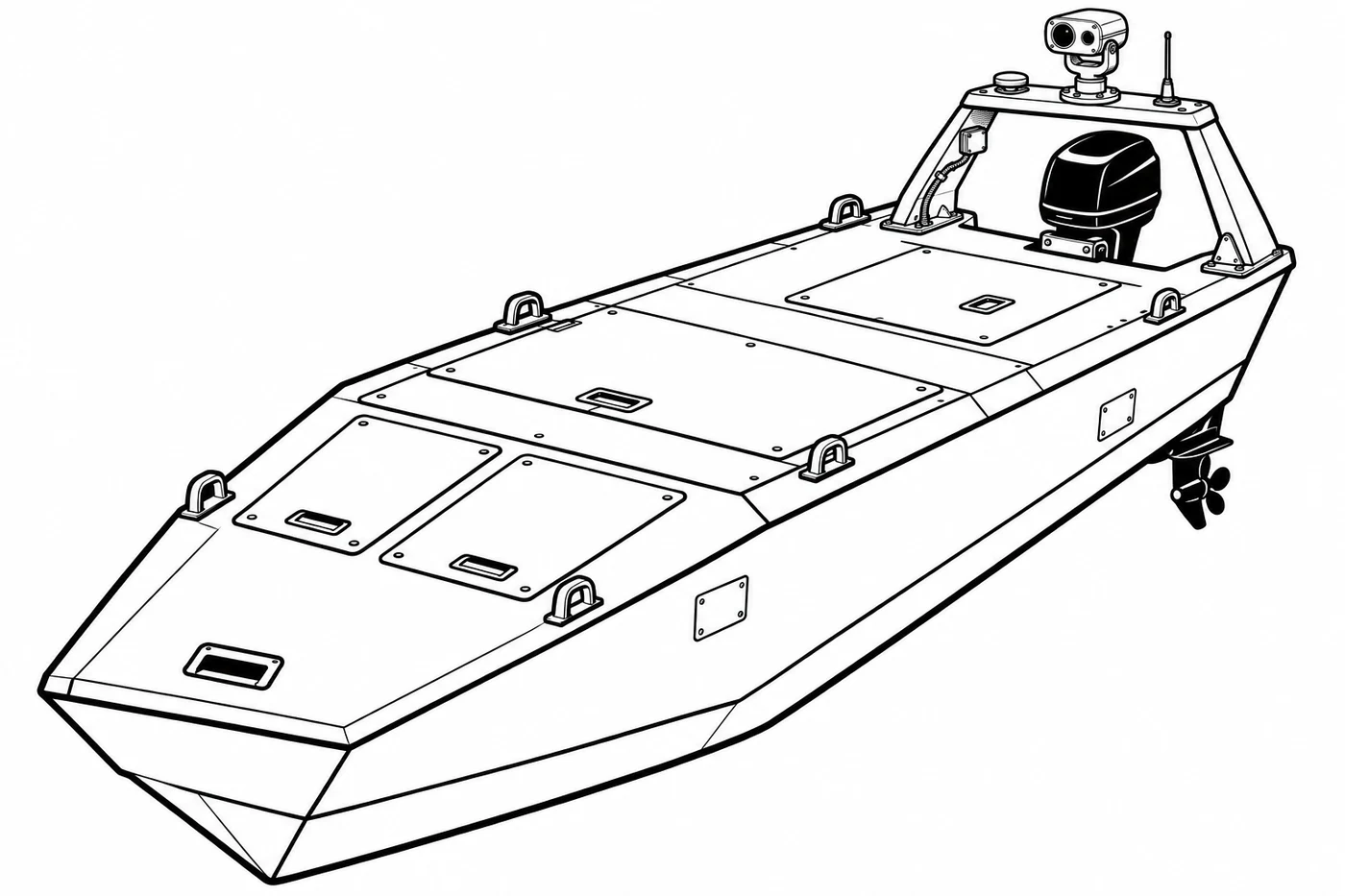
Barracuda overview
Last reviewed:
Barracuda is a Ukrainian family of unmanned surface vessels associated with the Barracuda special unit of the 40th Brigade, identified in early coverage as the 40th Separate Coastal Defense Brigade and in later reports as the 40th Separate Marine Brigade. Public reporting traces its reveal to August 2025 and describes boats developed and adapted by the unit for river, estuary and coastal operations. This is the Ukrainian naval system, not Anduril's unrelated American Barracuda-500 aerial vehicle. Its importance lies in combining a remotely controlled boat with interchangeable mission equipment, including the ability to carry aerial drones.
The program is better understood as several configurations than as a single standardized explosive boat. Reporting describes reconnaissance, logistics, evacuation, mine-laying, direct-strike and aerial-drone carrier roles, with different hulls and equipment for different tasks. A carrier can move small aircraft over water before they take off, extending the places from which aerial observation or strikes can originate without placing a crew on the launching vessel. The supplied illustration is used as an editorial representation; its outboard engine, deck fittings and sensor head are not treated as proof of a named production variant or exact dimensions.
Useful public performance figures exist, but they are reported values rather than a verified universal specification sheet. Defense Express's October 22, 2025 analysis describes standard-family boats reaching up to 70 km/h with 350–400 km range, and a Barracuda 1 carrier holding four to eight FPV drones. The same analysis describes other hull groups with different performance, including a larger Barracuda 9 reportedly reaching 55 km/h, up to 700 km range and up to 1,000 kg payload. Those larger-platform figures must not be assigned to every FPV carrier. The June 2026 FREEДOM report also quotes a four-to-eight-FPV load dependent on aircraft and ammunition size; neither source establishes a universal heavy-bomber capacity.
Control and communications likewise require configuration-specific treatment. August 2025 coverage described an early riverine boat without satellite communications, while the later Defense Express survey described Starlink and backup radio links on several variants. These accounts should not be flattened into a claim that every Barracuda has the same link, unlimited control range or uninterrupted connectivity. Reports also mention elements of artificial intelligence, but do not provide an independently assessed autonomy specification. Remote navigation, assisted perception and human-directed drone operations are different capabilities; the public record does not establish unrestricted autonomous weapons employment.
The aerial-carrier role predates the most recent headlines. MOST's May 15, 2026 field report recalls an October 2025 operation in which a Barracuda delivered FPV drones over water before a reported strike on a Russian logistics boat. FREEДOM's June 5, 2026 report describes FPVs taking off from the maritime platform and quotes the unit commander discussing bomber and reconnaissance drones among possible mission loads. This establishes a documented development path toward a more versatile carrier, not proof that every mentioned aircraft type or payload was employed on every mission. Maritime transport and the aircraft's subsequent flight remain distinct parts of the account.
Several summer 2026 reports show how the carrier role appeared in operational coverage. On July 14, Ukrinform relayed Ukrainian Navy footage describing a coordinated operation involving direct-strike, rocket-equipped and UAV-carrying boats. Kyiv Post's July 20 account reported sea-launched FPV attacks near occupied Zaliznyi Port, including the loss of one carrier under Russian attack; the outlet explicitly could not independently verify the video's time or location. On August 8, Militarnyi reported another brigade-released account of FPVs launched from Barracuda carriers against Russian troop-transport boats. These are dated reports of attributed operations, not an independently audited tally of destroyed targets.
The latest item reviewed is a November 23, 2026 social-media report attributed to NOELreports and reproduced by Monitor the Situation. It says Barracuda vessels transported FPV drones and heavy bomber drones into Russian rear areas, enabling attacks on logistics targets. This is included in the timeline as an unverified report, not as independently confirmed mission results. The relay does not establish the exact operation date, bomber model, payload, launch method or target losses. Earlier sources substantiate deck launches of FPVs, but the latest report alone does not prove that the heavy bombers took off directly from the boats rather than being transported for subsequent employment.
At the November 23, 2026 editorial review, Barracuda illustrates Ukraine's expansion from single-purpose maritime strike craft toward reusable or mission-configured carriers and support platforms. Sea Baby and MAGURA V5 provide context for other Ukrainian unmanned surface programs, but their developers, dimensions and performance figures should not be substituted for Barracuda's. Vampire (Baba Yaga) offers a separate profile of a Ukrainian heavy aerial bomber; no reviewed evidence identifies that specific aircraft as the type carried in the November report. The strongest basis for following Barracuda is its documented progression of roles and dated reporting, while keeping variant differences and unverified claims visible.
Armament
Variant-dependent FPV carrier, direct-strike or other mission modules; not all fitted together
Development and operational timeline
- Public coverage describes the Barracuda unit's modular Ukrainian riverine USV and early deployment; exact development start remains undisclosed
- An FPV-carrier operation against a Russian logistics boat is reported; recalled in MOST's May 2026 field coverage
- Defense Express analyzes nine reported variants, distinguishing FPV carriers from larger strike, support and extended-range boats
- MOST publishes field reporting on Barracuda operations in Kherson waterways and the earlier sea-launched FPV mission
- FREEДOM describes FPVs launching from a Barracuda and quotes the commander on four-to-eight-FPV loads and bomber-drone options
- Ukrinform relays Ukrainian Navy footage of a multi-platform operation including reconnaissance and FPV launches from a UAV carrier
- Kyiv Post reports the brigade's sea-launched FPV strikes near Zaliznyi Port; video timing, location and results are not independently verified
- Militarnyi reports brigade footage and claims of carrier-launched FPV attacks on Russian troop-transport boats near Zaliznyi Port
- Unverified social-media report: NOELreports, relayed by Monitor the Situation, says Barracudas transported FPV and heavy bomber drones behind Russian lines for logistics strikes; operation date and heavy-bomber launch method remain unconfirmed
- Editorial status review: earlier FPV-launch reporting retained separately from the latest unverified heavy-bomber transport account
Sources & further reading
- UNITED24 Media — August 2025 reveal, unit origins and early riverine configuration
- Defense Express — October 2025 variant survey and reported performance figures
- MOST — May 2026 field report and retrospective October 2025 FPV operation
- FREEДOM — June 2026 carrier report and unit commander's attributed statements (Ukrainian)
- Ukrinform — July 14, 2026 Navy footage of coordinated maritime and aerial-drone operations
- Kyiv Post — July 20, 2026 carrier-launched FPV operation and verification limits
- Militarnyi — August 8, 2026 reported operation against troop-transport boats
- Monitor the Situation — November 23, 2026 relay of NOELreports; unverified heavy-bomber transport report
- NOELreports — original post linked by the November 23 relay; not independently verified