Naval system · Armed USV
MAGURA V7
Anti-Ship Strike / ISR / Maritime Denial
Also known as: MAGURA V7 / MV7 / Maritime Autonomous Guard Unmanned Robotic Apparatus V7 / Ukrainian sea drone V7
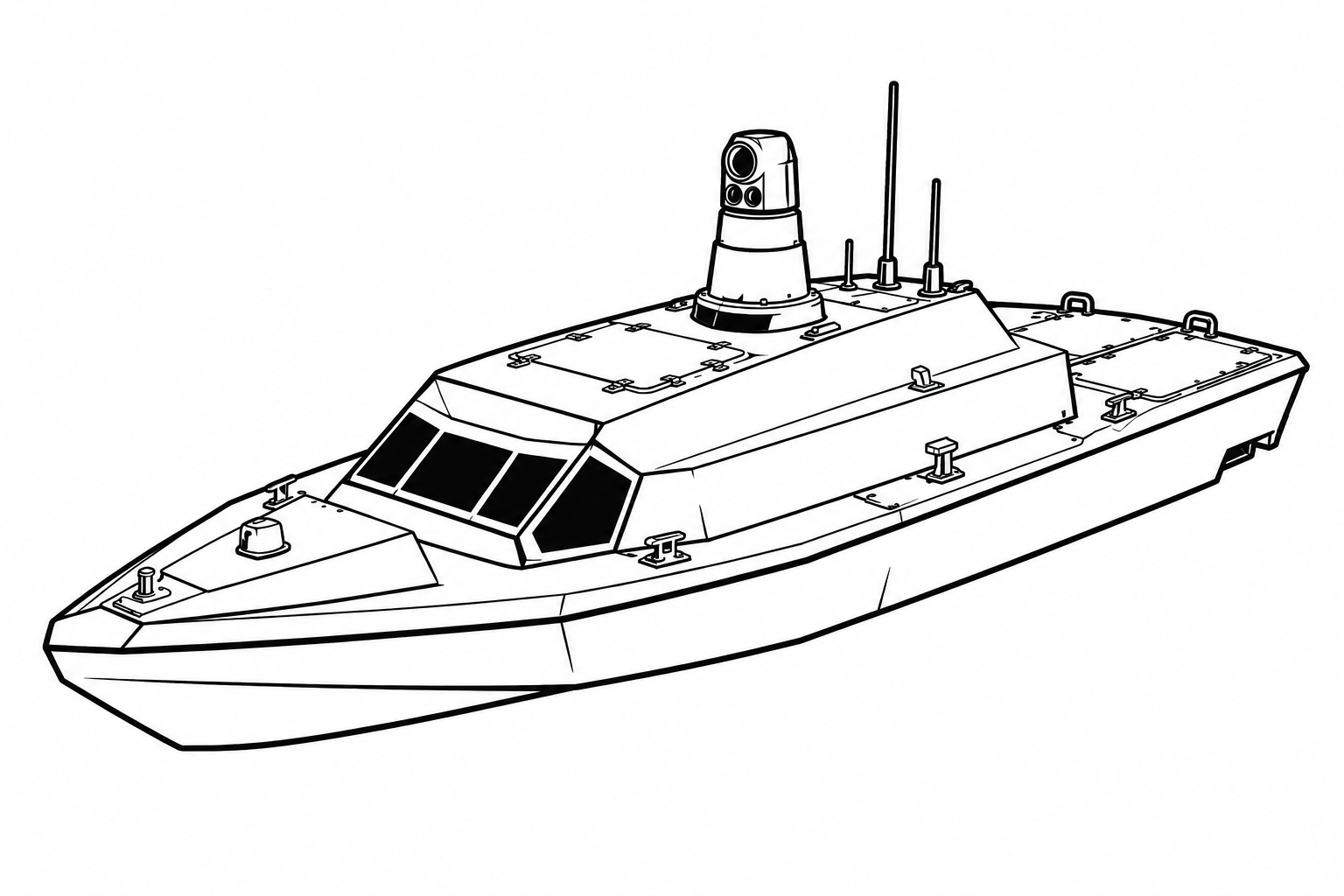
MAGURA V7 overview
The MAGURA V7 (Maritime Autonomous Guard Unmanned Robotic Apparatus, seventh generation) is the most capable and longest-ranged unmanned surface vessel in Ukraine's naval drone arsenal, developed by the Ukrainian Defense Ministry's Brave1 defense technology cluster in response to operational lessons accumulated during two years of Black Sea combat. Where the MAGURA V5 established proof of concept — demonstrating that a sub-$300,000 maritime drone could disable or sink vessels worth hundreds of millions — the V7 was designed to remove the operational constraints that limited the V5's reach: range, payload versatility, and survivability against evolving Russian electronic warfare and counterdrone systems. At approximately 6.5 meters in length with a reinforced composite hull, the V7 is powered by a diesel-electric drive system providing a combat radius assessed at over 1,000 kilometers, enabling strikes on targets across the entirety of the Black Sea and into the Kerch Strait approaches without reliance on forward staging positions. Its modular payload bay accommodates warhead packages up to 400 kg, camera and sensor pods for ISR missions, or combinations of the two.
The V7 incorporates several technical innovations directly derived from Black Sea combat experience. Electronic warfare hardening has been substantially improved over the V5, with redundant satellite and inertial navigation systems that allow the vessel to continue operating autonomously through periods of GPS denial — a critical upgrade given Russia's extensive deployment of GPS jammers across the Black Sea littoral. An AI-assisted target recognition system allows the V7 to identify and engage surface targets with reduced operator input, enabling saturation attacks in which multiple V7s coordinate timing and approach vectors against a single high-value target. Hull signature has also been addressed, with a lower freeboard profile and radar-absorbing coating reducing the vessel's radar cross-section compared to its predecessor. Communications architecture utilizes spread-spectrum burst transmissions and Starlink relay nodes to maintain connectivity while minimizing the electronic signature that allowed Russian forces to locate and engage some V5 units before they could complete their missions.
By 2025–2026, the MAGURA V7 has conducted multiple high-profile operations that have further constrained Russian naval freedom of movement. In early 2025 a coordinated V7 swarm attack targeted Russian logistics vessels in the Novorossiysk outer roadstead, striking two vessels and damaging port infrastructure. By mid-2025 Ukraine had publicly acknowledged the V7's role in establishing a de facto maritime exclusion zone for Russian surface vessels east of approximately 34°E longitude, compelling the Black Sea Fleet to concentrate remaining assets in Novorossiysk with dramatically reduced operational sortie rates. Baltic Sea allies — Estonia, Latvia, and Lithuania — have held closed-door discussions with Ukrainian operators about licensing or co-producing V7 derivatives for Baltic Sea maritime defense. As of early 2026, production of the V7 is ongoing at multiple dispersed Ukrainian facilities, with monthly output believed to exceed 30 units, representing a sustained attrition capability against Russian naval assets that conventional arms transfers cannot easily replicate.
Armament
Up to 400 kg shaped-charge or fragmentation warhead; modular payload bay
Development and operational timeline
- MAGURA V7 development initiated following after-action analysis of V5 Black Sea combat operations
- V7 prototype completes first open-water trials; extended-range diesel-electric drive system validated
- MAGURA V7 enters limited operational service with Ukrainian Naval Forces special operations units
- V7 conducts first confirmed long-range autonomous strike mission exceeding 700 km round trip
- Coordinated V7 swarm attack on Russian Black Sea Fleet logistics vessels; AI-assisted target coordination demonstrated
- V7 swarm strikes Novorossiysk outer roadstead; two Russian logistics vessels damaged
- Ukraine declares maritime exclusion zone east of 34°E enforced primarily by V7 fleet; Russian surface sortie rate drops sharply
- Baltic NATO states open co-production discussions with Ukraine for V7-derived maritime defense systems
- V7 monthly production exceeds 30 units; platform credited with effectively neutralizing Russian Black Sea Fleet surface threat