Air system · Heavy Strike Hexacopter
Vampire (Baba Yaga)
Precision Strike / Area Bombardment / Night Attack
Also known as: Baba Yaga / Vampire drone / Ukrainian heavy bomber hexacopter
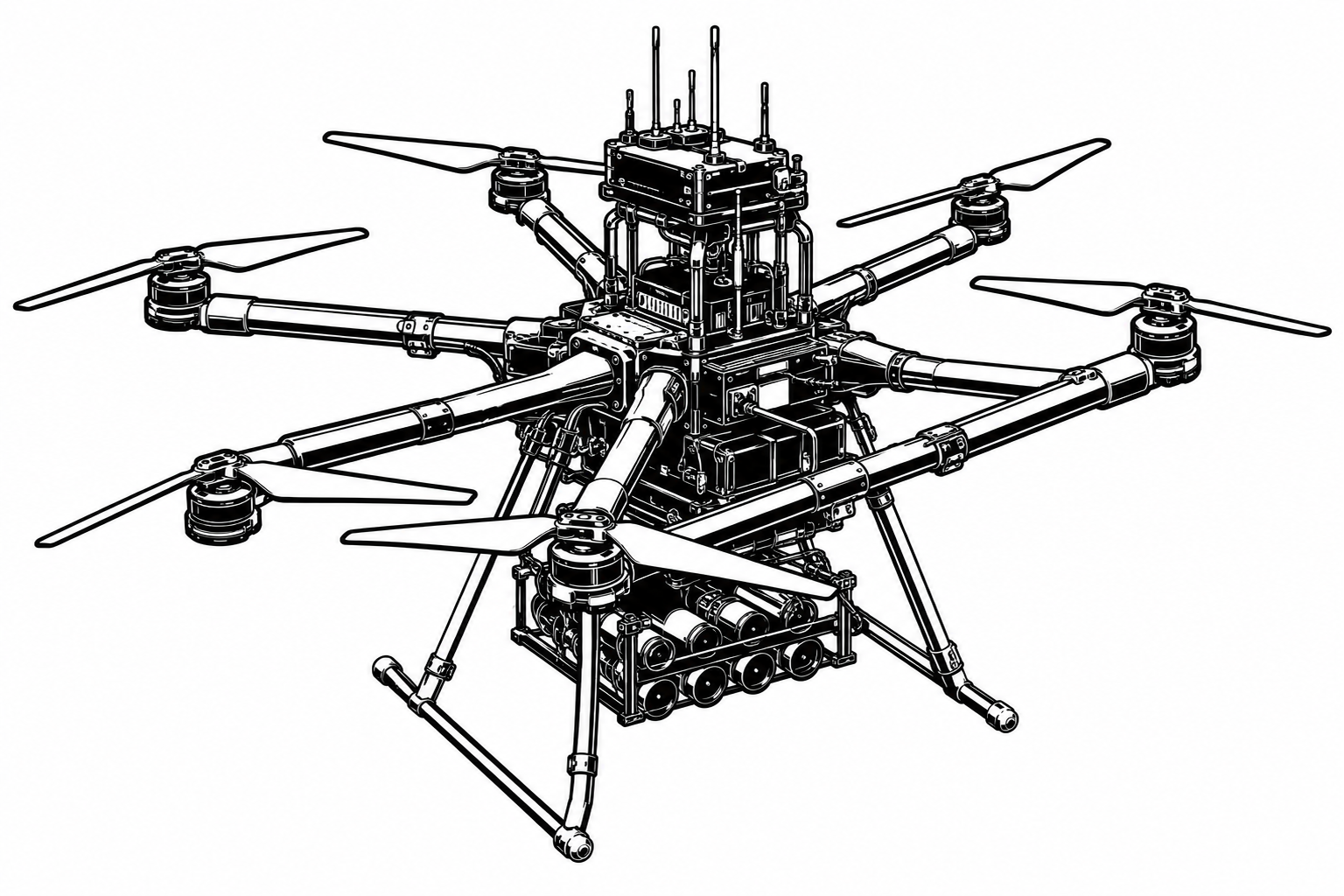
Vampire (Baba Yaga) overview
The drone known to Russian soldiers as 'Baba Yaga' — the child-eating witch of Slavic folklore — began its life as a commercial agricultural spray hexacopter. Heavy-lift agricultural drones designed to carry 10-20 kg of pesticide over crop fields were widely available from Chinese manufacturers and Western distributors before the full-scale invasion began. Ukrainian engineers, primarily working through volunteer networks and small defense companies like SkyFall, recognized that a platform capable of carrying 15 kg of chemicals could just as readily carry 15 kg of munitions. The conversion was relatively straightforward: remove the spray tank, add an electromechanical release mechanism, wire it to a trigger on the controller, and load improvised aerial bombs.
What made the Baba Yaga particularly effective was its combination of payload capacity, night-operation capability, and the acoustic signature that gave it its name. At night, the low-frequency hum of its large rotors carries hundreds of meters in still air — a sound Russian troops came to dread as a predictor of imminent attack. By 2024, Ukrainian crews were operating Baba Yaga missions almost exclusively at night to minimize exposure to Russian counter-drone systems, using thermal cameras to locate targets, and dropping modified mortar rounds, RKG-3 anti-tank grenades, and purpose-built aerial bombs with precision that was previously only available through artillery or air strikes. The platform became the most-used Ukrainian bomber drone of 2025-2026, with hundreds of craft active across multiple front sectors simultaneously.
The Baba Yaga's success prompted rapid Russian countermeasures — dedicated acoustic detection sensors, nets strung above trenches and command posts, and intensified employment of electronic warfare jammers tuned to the control frequencies used by agricultural hexacopters. Ukraine responded with encryption upgrades, frequency-hopping radios, and in some cases fiber-optic control cables that are immune to RF jamming. The resulting technical back-and-forth defined the drone war's middle period and drove the industrial innovation on both sides that produced purpose-built military heavy-lift strike platforms modeled on the agricultural drone concept.
Armament
1–3 × 82mm mortar rounds, F-1 grenades, TM-62 anti-tank mines, or purpose-built aerial bombs delivered via drop mechanism
Development and operational timeline
- First reports of Ukrainian units adapting agricultural hexacopters for bomb-dropping emerge weeks after full-scale invasion begins
- SkyFall and other Ukrainian companies begin systematic conversion of DJI Agras and JOUAV agricultural hexacopters to strike configuration
- Russian troops begin using callsign 'Baba Yaga' for large nocturnal Ukrainian hexacopters; name spreads in Russian military communications
- Dedicated Baba Yaga munitions developed: modified PG-7 rocket warheads and purpose-built aerial bombs with drag fins
- Baba Yaga operations shift almost exclusively to night missions; thermal cameras integrated as standard
- Ukraine fields first purpose-built Vampire platforms with extended battery life and heavier payload capacity
- Russia deploys anti-Baba-Yaga acoustic detection nets above trenches; Ukraine responds with frequency-hopping control systems
- Fiber-optic control cable variants introduced; immune to RF jamming, allowing operations in heavy electronic warfare environments
- Baba Yaga operations documented in Zaporizhzhia, Donetsk, Kherson, and Kharkiv oblasts simultaneously
- Ukraine begins exporting Vampire platform design to allied nations studying asymmetric drone warfare
- Baba Yaga named most-used Ukrainian bomber drone; estimated 300+ active platforms across front line
- Next-generation Vampire 2 introduced with improved propulsion, extended range, and two-bomb dispenser