Air system · Autonomous Combat Aircraft
YFQ-44A Fury
Collaborative Combat / Air-to-Air / Strike / EW
Also known as: YFQ-44A / Fury / GA-ASI Fury / General Atomics Fury CCA
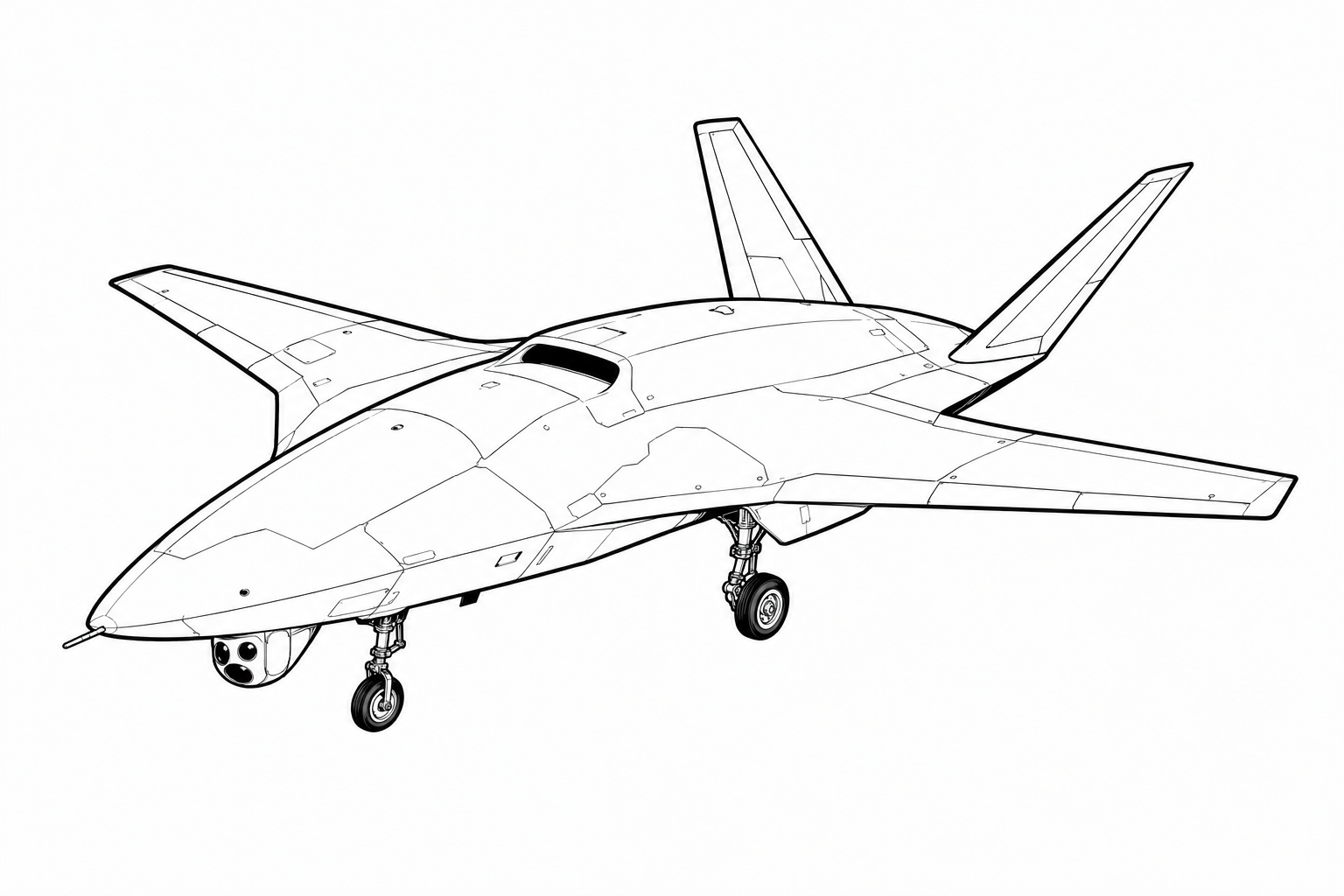
YFQ-44A Fury overview
The YFQ-44A Fury is General Atomics Aeronautical Systems' contender for the U.S. Air Force's Collaborative Combat Aircraft (CCA) program — arguably the most consequential unmanned aviation competition since the original Predator program. Developed under the USAF's requirement for an affordable, attritable autonomous wingman that can fly alongside the F-35A and F-22 in contested airspace, the Fury represents General Atomics' deliberate departure from its long-established MALE drone lineage. Rather than adapting an existing platform, GA-ASI designed the Fury from a clean sheet with a single overriding constraint: survive long enough in an anti-access/area-denial environment to matter, while remaining affordable enough to accept losses that would be unconscionable for a crewed aircraft. The result is a sleek, twin-tailed low-observable design powered by a single turbofan engine — speculated to be derived from the Williams FJ44 family — with an estimated combat radius exceeding 700 nautical miles and a payload capacity accommodating two to four AIM-120 AMRAAM missiles or equivalent-weight strike munitions in an internal bay. The aircraft's aerodynamic configuration prioritizes supersonic dash capability and high-angle-of-attack maneuverability, enabling it to generate and exploit offensive and defensive opportunities that a slower MALE drone cannot.
The Fury's autonomous systems architecture is central to the CCA concept of operations. Rather than relying on continuous datalink from a ground station or crewed aircraft, the Fury is designed to execute complex mission segments autonomously when communications are degraded — using AI-driven mission management software to make tactical decisions about timing, sequencing, and target prioritization within commander's intent rules. This 'trust architecture' is perhaps the most technically challenging aspect of the entire CCA program: the USAF must certify that an autonomous aircraft can make lethal engagement decisions within established legal and ethical rules of engagement without real-time human confirmation of each weapon release. GA-ASI has partnered with L3Harris for the mission system integration and with Honeywell for the fly-by-wire flight control system, drawing on decades of experience integrating complex avionics into remotely piloted aircraft. The Fury also incorporates a modular electronic warfare suite that allows it to perform jamming and deception missions in addition to kinetic strike, giving the CCA force a multi-role capability that extends well beyond simple fighter escort.
As of 2025–2026, the YFQ-44A is competing directly against Anduril's YFQ-42A in a fly-off evaluation overseen by Air Force Materiel Command. The USAF has funded both competitors through an increment 1 development phase, with a source selection decision expected in the 2026–2027 timeframe that could result in a production contract for over 1,000 aircraft — a program of record that would represent the largest autonomous aircraft acquisition in history. GA-ASI's pitch emphasizes manufacturing maturity and risk reduction: the company's Palmdale production facilities already build MQ-9 Reapers at scale, and the production infrastructure, supplier base, and quality management systems for the Fury can leverage that existing foundation. Flight test data from Edwards Air Force Base evaluations in late 2025 indicated the Fury met or exceeded performance specifications in autonomy, aerodynamics, and electromagnetic compatibility, positioning GA-ASI as a strong competitor heading into the final source selection phase.
Armament
2–4 AIM-120 AMRAAM or GBU-53/B StormBreaker in internal bay; electronic warfare payload option
Development and operational timeline
- USAF releases Collaborative Combat Aircraft requirements; General Atomics begins Fury concept development
- GA-ASI awarded CCA increment 1 contract alongside Anduril; YFQ-44A designation assigned
- Fury design configuration finalized; L3Harris and Honeywell named as mission system and flight control partners
- YFQ-44A Fury first flight at Edwards Air Force Base; autonomous navigation and datalink modes tested
- USAF completes initial airworthiness review; Fury cleared for expanded flight envelope testing
- Fury demonstrates AI-assisted autonomous mission segment execution including multi-target sequencing without real-time operator input
- Head-to-head fly-off evaluation with YFQ-42A begins at Eglin Air Force Base; both aircraft assessed on autonomy, survivability, and cost
- Edwards AFB test results confirm Fury meets USAF performance specifications; GA-ASI advances manufacturing readiness review
- USAF CCA source selection decision timeline set for late 2026; production contract for 1,000+ aircraft at stake