Air system · Short-Runway MALE UAV
Mojave
Strike / ISR / STOL Operations from Austere Airfields
Also known as: GA-ASI Mojave / STOL MALE drone / Army desert drone
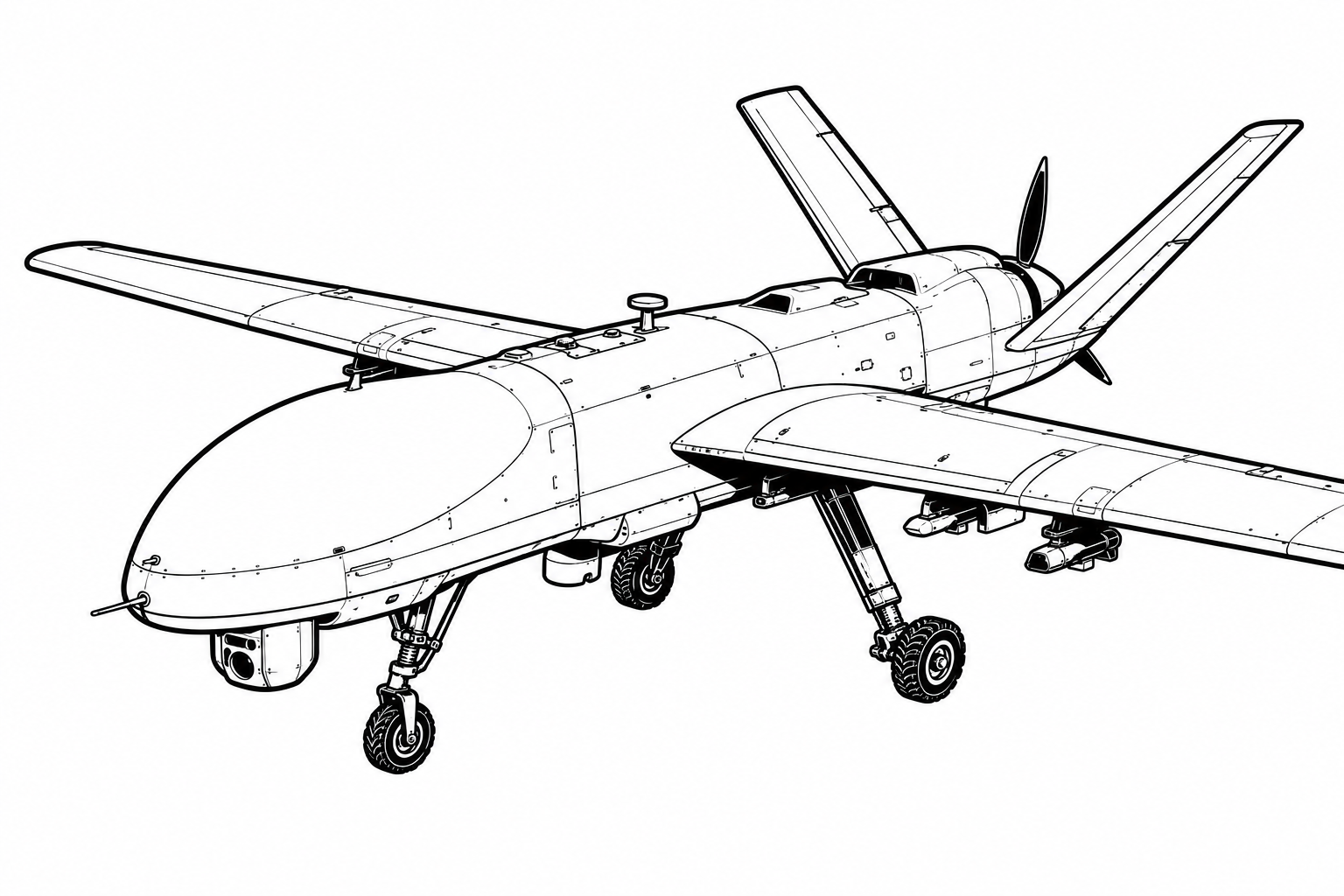
Mojave overview
The Mojave fills a gap that the MQ-9 Reaper family leaves open: the need for a long-endurance strike and reconnaissance platform that can operate from austere forward locations with short, unprepared airstrips. The MQ-9's long wingspans and high landing speeds require paved runways of substantial length — infrastructure that exists at major air bases but is often absent at the forward operating locations where ground commanders most need organic air support. Every MQ-9 mission from a distant base incurs transit time that reduces time-on-station, and the logistics chain connecting that base to the front is a vulnerability. Mojave addresses this by using larger wing area and high-lift devices to achieve short take-off and landing performance on strips as short as 1,500 feet — including unpaved dirt or gravel surfaces.
The short-field capability fundamentally changes operational concepts for employment. Rather than requiring a large, fixed, and conspicuous airbase infrastructure that presents a high-value target, Mojave can be forward-deployed to concealed locations close to the area of operations — a partially-cleared field, a short highway segment, a desert plateau — and relocated rapidly if the position is compromised. This mobility and concealability represents a significant survivability advantage in contested environments where adversary long-range fires can threaten fixed airbase infrastructure.
The U.S. Army's sustained interest in the Mojave through 2025-2026 reflects a doctrinal shift toward organic Army aviation that can operate independently of Air Force basing infrastructure. Army aviation has historically focused on rotary-wing platforms — helicopters — but their inherent speed and endurance limitations are increasingly apparent in peer competition scenarios covering vast geographical areas. Mojave's combination of fixed-wing endurance and STOL performance offers a bridge between those constraints: helicopter-like operational flexibility from forward locations, but with the range and endurance of a fixed-wing aircraft.
Armament
Up to 16 × AGM-114 Hellfire missiles or equivalent guided munitions; full MQ-9 weapons compatibility
Development and operational timeline
- GA-ASI announces Mojave as STOL MALE UAV; enlarged wing, flaps, and ruggedized landing gear specified
- Mojave prototype first flight; take-off and landing on 1,500-foot unprepared strip demonstrated
- Weapons integration; Mojave carries 16 Hellfire missiles simultaneously — double MQ-9 capacity
- U.S. Army evaluates Mojave for organic MALE UAS requirement; forward basing concept demonstrated
- Mojave demonstrates launch from grass strip at undisclosed desert location; dirt surface operations validated
- Army MALE UAS assessment continues; Mojave competes alongside other systems for organic capability slot
- Maritime configuration tested; Mojave demonstrates deck operations from naval vessel in initial evaluation
- GA-ASI shows Mojave to international customers; Australia, UK, and Gulf states briefed
- Army signals continued interest in Mojave; forward deployment exercise conducted with infantry division
- GA-ASI reveals Mojave software updates improving autonomous launch and recovery for reduced ground crew requirement