Naval system · Hybrid USV / UUV
Ocean Aero Triton
Subsurface ISR / Ocean Survey / Maritime Domain Awareness
Also known as: Triton USV UUV / Ocean Aero hybrid vessel / sailing submarine drone
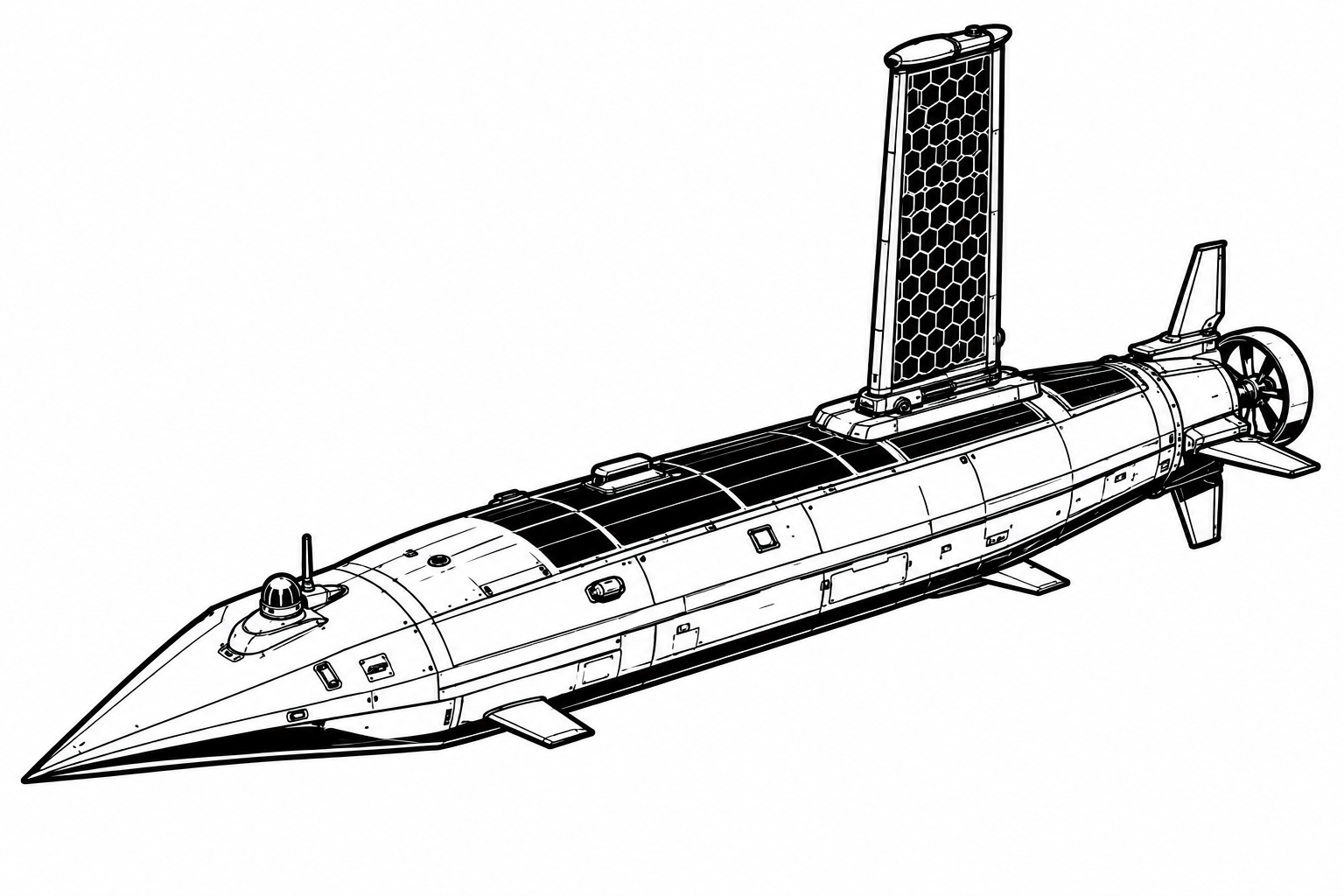
Ocean Aero Triton overview
The Ocean Aero Triton occupies a genuinely unique design niche — a vehicle that is simultaneously a sailing surface vessel and a submarine. On the surface it operates exactly as a conventional autonomous sailing drone, propelled by wind, recharged by solar panels, and managed remotely through satellite communications. When the mission requires covert acoustic sensing or subsurface work, it lowers its mast, floods its ballast chambers, and submerges to depths of up to 200 meters — operating silently under the surface using a combination of stored electrical energy and pressure-tolerant systems that have been hardened for the underwater environment.
The military value of this dual-mode capability is hard to overstate. A vessel approaching an area of interest on the surface can be detected, tracked, and identified through radar, visual observation, AIS transponder data, or electronic emissions. A submerged vehicle approaching through the same area is essentially invisible to surface surveillance — detectable only by active sonar or acoustic anomaly detection. The Triton's ability to transit an area covertly, submerge, and conduct acoustic collection without ever surfacing to reveal its position provides intelligence collection capability that combines the range and endurance of a surface vessel with the covert access of a submarine.
The U.S. Navy's interest in the Triton grew through 2025-2026 as commanders sought low-cost persistent underwater domain awareness that could be deployed in areas where the presence of crewed submarines would be too escalatory or where submarine resources are committed to higher-priority missions. The Triton's low unit cost compared to even the smallest crewed submarines means it can be deployed in areas where loss is an acceptable risk — near adversary naval bases, in heavily mined areas, or in other environments where sending a crewed submarine would be unacceptably costly if discovered or lost.
Armament
None (ISR); acoustic sensors, cameras, chemical sensors, oceanographic instruments
Development and operational timeline
- Ocean Aero founded; Triton hybrid USV/UUV concept development begins
- Triton prototype first trials; surface sailing and submergence transition demonstrated
- First sustained submerged operation; Triton maintains 6-hour submerged acoustic collection mission
- U.S. Navy SBIR funding awarded; Triton evaluated for Navy mine countermeasures and UDA program
- Acoustic sensor integration; Triton carries passive sonar while submerged for submarine detection
- Extended endurance trial; Triton completes 30-day combined surface/submerged mission autonomously
- Navy evaluation contract awarded; Triton assessed for forward-area maritime domain awareness
- Pacific deployment; Triton conducts autonomous mission in contested maritime area
- Mine detection payload integration; Triton carries forward-looking sonar for mine countermeasures
- INDOPACOM exercise participation; Triton provides submerged acoustic intelligence during fleet exercise
- Navy contract for sustained Triton deployment; multiple units assigned to persistent monitoring mission
- Triton fleet expanded; Ocean Aero delivers additional units under Navy production contract