Air system · Tactical Reconnaissance UAV
LUNA NG
ISR / Target Tracking / Communications Relay
Also known as: Rheinmetall LUNA NG / LUNA New Generation / HUSAR
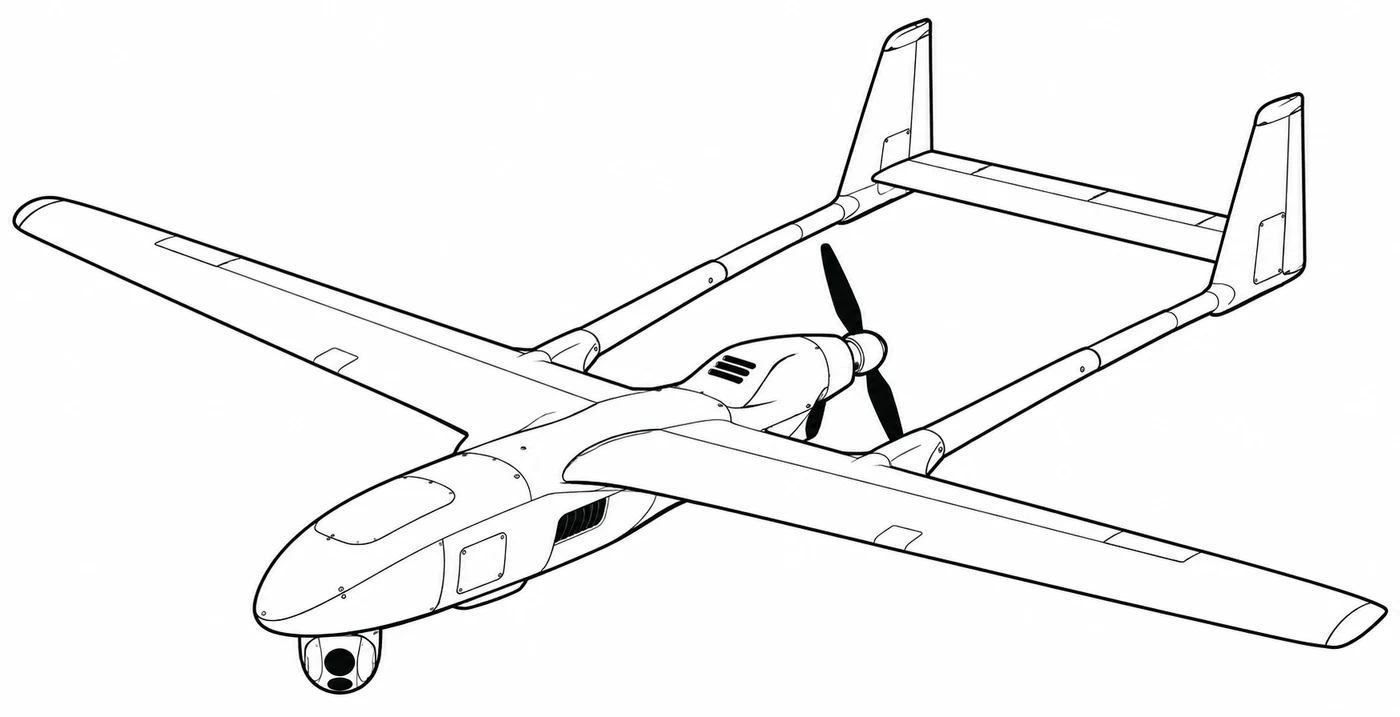
LUNA NG overview
Last reviewed:
LUNA NG is Rheinmetall's next-generation tactical airborne reconnaissance system, developed from the LUNA family and introduced in Germany under the HUSAR designation. Its purpose is to provide surveillance, detection, classification and tracking information to ground forces. It is a recoverable sensor aircraft rather than a one-way attack drone. The name covers a complete system of aircraft, control stations, launch equipment, communications and support vehicles; buying one system is not the same as buying one drone, a distinction that matters when interpreting German procurement quantities.
Rheinmetall's May 2024 technical brochure gives a 5.34 m wingspan, 3.17 m length, 0.73 m height and 110 kg takeoff weight. It describes a liquid-cooled heavy-fuel Wankel rotary engine, typical reconnaissance speed of 90 km/h indicated airspeed and maximum indicated airspeed of 130 km/h. Flight duration exceeds 12 hours depending on the payload and mission profile, while the data-link range is above 100 km. These manufacturer figures are more specific than rounded dimensions in early reporting and should not be substituted for specifications of the smaller original LUNA.
The carbon-fiber airframe is designed to keep weight low and support persistent observation. Publicly described modular payload options include electro-optical and infrared sensors, electronic-support equipment and communications-relay functions. Available options do not mean every aircraft carries every sensor at once. Similarly, connecting sensor information to a strike network does not mean LUNA NG itself carries an explosive warhead. The distinction between finding a target, passing information and delivering a weapon is central to understanding its place beside systems such as RQ-7 Shadow and RQ-21 Blackjack.
LUNA NG is runway-independent: a catapult launches the aircraft and it can recover in a net or by parachute using automated navigation. That reduces dependence on airfields but does not remove the requirement for a suitable launch area, recovery space, antennas, trained crews and logistics. In its June 2026 description, Rheinmetall identifies five reconnaissance aircraft, two ground control stations, two launch vehicles and associated transport and workshop equipment in each complete German system. A compact air vehicle therefore still belongs to a substantial deployable reconnaissance capability.
The September 2023 German order covered 13 systems, with initial series deliveries originally scheduled for 2025. Later official material confirms delivery of LUNA NG to Ukraine by June 2024. These are separate customer timelines and should not be merged into one universal service-entry date. Rheinmetall's June 10, 2026 ILA release describes integration with the Bundeswehr's C2-UMS Bw network at its combat training center, allowing reconnaissance information to interact with a wider reconnaissance-and-strike network, including loitering munitions. It is an integration claim, not an audited combat-effectiveness statistic.
On September 1, 2026, Rheinmetall announced provisional airworthiness certification from the Bundeswehr Aviation Authority. The company said approximately 150 flights and 200 flight hours had been completed under civil operating permissions, and that the provisional approval allowed independent Bundeswehr training and test operations. This is a meaningful regulatory milestone, but it was not full type certification: the same release says work toward full certification was continuing. Nor should those test-flight totals be described as cumulative combat missions flown in Ukraine.
The November 21, 2026 editorial review therefore places LUNA NG in an active procurement, integration and certification context, while preserving the distinction between provisional approval and a completed unrestricted operational clearance. It also keeps projected delivery dates separate from individually documented handovers. The aircraft's usefulness lies in providing persistent tactical information with a deployable, runway-independent system. Readers comparing it with TEKEVER AR3 or CAMCOPTER S-100 should consider launch method, payload configuration, command-network integration and support footprint, not simply compare headline endurance figures.
Armament
Reconnaissance sensor-to-shooter networking; not a standard onboard warhead
Development and operational timeline
- Rheinmetall announces Germany's order for 13 LUNA NG systems; first series delivery was then planned for 2025
- Rheinmetall's Eurosatory material confirms LUNA NG had already been supplied to Ukraine
- ILA release describes C2-UMS Bw integration and a German configuration comprising five aircraft per complete system
- Provisional airworthiness certification announced for Bundeswehr training and test flights; full type certification remains in progress
- Editorial status review: 2026 network integration and provisional approval included; full certification and complete delivery totals not inferred