Air system · Jet-Powered One-Way Attack UAV
Geran-3
Long-Range Strike
Also known as: Geranium-3 / U-series Geran / Russian Shahed-238 derivative
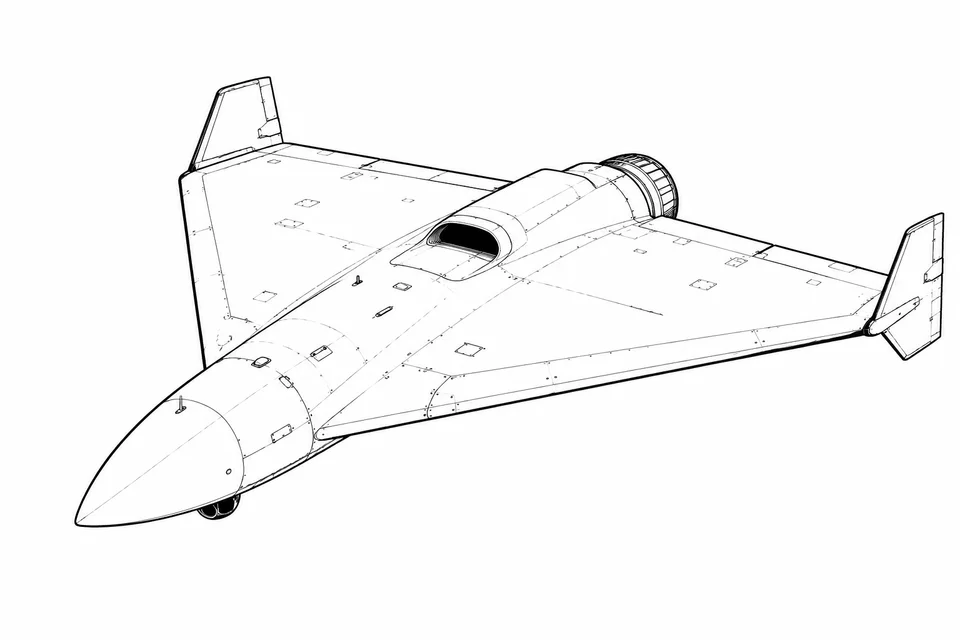
Geran-3 overview
Last reviewed:
Geran-3 is a Russian turbojet-powered one-way attack aircraft associated with the Iranian Shahed-238 design and Russia's wider Geran production network. Its purpose is long-range strike, not persistent reusable reconnaissance. Unlike the piston-powered Geran-2, the Geran-3 substitutes a compact jet engine while retaining a broadly related delta-wing layout. It should also be distinguished from the later Geran-5, whose conventional aerodynamic arrangement represents a more substantial external redesign. Treating all three as one aircraft obscures important differences in propulsion, speed and evidence.
A particularly useful public milestone came in September 2025, when Ukrainian intelligence released a three-dimensional model and a detailed components inventory. The GUR War & Sanctions record identifies a Telefly JT80 turbojet along with navigation, inertial, control and electrical equipment recovered or attributed to the type. This is evidence about examined examples, not proof that every production batch uses an identical bill of materials. It also does not, by itself, establish that every commercial component manufacturer knowingly supplied a military program.
Published performance figures differ. Ukrainian reporting accompanying the September disclosure described approximately 300–370 km/h and a possible range up to 1,000 km. IISS's January 2026 comparison instead used about 330 km/h and up to 600 km for Geran-3, while assigning higher speeds to Geran-4 and Geran-5. This page retains the discrepancy rather than averaging incompatible estimates or importing the later aircraft's 500–600 km/h figures. Range depends on fuel, warhead, altitude and route, and the available evidence does not establish a universal maximum for all examples.
The operational significance is a changed interception problem rather than a completely new mission. A faster approach shortens the time available for detection, identification and engagement compared with a slower propeller-driven one-way attack drone. That can challenge mobile gun teams and some interceptor aircraft, but it does not prove immunity to radar, electronic warfare or surface-to-air missiles. Publicly identified navigation and control components show adaptation within the supply chain; they should not be converted into unsupported claims of autonomous target recognition or a guaranteed resistance to jamming.
By January 2026, IISS described Geran-3 as already in wider use than the newer Geran-4 and Geran-5. That is an analyst assessment of relative adoption, not an audited fleet or production total. Through the November review, the strongest profile is therefore a combination of recovered-component evidence, source-specific performance estimates and clearly separated variant identities. Warhead changes and any air-to-air or air-launch claims require their own evidence; capabilities observed on another member of the Geran family cannot automatically be assigned to the Geran-3.
Armament
Integral explosive warhead; configuration-dependent
Development and operational timeline
- Ukrainian intelligence publishes Geran-3 component and airframe information, including a Telefly JT80 turbojet; contemporary reporting provides source-specific speed and range estimates
- The separate Geran-5 disclosure highlights the expanding jet-powered family; its performance is not a Geran-3 specification
- IISS describes Geran-3 as the jet-powered variant already in wider use and compares its reported performance with Geran-4 and Geran-5
- Editorial status review: recovered-component findings retained; conflicting range estimates and uncertain batch-level specifications remain explicitly qualified