Air system · Jet-Powered Strike UAV
Geran-5
Jet-Powered Long-Range One-Way Attack
Also known as: Geranium-5 / Герань-5
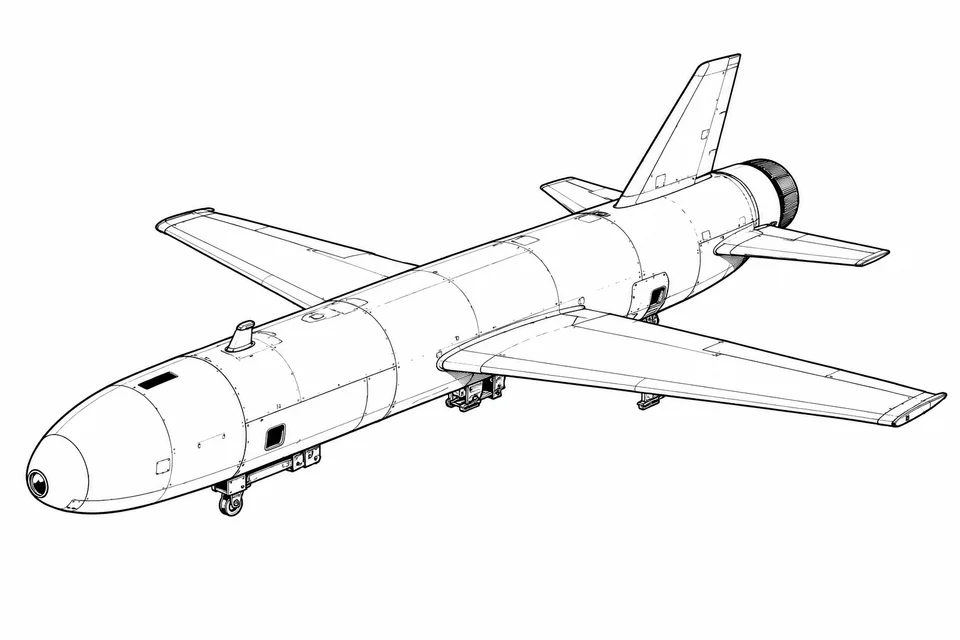
Geran-5 overview
Last reviewed:
Geran-5 is a Russian jet-powered one-way attack drone first reported in use against Ukraine in early January 2026. Ukrainian intelligence describes a roughly six-meter aircraft with a conventional wing-and-tail arrangement, a reported 90 kg warhead and approximately 1,000 km declared range. Its designation places it in the Geran ecosystem, but its external layout differs substantially from the delta-wing Geran-2 and Geran-3. That distinction matters when interpreting photographs, performance claims and descriptions of the wider Russian long-range strike inventory.
Ukraine's Defence Intelligence, also known as GUR or DIU, disclosed the new type on January 11. Interfax-Ukraine reported the intelligence account the following day, while the International Institute for Strategic Studies examined the evidence on January 28. The IISS analysis cited recovered debris and imagery as evidence of the changed aerodynamic layout and some internal commonality with earlier Gerans. These sources provide a firmer identification basis than an unattributed social-media label, although a full Russian manufacturer specification and independent flight-test report are not available in the reviewed material.
The propulsion system is a Chinese-origin Telefly turbojet according to Ukrainian investigators. Their component account also identifies a Kometa satellite-navigation installation, tracking electronics and cellular modems. IISS discussed a reported 200 kg-thrust engine, maximum speed around 600 km/h and range around 950 km; the earlier intelligence announcement used approximately 1,000 km. Those figures describe reported performance, not a certified envelope. Speed, payload, flight altitude and range are linked trade-offs, so the quoted maxima should not be combined into a guaranteed mission profile.
The practical difference from a propeller-powered Geran is the time available for interception. Higher speed reduces engagement opportunities for gun teams and some slower interceptor drones, while potentially increasing dependence on more capable air-defense assets. It does not make the aircraft invisible or invulnerable. IISS places Geran-5 in a broader shift toward comparatively low-cost cruise-missile-like weapons: systems that can deliver a meaningful warhead at distance without necessarily matching the navigation independence, engine efficiency or survivability of more sophisticated cruise missiles.
Ukrainian reporting also described work on possible Su-25 air launch and an R-73 air-to-air missile fit. These were development options, not evidence that every Geran-5 is an operational air-launched interceptor. Likewise, similarities with Iran's Karrar do not establish that the aircraft is an unchanged Iranian design; IISS noted important differences and uncertainty over origin. Through the November 2026 review, the strongest public findings remain the recovered-aircraft evidence, the January disclosure and a clearly attributed set of performance estimates. Production totals and variant-specific combat effectiveness remain insufficiently established for a definitive scorecard.
Armament
Integral attack warhead; proposed R-73 fit is not baseline service equipment
Development and operational timeline
- Ukraine reports initial Geran-5 use during combined air attacks in early January; the exact first-use date is not disclosed
- GUR publicly discloses Geran-5 and describes its layout, components and reported performance
- Interfax-Ukraine reports the GUR assessment, including a roughly 90 kg warhead and 1,000 km declared range
- IISS analyzes recovered-aircraft imagery and differentiates Geran-3, Geran-4 and Geran-5; proposed air-launch and air-to-air roles remain qualified
- Editorial status review: reported specifications and observed identification evidence distinguished from proposed configurations and unverified production totals