Air system · Jet-Powered Strike Drone
Shahed-238
High-Speed Infrastructure Strike / Precision Attack
Also known as: Shahed 238 / jet-powered Shahed / Iranian fast strike drone
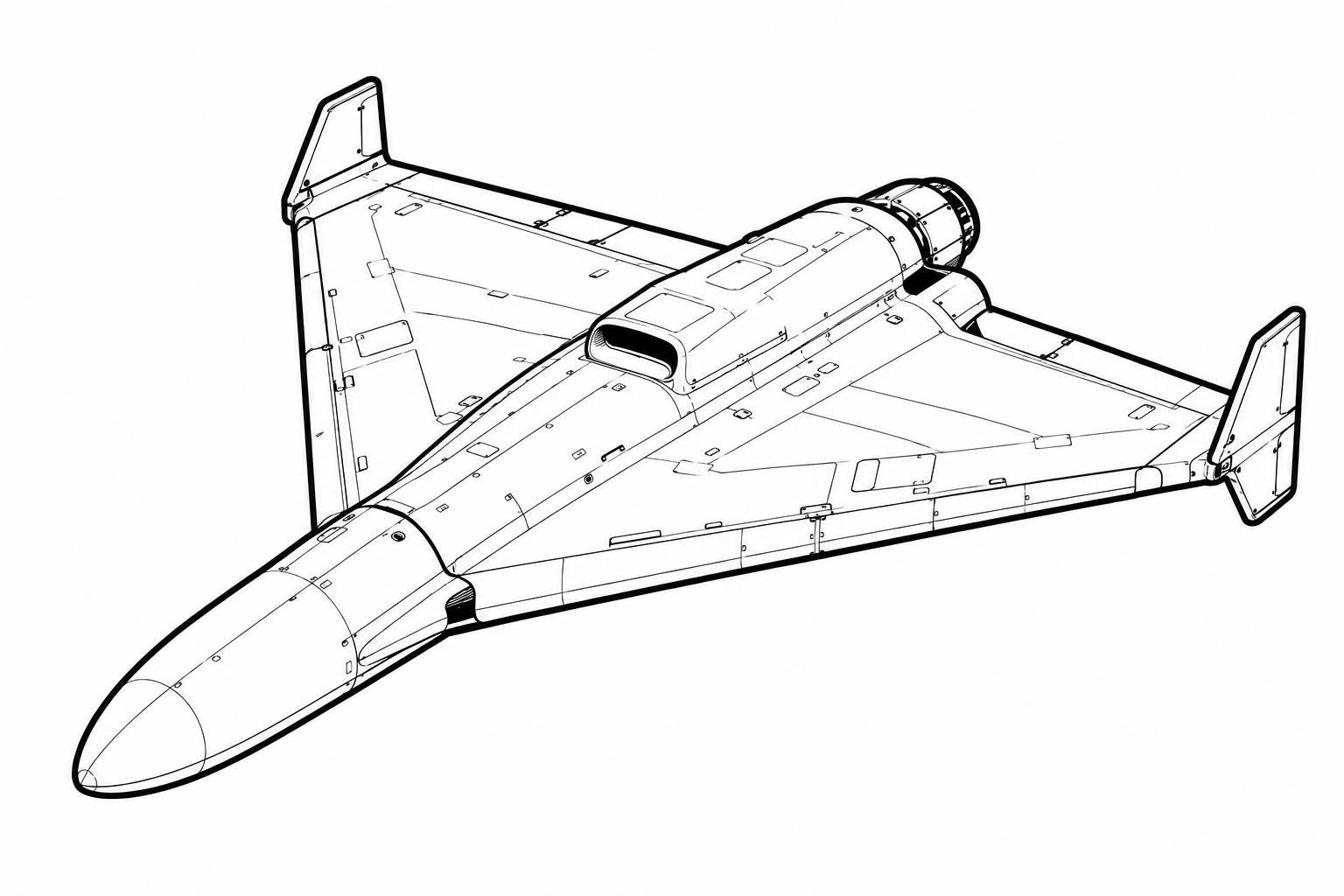
Shahed-238 overview
The Shahed-238 represents the most technically significant evolution of Iran's Shahed strike drone family: the replacement of the piston engine that defines the Shahed-136 with a small turbofan or turbojet powerplant that more than triples the aircraft's cruise speed. This single change fundamentally alters the threat calculus facing air defense systems. Against the Shahed-136's 185 km/h approach speed, even relatively simple systems — towed anti-aircraft guns, shoulder-fired missiles, interceptor drones — can engage effectively because there is sufficient time to detect, track, compute a firing solution, and engage. Against the Shahed-238's 580 km/h approach speed, the same systems have roughly one-third the response time, and many existing short-range systems simply cannot slew their sights and track fast enough.
Iran revealed the Shahed-238 publicly in 2023, demonstrating it in what appeared to be a functional if not yet fully operational configuration. The transition to series production took until 2024-2025, and by 2026 the Shahed-238 was appearing with increasing frequency in reports of strikes against Ukrainian infrastructure — confirmed primarily through the characteristic turbine exhaust signature picked up by acoustic sensors and the distinctive sound profile that differs sharply from the two-stroke engine sound of the Shahed-136 that Ukrainian civilians and military personnel learned to recognize. The jet-powered platform is significantly louder at close range but provides dramatically less warning time due to its speed.
The Shahed-238's range — estimated at 1,800 km versus the Shahed-136's approximately 2,000 km — is slightly shorter due to the turbine's higher fuel consumption, but remains sufficient to reach all of Ukraine from Iranian or Russian territory. Its precision terminal guidance appears comparable to the Shahed-136, suggesting that the core navigation technology was retained while the propulsion was upgraded. Western air defense suppliers began developing specific intercept strategies for the Shahed-238 through 2025-2026, recognizing that doctrine and systems designed for the Shahed-136 required adaptation for the faster platform.
Armament
50 kg blast-fragmentation warhead; GPS/INS guidance with optical terminal seeker option
Development and operational timeline
- Iranian defense ministry confirms development of jet-powered Shahed-238 as high-speed strike drone
- Shahed-238 publicly revealed at Iranian aerospace exhibition; turbofan powerplant and speed parameters disclosed
- Shahed-238 range and precision testing completed; Iranian military validates operational performance
- Iran begins series production; first production units reportedly transferred to IRGC
- Russia receives first Shahed-238 shipment under expanded Iran-Russia drone cooperation agreement
- First suspected Shahed-238 use in Ukraine; acoustic sensors detect turbine signature in strike wave
- Western intelligence confirms Shahed-238 operational use against Ukrainian targets; speed challenges existing intercept systems
- Ukraine requests additional short-range interceptors specifically tuned for Shahed-238 speed regime
- Shahed-238 frequency of use increases; appears in mixed waves with slower Shahed-136 to complicate defense
- Iran confirms production ramp; Shahed-238 marketed to third parties alongside Shahed-136