Air system · Long-Range One-Way Attack UAV
Samad-3
Long-Range Strike
Also known as: Sammad-3 / Samad 3 / Sammad 3 / صماد-3
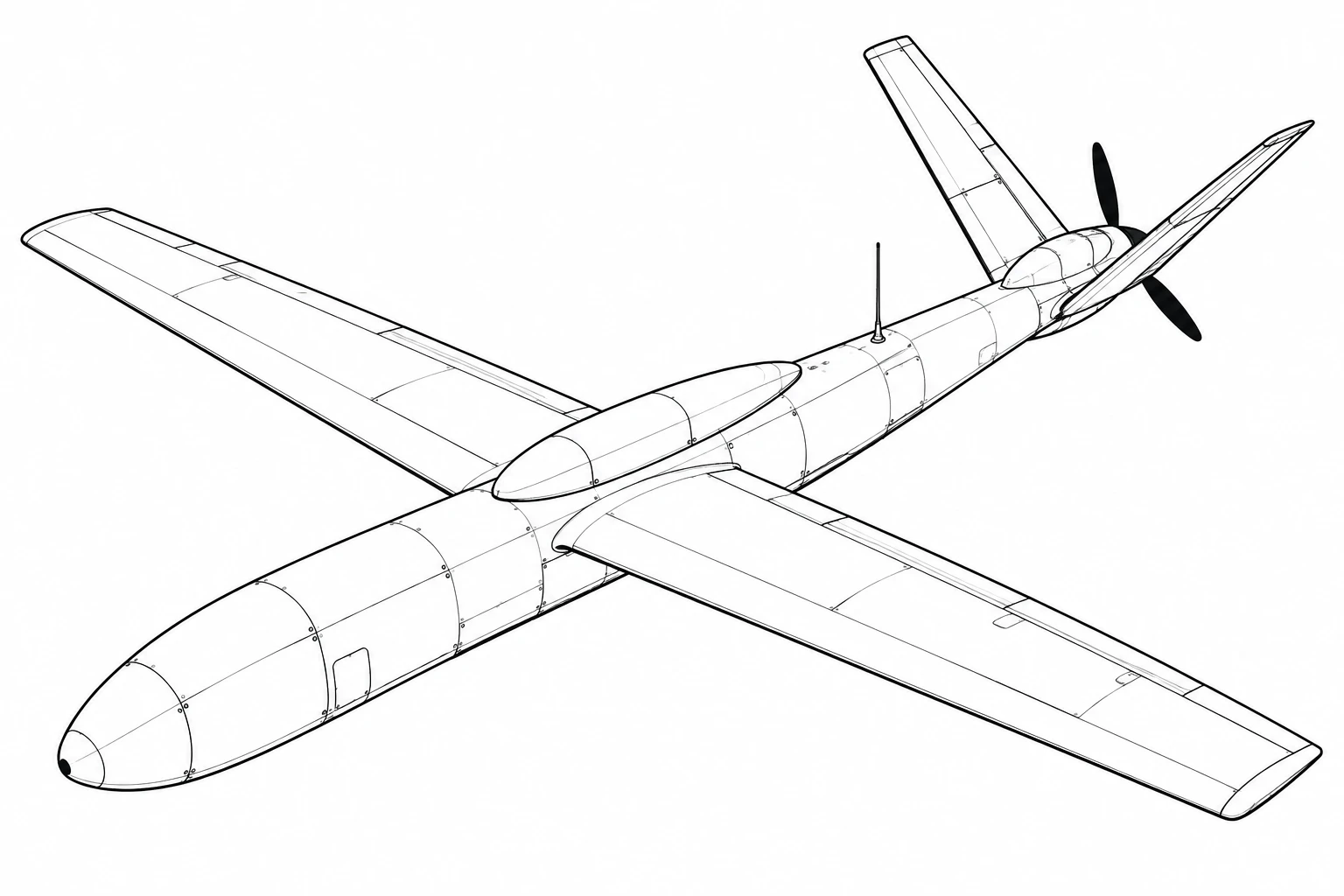
Samad-3 overview
Last reviewed:
Samad-3 is a long-range, propeller-driven one-way attack drone operated by Yemen's Ansar Allah, commonly known as the Houthis. It belongs to the Samad or Sammad family, but should not be confused with the smaller Samad-1 reconnaissance aircraft or the shorter-range Samad-2. Its defining external feature is an additional fuel tank carried above the fuselage. The purpose is to extend the reach of an expendable aircraft carrying an explosive payload, rather than to provide the reusable armed-surveillance mission associated with aircraft such as the MQ-9 Reaper.
The aircraft combines a slender fuselage, long straight wings, a V-tail and a rear-mounted piston engine driving a pusher propeller. A 2020 peer-reviewed study by Netherlands Defence Academy researchers reconstructed the Samad-2 and Samad-3 geometry from UN reporting and public imagery, using a length of approximately 2.8 m and a wingspan of 4.5 m. Those dimensions are a published reconstruction, not an authenticated manufacturer drawing of every production batch. The study used an 18 kg explosive payload and estimated a Samad-3 maximum takeoff mass of about 107 kg; the latter is a model-derived mass, not a weighed operational airframe.
Public range figures need particular care. The U.S. Army's ODIN reference records a Houthi claim of 1,500 km for Samad-3. The Netherlands Defence Academy study found that the extended-fuel configuration could exceed 1,800 km under its modeled assumptions, with the results depending on aerodynamic uncertainty, fuel, weather and flight conditions. A modeling result is not an independently observed maximum-range test. Neither number is a two-way reconnaissance radius, and neither establishes a particular terminal accuracy, resistance to jamming or ability to penetrate a specific air-defense system. A verified maximum speed, endurance and service ceiling for a standardized baseline configuration were not established by the sources reviewed.
The Houthis describe their drones as domestically developed, while external investigations document foreign components and Iranian connections within their wider UAV supply chain. Conflict Armament Research examined a Sammad-pattern aircraft recovered in 2018 and traced similarities in components and construction across regional systems. That family-level evidence does not identify one independently verified factory or prove that every Samad-3 is assembled in the same country. This catalog lists Yemen as the operating program's country and identifies the manufacturer as Houthi-associated production with a disputed supply chain, rather than assigning the aircraft to an unsupported named commercial manufacturer.
The public operational record mixes claims with recoveries and technical assessments. CSIS documented the display of Samad-3 at the July 7, 2019 military exhibition in Sana'a. The 2020 academic study, citing the UN Panel of Experts, says a recovered aircraft from the August 17, 2019 Shaybah oil-field attack was identified as Samad-3. This should not be extended to the separate September 2019 Abqaiq and Khurays attacks: the same paper discusses the UN's rejection of the Houthis' claimed launch responsibility for those attacks, and a simulation of possible aircraft range is not evidence of attribution.
In July 2024, Israeli officials initially assessed the drone used in the fatal Tel Aviv attack as an extended-range Samad-3; the Houthis described their aircraft as a new system, subsequently widely called Yafa. Reporting on a modified or related aircraft does not establish that the original Samad-3 has identical range or equipment, and claims of radar invisibility should not be treated as demonstrated stealth. At the November 1, 2026 editorial review, the sources linked here support an established long-range attack-drone design, but do not establish a new baseline upgrade, an audited fleet inventory or a fleet-wide combat success rate for 2026. The final timeline entry is therefore a review date, not an invented operational milestone.
Armament
Integrated explosive payload for one-way attack; not a reusable aircraft carrying releasable weapons
Development and operational timeline
- Samad-family aircraft enter the documented conflict record; CAR later describes a Sammad-pattern airframe recovered in June and inspected in September, without establishing that every recovered family member was Samad-3
- Samad-3 is publicly displayed at the Sana'a military exhibition, documented by CSIS; this is a display date, not a confirmed first flight
- Shaybah oil-field attack: the subsequent academic study cites UN identification of a recovered Samad-3 airframe
- Conflict Armament Research publishes its investigation of Houthi UAV construction, foreign components and Sammad-pattern supply-chain evidence
- Netherlands Defence Academy researchers publish peer-reviewed Samad-2/3 flight-performance modeling, distinguishing estimated range from observed test results
- Israeli military initially assesses the Tel Aviv attack aircraft as an extended-range Samad-3; the modified aircraft must not be treated as proof of unchanged baseline performance
- Editorial status review: baseline design, source qualifications and related-aircraft distinctions checked; no new 2026 operational milestone or production total established by the reviewed sources
Sources & further reading
- CSIS Missile Threat — July 2019 public exhibition of Samad-3
- Voskuijl, Dekkers and Savelsberg — Flight Performance Analysis of the Samad Attack Drones (2020), technical reconstruction and uncertainty analysis
- Conflict Armament Research — Evolution of UAVs employed by Houthi forces in Yemen (February 2020)
- U.S. Army ODIN — Sammad-3 reference and attributed 1,500 km range claim
- Business Insider — July 19, 2024 reporting on the Israeli assessment of the extended-range Tel Aviv attack aircraft