Air system · Long-Range One-Way Attack UAV
FP-1
Deep Strike / Strategic Infrastructure Attack
Also known as: Fire Point FP-1 / FP1
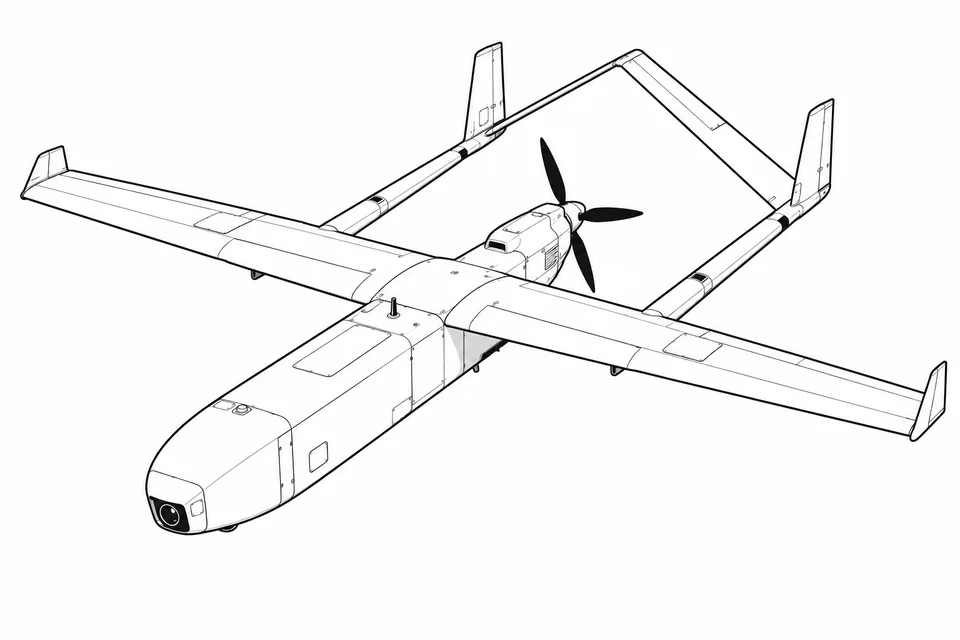
FP-1 overview
Last reviewed:
FP-1 is Fire Point's Ukrainian long-range, one-way attack aircraft, designed for strikes against targets beyond the immediate battlefield. It belongs to the category of comparatively economical fixed-wing strike drones rather than reusable armed reconnaissance aircraft. Its mission is different from that of a small FPV quadcopter: a larger airframe carries fuel and a dedicated warhead over substantial distances. The name refers to a specific Fire Point product and should not be expanded into a generic label for all Ukrainian deep-strike aircraft or every weapon produced by the company.
The aircraft became publicly prominent at a Ukrainian equipment exhibition in May 2025. Contemporary reporting described a range of up to approximately 1,600 kilometres and a warhead of up to 120 kilograms, while cautioning that payload affected achievable range. These early figures are useful historical reference points, not a single immutable specification. Like other long-range drones, FP-1 must balance fuel, structure and warhead mass. A profile that combines the largest reported warhead with the longest subsequently announced range would imply a configuration that the sources do not establish.
The most important published update in the reviewed 2026 record came on July 29. Defender Media reported Fire Point's specifications for an upgraded FP-1 with a 3,400-kilometre range carrying a 60-kilogram warhead. The publication described new photographs showing redesigned wings with additional fuel tanks. It also relayed manufacturer figures of a six-metre wingspan, a maximum speed of 205 kilometres per hour and cruising speeds of 140–180 kilometres per hour. These are attributed manufacturer figures, not independently measured performance guarantees for every production aircraft.
The July account also placed the specification change in a broader operational narrative. It referred to a June 20 presidential statement about ranges beyond 3,000 kilometres and reporting of strikes on distant Russian refining infrastructure. Such reports help explain why FP-1 attracts interest, but identifying a damaged target does not automatically establish the exact aircraft configuration, route, warhead mass or total number launched. This profile therefore treats the upgraded range-and-payload pairing as a published product claim and does not convert every reported long-distance attack into an individually verified FP-1 mission.
The design's relevance is as much industrial as aerodynamic. Deep-strike campaigns require a continuing supply of aircraft, engines, navigation components, warheads and trained launch crews. Claims about low unit cost and large daily output are frequently repeated, but production capacity, actual deliveries and successfully completed missions are different quantities. No universal November 2026 unit price or audited production total is asserted here. Mission results also depend on defenses, weather and navigation conditions; describing the aircraft as low-cost does not demonstrate that it is immune to electronic warfare or air-defense interception.
FP-2 is the closest catalog reference for understanding Fire Point's product differentiation. The same July 2026 report described FP-2 as a shorter-range system with a larger, 200-kilogram warhead and a reported 700-kilometre reach. Those values belong to FP-2, not FP-1. Looking at both aircraft makes the range-versus-payload trade-off clearer than treating one as merely a renamed version of the other. Neither the company's other missiles nor an unrelated strike drone's propulsion or guidance equipment should be assigned to FP-1 without supporting evidence.
Other useful Ukrainian comparisons include Liutyi, UJ-26 Beaver and MICH 2000. They provide context for a broader national effort to reach industrial and military targets, but each has a different development record and source quality. There is no basis for assuming common navigation systems, identical warheads or interchangeable operating procedures simply because the aircraft originate in Ukraine. Their related profiles help readers evaluate differences in reported range, disclosure, manufacturing context and whether a figure describes an early configuration or a later revision.
As reviewed on November 8, 2026, the main content update is the explicitly paired 3,400-kilometre and 60-kilogram claim for the revised FP-1, with the earlier 2025 configuration retained in the historical discussion. Endurance, ceiling, launch weight and a complete authenticated guidance specification are not supplied by the reviewed announcement. Keeping those gaps visible is more useful than deriving them from range or imagery. The timeline separates the public debut, evolving operational statements, published specification revision and this editorial review.
Armament
Integral warhead; 60 kg in the published long-range configuration
Development and operational timeline
- Ukrainian exhibition reporting presents FP-1 with up to 1,600 km range and up to 120 kg warhead, dependent on configuration
- A presidential statement reported by Defender Media describes an upgraded FP-1 reaching beyond 3,000 km
- Published Fire Point figures pair an upgraded FP-1's claimed 3,400 km range with a 60 kg warhead and show revised fuel-carrying wings
- Editorial status review: retain early and upgraded configurations separately; published claims do not establish every operational mission or production total