Air system · Long-Range One-Way Attack UAV
UJ-26 Beaver
Deep Strike
Also known as: UJ-26 Bober / Bober / Beaver drone / Бобер
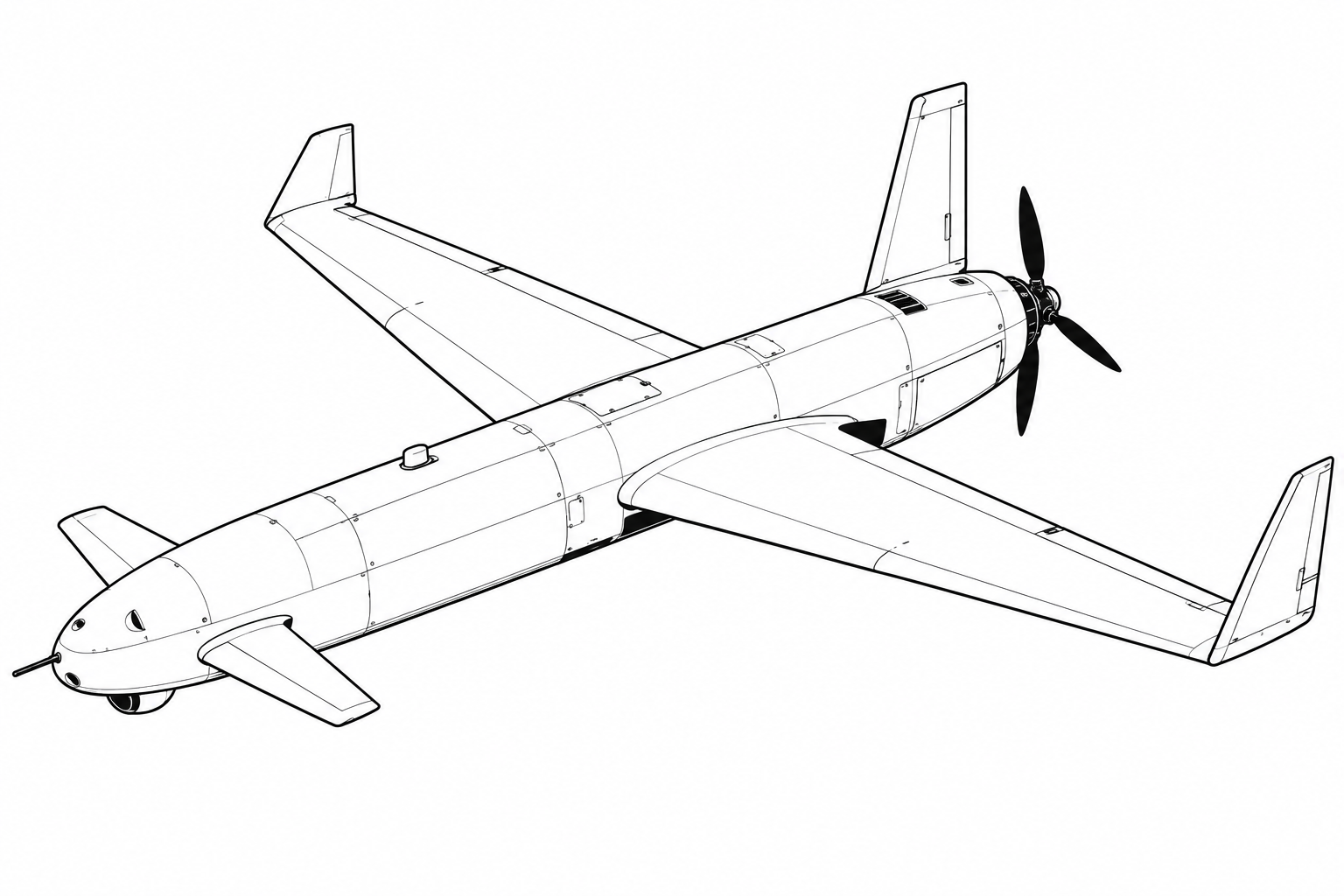
UJ-26 Beaver overview
Last reviewed:
The UJ-26 Beaver, also known as Bober, is a Ukrainian long-range one-way attack drone associated with deep strikes against Russian military and strategic infrastructure. Its Ukrainian nickname means beaver. The aircraft is consumed in its mission rather than returning as a reusable reconnaissance platform. Its role reflects Ukraine's effort to reach targets well beyond the immediate front line using domestically developed unmanned systems.
Public photographs show a distinctive canard arrangement with a forward control surface and rear propulsion, making Beaver recognizable among several Ukrainian long-range drone designs. Recognition by shape remains imperfect, especially when imagery shows damaged wreckage. A photograph does not establish the specific guidance package, warhead, or production batch. Attribution of a strike to Beaver should therefore be treated separately from the broader evidence that Ukraine carried out a long-range drone operation.
A June 2026 New Voice of Ukraine profile reports a range up to 1,000 km, flight time around seven hours, speed of 120–200 km/h, and a 20 kg warhead. It also gives an approximate 150 kg aircraft weight and 2.5 m length. These are reported figures rather than a complete independently validated factory data sheet. Maximum range and maximum speed should not be assumed to apply simultaneously, and total aircraft weight should not be confused with payload mass.
Beaver became publicly prominent in 2023, including reporting around drone attacks in the Moscow area. The June 2026 account cites the Kruk training center's identification of May 2023 as its first publicly documented use and quotes Ukrainian intelligence on its early deep-strike role. Such statements help establish the public program history but do not disclose all missions or independently establish the damage from individual strikes. Ukrainian announcements are evidence of what the operator says, not an unrestricted mission log.
Later reporting has described modifications and continued long-range use, but details of manufacture, guidance, electronic protection, and production quantities are deliberately limited. The existence of another Ukrainian drone with a similar stated range is not evidence that it shares Beaver's engine or navigation architecture. Public descriptions establish a deep-strike role but do not establish the exact guidance package, a consistent strike success rate, or the configuration used in every reported mission.
Through October 2026, Beaver remains an important example of Ukraine's indigenous deep-strike development, with useful public estimates but significant uncertainty around the latest configuration. Its wider significance is the pressure long-range unmanned attacks place on rear-area air defenses, logistics, and infrastructure protection. Claims of a successful strike must be evaluated separately from advertised reach. The publicly documented history covers selected appearances and operator statements, leaving substantial gaps in the complete manufacturing, delivery, and operational record.
Armament
Integral one-way explosive payload; reported warhead about 20 kg
Development and operational timeline
- A Ukrainian training-center account identifies the first publicly documented Beaver use during attacks in the Moscow area
- Public imagery and reporting establish Bober/Beaver as a recognizable Ukrainian long-range one-way drone
- Defense reporting describes an upgraded UJ-26 in long-range operations; configuration details remain limited
- New Voice publishes reported dimensions, warhead, speed, endurance, and range, citing Ukrainian sources
- Status review: current production quantities and detailed mission results remain undisclosed; reported figures are not a verified universal specification