Land system · Six-Wheel Logistics UGV
Ratel H
Cargo Transport / Casualty Evacuation / Modular Support
Also known as: RATEL H / Ratel-H / Ratel H logistics UGV
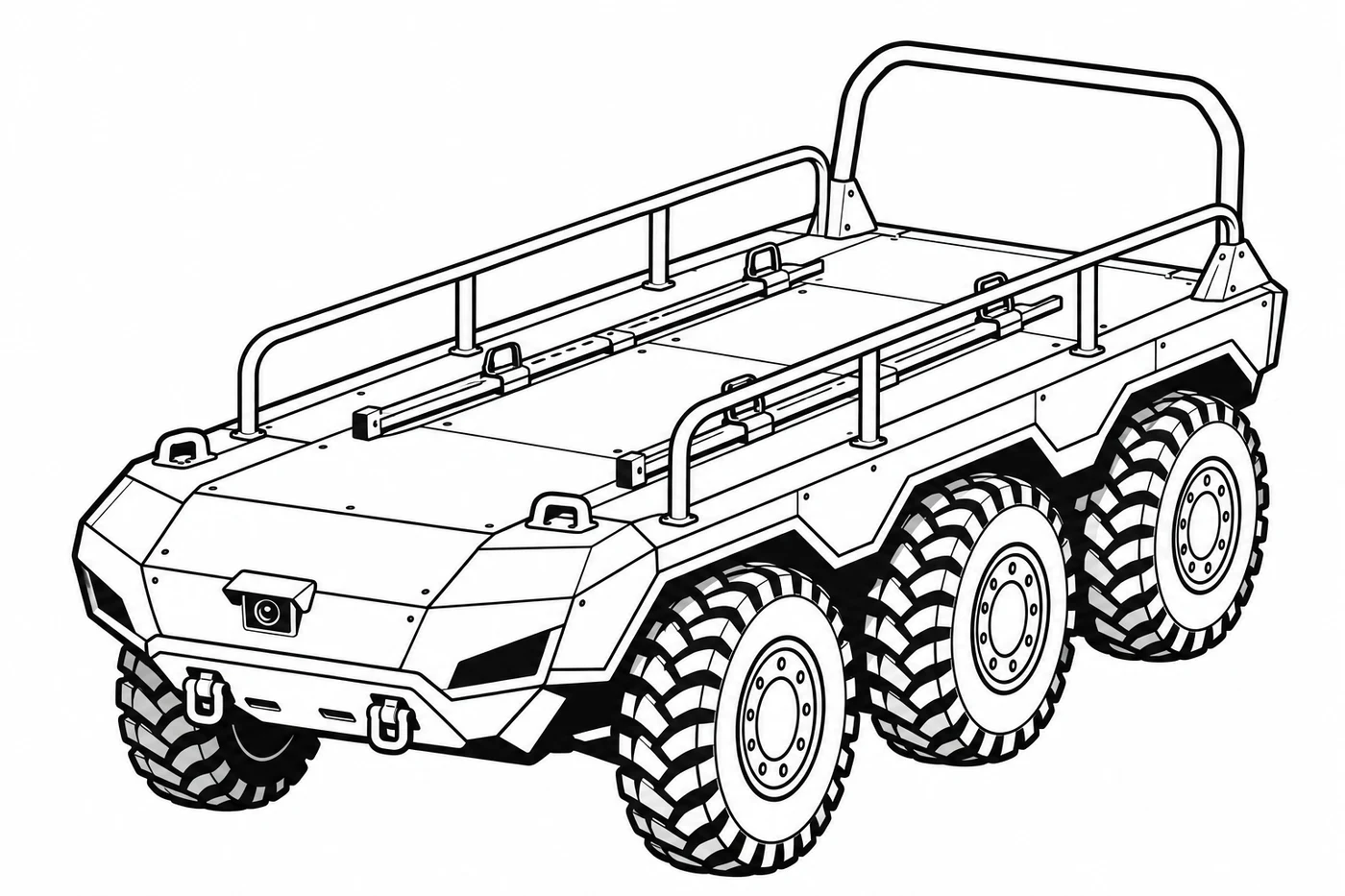
Ratel H overview
Last reviewed:
Ratel H is a Ukrainian six-wheel electric ground robot designed primarily to transport cargo, deliver supplies and support casualty evacuation. Its broad load bed and relatively large chassis place it in a different class from the smaller Ratel S already in the catalog. July 27, 2024 reporting attributed completion of field trials and the start of serial production to Ukraine's digital transformation minister. The supplied illustration represents the logistics configuration; it should not be read as a verified drawing of a particular production batch.
The current manufacturer page reviewed for this entry lists a 500 kg payload, a 1,185 kg vehicle mass and a 1,685 kg loaded mass. It gives dimensions of 2.48 m long, 1.40 m wide and 1.82 m high, speed up to 10 km/h and travel distance up to 55 km. These are supplier specifications for the listed configuration. Overall height includes fitted equipment and is not simply the height of the cargo deck, while useful travel under load depends on terrain, battery condition and operating pattern.
Public Ratel H figures have changed. September 2026 reporting still quoted a 400 kg payload, speed of 8 km/h and a travel figure up to 60 km, while the manufacturer's current page presents the newer numbers above. Rather than merge those values into one idealized platform, this profile identifies the source difference explicitly. Travel distance must also be distinguished from reliable control range: buildings, terrain, relay arrangements and interference can change the usable connection independently of how far the vehicle's batteries can move it.
A particularly useful first-hand historical source is the National Museum of the History of Ukraine in the Second World War. Its April 14, 2026 acquisition account describes an actual Ratel H donated after front-line service. According to the museum and the manufacturer's founder, that individual vehicle performed about 15 missions and transported more than nine tonnes of cargo while serving with the RAROG unit in the Siversk area between autumn 2025 and the following January. These are attributed service-history claims about one exhibit, not fleet-wide reliability statistics.
The museum account also describes damage, field repair and transfer of cargo to another Ratel H after an attack. That provides a more realistic operational picture than assuming a robot can complete every trip without support. Removing a driver reduces one kind of exposure, but recovery teams, maintainers and receiving personnel still carry risk. Evacuation use likewise depends on medical judgment and an appropriate installation; carrying a stretcher does not by itself establish clinical monitoring, protection or a safe ride across every obstacle.
During 2026, Ratel Robotics also explored an armed derivative. Ukrainska Pravda reported on September 19 that a remotely controlled 12.7 mm turret was undergoing integration trials, following an earlier public display and cooperation with Danish partners. Testing a turret is not the same as declaring an armed fleet in operational service, and its mass, stability and power demands can alter logistics performance. This entry therefore keeps the depicted cargo vehicle separate from the weaponized test configuration and avoids claiming autonomous decisions to use lethal force.
The November 21, 2026 review combines the updated supplier specifications with the museum's vehicle-specific history and the documented turret-testing report. Ratel S remains a useful family comparison only when its different role is made clear. Tencore TerMIT offers a tracked Ukrainian logistics counterpart, and THeMIS provides a larger international context for modular support robots. Capacity, maintenance and recovery evidence are more informative here than treating every platform described as combat-tested as interchangeable or invulnerable.
Armament
Unarmed logistics baseline; 12.7 mm turret derivative under trial in 2026
Development and operational timeline
- Reporting relays the Ukrainian digital transformation minister's announcement of completed field trials and serial production
- Museum's later account places its individual Ratel H exhibit in logistics service during autumn 2025; not a family-wide introduction date
- Museum account describes the end of that exhibit's October-to-January service period
- Kyiv War Museum announces acquisition of a front-line Ratel H and publishes its attributed mission and cargo history
- Ukrainska Pravda reports 12.7 mm turret integration trials; testing is separate from logistics service
- Editorial status review: current 500 kg manufacturer rating is distinguished from older 400 kg reporting