Land system · Tracked Logistics UGV
Tencore TerMIT
Resupply / Casualty Evacuation / Modular Support
Also known as: TERMIT / TerMIT 2.0 / TerMit / TENCORE TerMIT UGV
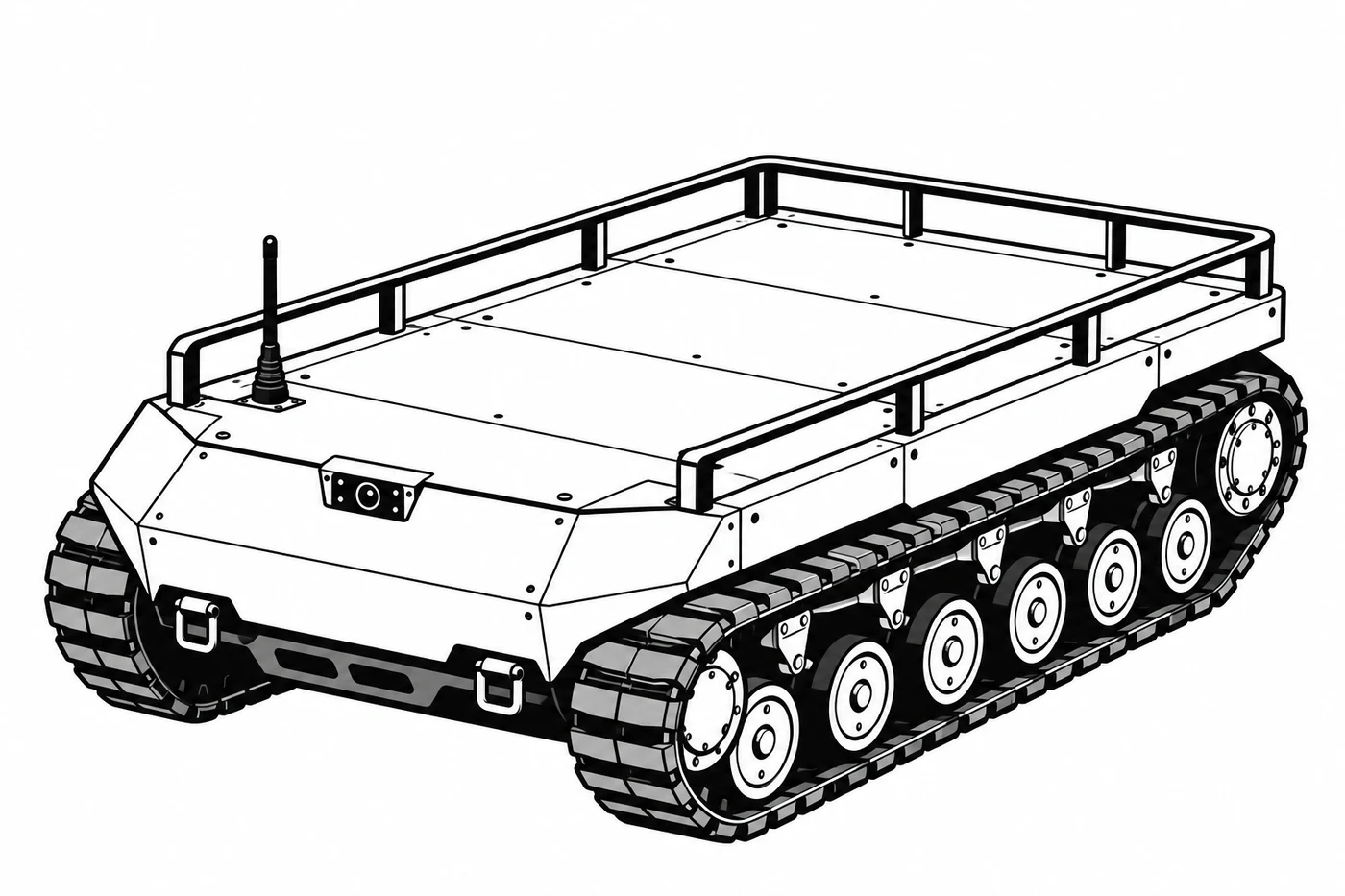
Tencore TerMIT overview
Last reviewed:
Tencore TerMIT is a Ukrainian family of tracked electric unmanned ground vehicles developed for dangerous support work close to the front line. Its low cargo platform can be configured for resupply, casualty evacuation and engineering tasks, while other installations carry surveillance equipment or remotely controlled weapon stations. The family should not be confused with an aerial drone or a single standardized combat vehicle. Its principal significance is moving equipment and casualties without requiring a driver to accompany every trip through exposed ground.
Ukraine's Ministry of Defence announced on June 21, 2025 that it had codified and authorized a new TERMIT iteration for use by the Defence Forces. The ministry said earlier vehicles were already working at the front and described the authorized platform as carrying up to 300 kg. It highlighted the low center of gravity, tracked mobility, several hours of battery operation and travel over several dozen kilometers. Authorization is a documented procurement milestone, not the date on which every TerMIT variant first appeared.
The manufacturer's reviewed TerMIT 2.0 technical table describes a larger contemporary configuration: approximately 1.726 m long, 1.293 m wide and 1.257 m high with its mast. It gives a 570 kg unarmored platform weight, about 640 kg with core armor, up to 40 km of travel, and speeds of 15 km/h on paved roads or 12 km/h off-road. Listed payloads are approximately 398 kg without armor and 327 kg with armor. These are manufacturer figures with stated tolerances, not independently measured battlefield averages.
Those figures must remain attached to their configuration. The same website contains module-specific and older-looking values, including lower payload ratings and different component weights; adding them together would produce a fictional vehicle. Cargo volume, patient accommodation, armor, batteries and towing equipment all compete for useful capacity. The supplied illustration is used as artwork, not as proof that the pictured chassis has a particular protection standard. Published travel distance also does not establish the usable radio-control radius under local terrain or interference conditions.
International industrial cooperation became an important part of the 2026 story. An October 20 Defender Media report, based on an interview with Tencore's chief executive, described Quantum Tencore Industries and the aim of producing the first German-built TerMIT vehicles before year-end. The company was still obtaining permits and transferring manufacturing technology. This is evidence of an operating joint venture and a production target, not confirmation that all planned German vehicles had already left the assembly line by this profile's review date.
On November 11, 2026, Militarnyi reported Tencore's demonstration and scaling plans for its AI KIT autonomy module. The chief executive described a limited group of deployed kits, further orders and predefined behavior when communications or positioning were lost. Reported reductions in vehicle losses were company-relayed unit claims, not an independently audited fleet survival rate. The module's development does not mean every TerMIT is autonomous, immune to jamming or able to recognize every obstacle; the baseline remains a mission-configured ground platform.
The November 21, 2026 review therefore treats TerMIT as an evolving, field-used support family rather than a fixed specification sheet. Ratel H offers a useful comparison with a larger wheeled Ukrainian logistics platform, while Ratel S has a different primary mission and should not inherit TerMIT cargo figures. THeMIS provides international context for tracked modular support vehicles. For each comparison, useful questions concern the exact load, ground conditions, energy supply, recovery arrangements and operator workload, not simply the highest headline payload.
Armament
Unarmed logistics baseline; optional mission-specific weapon stations are separate configurations
Development and operational timeline
- Ukraine's Ministry of Defence announces codification and authorization of a new TERMIT iteration; earlier models were already in front-line use
- Defender Media reports Quantum Tencore Industries' target for initial German production by year-end; permits and technology transfer remained in progress
- Militarnyi reports AI KIT demonstration, limited deployment experience and scaling plans; claims do not apply to every TerMIT
- Editorial status review: updated TerMIT 2.0 manufacturer figures are separated from the earlier 300 kg ministry-described configuration