Naval system · USV
Devil Ray T-38
High-Speed ISR / ASW
Also known as: Devil Ray T-38 / MARTAC T-38 / large unmanned surface vessel
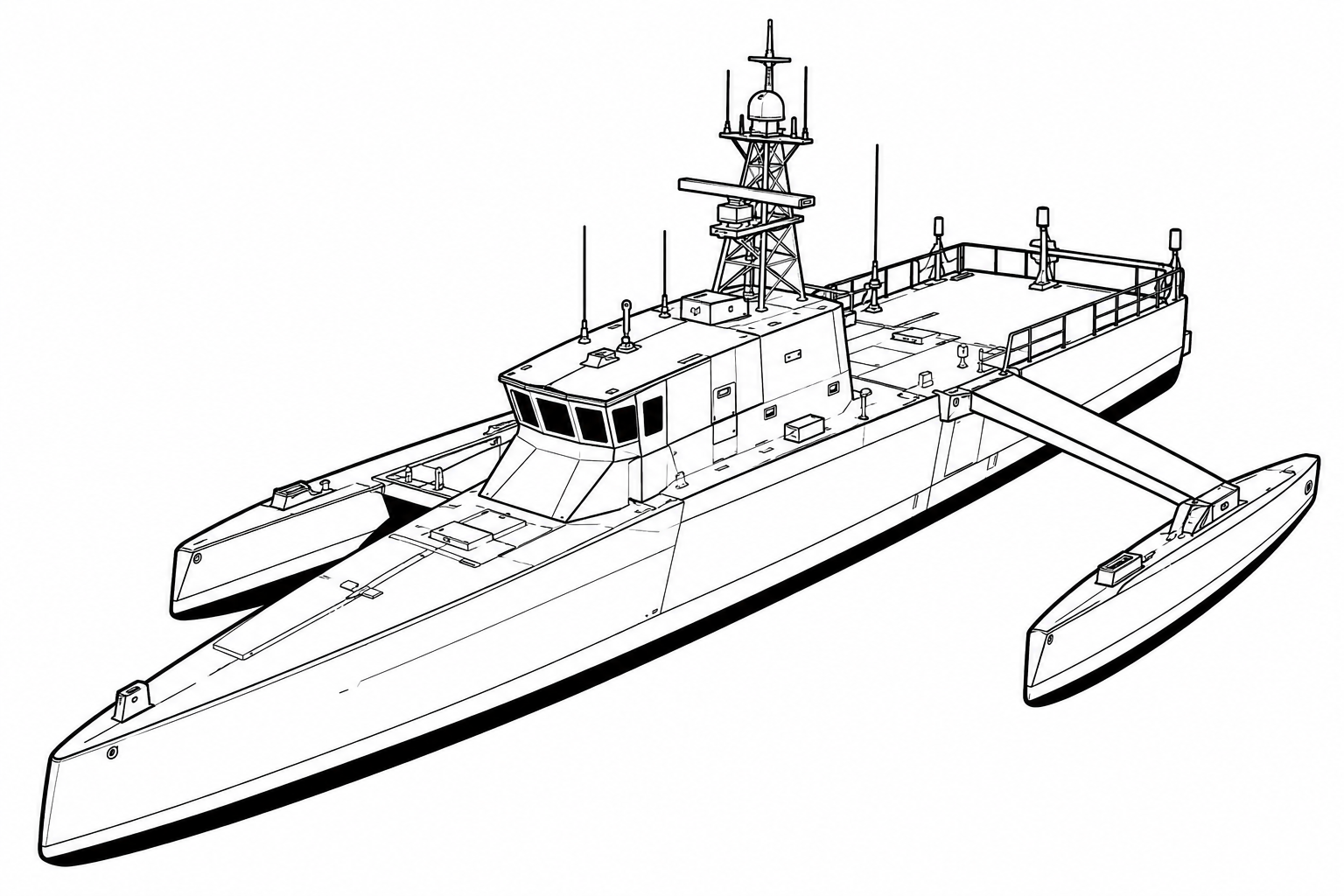
Devil Ray T-38 overview
The Devil Ray T-38 is a large unmanned surface vessel developed by MARTAC (Maritime Tactical Systems), a Florida-based company specializing in autonomous catamaran hull designs, for U.S. Navy evaluation under the Ghost Fleet Overlord and broader unmanned surface vessel development programs. The 38-foot (approximately 11.6-meter) twin-hull catamaran design was specifically selected by MARTAC for its superior seakeeping characteristics — a catamaran's wide stance prevents the rolling motion that degrades sensor performance on mono-hull vessels, and its dual-hull configuration creates a stable center platform for mounting sensors and weapons without the constant angular motion that renders imagery and sonar unusable in open-ocean conditions. The vessel reaches speeds exceeding 50 knots under full power, significantly faster than most other military USV candidates, allowing it to reposition rapidly between patrol sectors or race to intercept a contact of interest.
The T-38's open, modular payload bay occupies the central deck between the hulls, sized to accept standard DoD payload containers and configured with standardized electrical and data interfaces that allow different mission packages to be installed at the pier without specialized engineers. Payload configurations demonstrated to date include an electro-optical/infrared tower for ISR, a towed line array sonar for anti-submarine warfare, a mine countermeasures package with towed detection sonar, and a surface strike configuration with deck-mounted weapon systems. The vessel's MARTAC autonomous control system handles navigation, obstacle avoidance, station-keeping, and fuel management, communicating with a remote operator station via encrypted satellite or line-of-sight data link while maintaining a watch for contact alerts that may require operator direction.
The T-38 has participated in several major Navy exercises including RIMPAC — the world's largest naval exercise — where it operated alongside manned warships and other unmanned platforms in distributed maritime operations scenarios. These exercises provided operational data on human-machine teaming challenges, communications architecture requirements, and the practical limitations of autonomous surface vessels in high-traffic maritime environments. As of 2025–2026, MARTAC has delivered multiple T-38 units to Navy evaluation programs and is developing the larger T-48 variant with increased range, payload capacity, and endurance for the Navy's Medium Unmanned Surface Vehicle requirement.
Armament
Modular payload bay (ISR, ASW sonar, EW systems)
Development and operational timeline
- MARTAC unveils Devil Ray T-38 catamaran USV platform
- T-38 participates in Navy unmanned systems exercise; Ghost Fleet Overlord evaluation begins
- Devil Ray T-38 completes extended autonomous open-ocean transit demonstrating 50+ knot capability
- T-38 participates in RIMPAC alongside manned warships in distributed maritime operations
- T-38 deploys with towed array sonar for ASW detection demonstration
- MARTAC delivers multiple T-38 units for expanded Navy evaluation
- T-38 validates mine countermeasures payload configuration in operational test
- MARTAC advances T-48 development for Navy MUSV competition; T-38 fleet continues evaluation