Air system · Tactical
ScanEagle
Reconnaissance / Surveillance
Also known as: ScanEagle / ScanEagle 2 / Integrator ER (related)
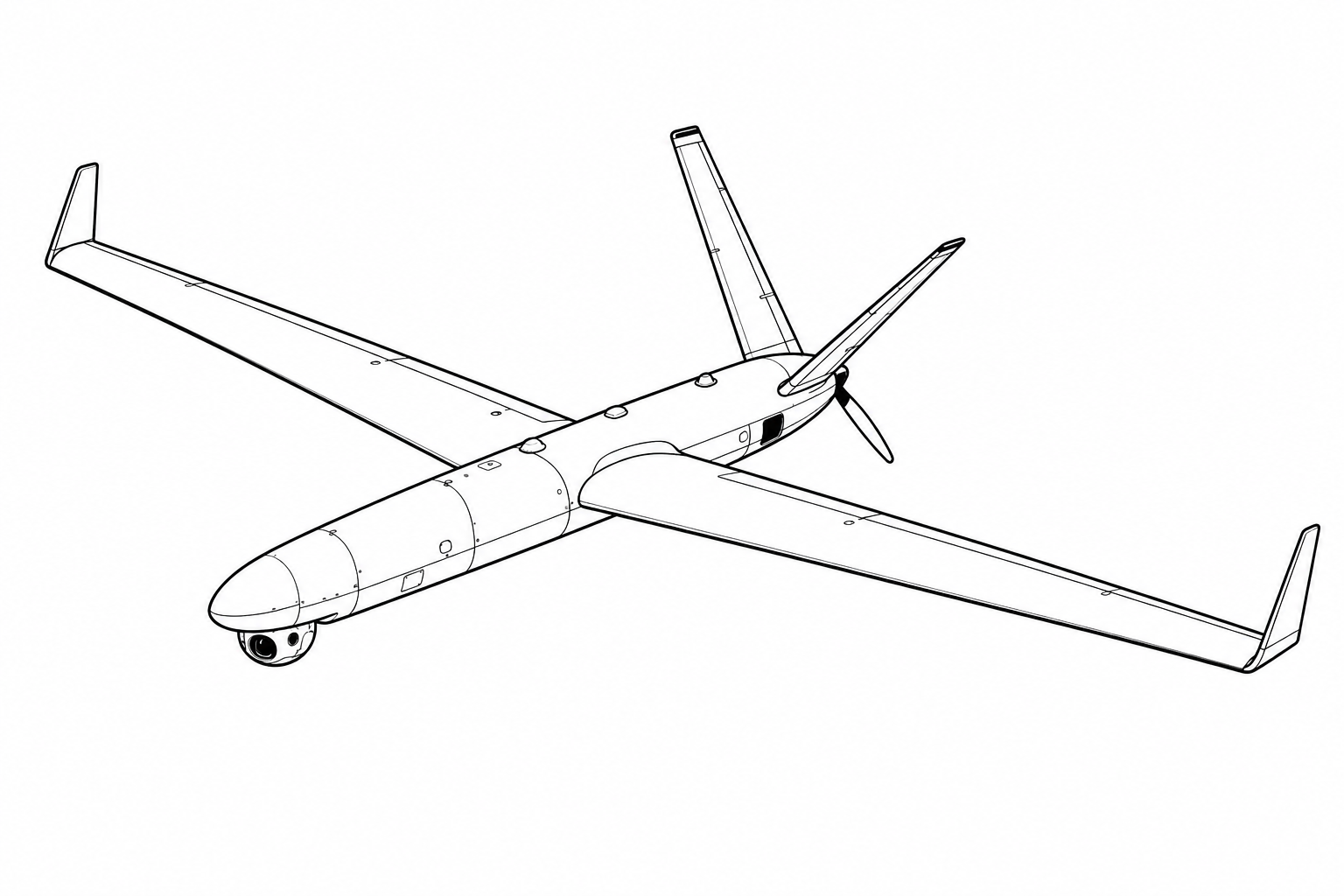
ScanEagle overview
The ScanEagle is a small, long-endurance unmanned aerial vehicle developed by Insitu, a subsidiary of Boeing. Its origins lie in the commercial fishing industry — the platform was originally designed as a tuna-spotting drone called the SeaScan, used by fishing boats to locate schools of yellowfin tuna in the Pacific. The military potential was obvious: the same persistent, runway-independent surveillance capability that could find fish could find insurgents, and Insitu partnered with Boeing to adapt the system for combat use. The ScanEagle entered service with the U.S. Marine Corps in 2004 and provided critical tactical ISR during the Battle of Fallujah. Its pneumatic SuperWedge catapult launcher and patented SkyHook wingtip-catch recovery system — a cable strung between two poles that the aircraft flies into — eliminate all runway requirements, allowing operations from forward operating bases, ship decks, and coastal patrol vessels.
The ScanEagle's small size — a 10-foot wingspan and 18-kilogram maximum takeoff weight — makes it easily transportable, and its quiet electric motor is difficult to detect at operating altitudes. The EO/IR ball turret provides continuous day/night video that is transmitted in real time to a ground or shipboard operator. Over 24 hours of endurance at altitudes up to 19,500 feet gives small units a persistence that would previously have required a dedicated reconnaissance aircraft and significant support infrastructure. Special Operations Command adopted the ScanEagle for clandestine ISR missions where the platform's small acoustic and thermal signature reduced the risk of detection during sensitive operations. The U.S. Navy has operated ScanEagle from patrol craft, littoral combat ships, and amphibious vessels, making it uniquely valuable for maritime security operations.
As of 2025–2026, Boeing Insitu has delivered over 1,000 ScanEagle systems to military and government customers across more than 30 countries. The ScanEagle 2 introduced a digital datalink, improved EO/IR sensors, and a new payload interface that accommodates SIGINT and communications intelligence packages. The system has been used for maritime surveillance operations against human trafficking and drug smuggling networks in the Caribbean, counter-piracy patrols in the Gulf of Aden, and border security along the U.S.-Mexico frontier. Iran claimed in 2012 to have captured a ScanEagle operating over the Persian Gulf — a claim the U.S. Navy denied — but the incident spotlighted the platform's extensive maritime surveillance role. The ScanEagle and its sibling the RQ-21 Blackjack remain the primary shipborne ISR drones of the U.S. Navy and Marine Corps.
Armament
None (ISR only)
Development and operational timeline
- ScanEagle deploys with USMC in Iraq; provides ISR during Battle of Fallujah
- Achieves initial operational capability with U.S. forces across services
- U.S. Navy begins ScanEagle deployments aboard patrol and littoral combat vessels
- Iran claims to have captured a ScanEagle operating over Persian Gulf — U.S. Navy denies
- ScanEagle deployed for maritime counter-piracy and anti-trafficking patrols
- ScanEagle 2 introduced with digital datalink and enhanced EO/IR payload
- Boeing Insitu delivers 1,000th ScanEagle system to global customers
- ScanEagle 2 selected for additional foreign military sales to Indo-Pacific partners