Naval system · Medium Autonomous Surface Vessel
Saronic Marauder
Maritime Logistics / Modular Payload Deployment
Also known as: Marauder ASV / Saronic Marauder MUSV
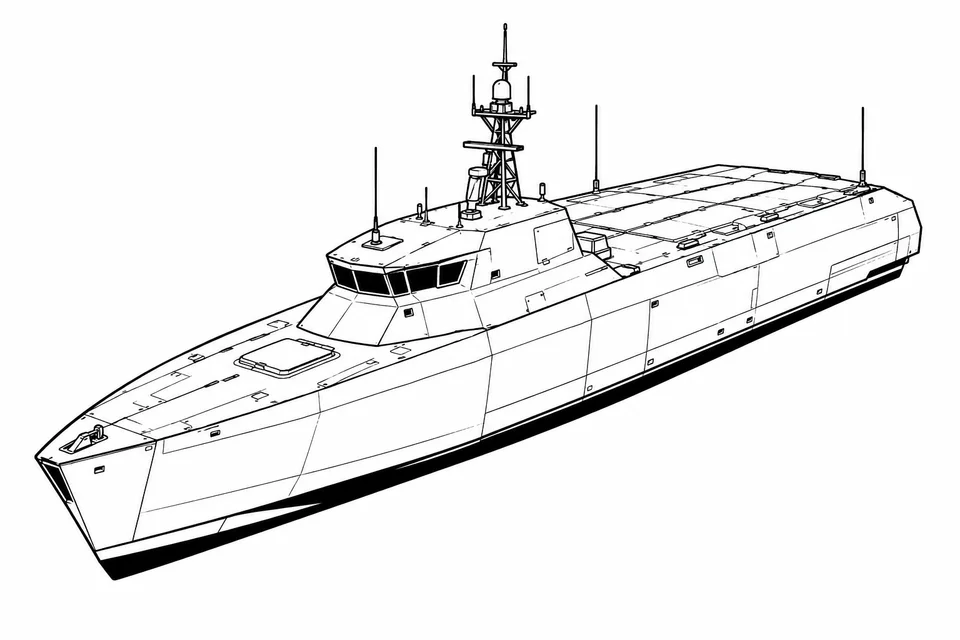
Saronic Marauder overview
Last reviewed:
Saronic Marauder is a medium autonomous surface vessel designed to transport and deploy modular payloads across long maritime missions. Saronic's current vessel page describes a 180-foot, approximately 54.9-meter ship with up to 150 metric tons of payload, a 12-knot cruise speed and more than 25 knots sprint speed. That makes it substantially larger than the small stealth attack boat previously described on this page. Its public emphasis is logistics and at-sea payload deployment; a modular deck does not establish that a particular missile, mine or electronic-warfare fit has already been qualified.
The program's public history also explains apparently inconsistent dimensions. When Saronic announced its acquisition of Louisiana shipbuilder Gulf Craft in April 2025, contemporary reporting described Marauder as a 150-foot design. The current manufacturer specification and later production announcement describe a 180-foot vessel. These are dated descriptions of the program's evolution, not numbers that should be silently combined. Gulf Craft's Franklin, Louisiana facilities provided a development and production base for larger vessels beyond the company's smaller autonomous boats.
Payload configuration is central to the current concept. Saronic says Marauder can accommodate four 40-foot ISO containers, eight 20-foot containers or other modular arrangements within its 150-ton maximum payload. This supports the movement of supplies and carriage of mission equipment without requiring a conventional crewed ship for each task. Container capacity is not equivalent to an installed weapon inventory, and maximum payload is not the vessel's displacement. The public source does not support the former profile's eight-ton total weight or two-ton payload.
Range must be read together with load. The manufacturer quotes 5,400 nautical miles at a 25-ton base load and 4,100 nautical miles at the 150-ton maximum load, approximately 10,000 km and 7,600 km respectively. These are advertised figures under stated loading conditions, not a promise to cover the longest distance at sprint speed with maximum cargo. Real operations also depend on sea state, route, sensor use and reserve policy. Distinguishing cruise from sprint and base from maximum load gives readers a much more meaningful specification than a single headline range.
Saronic's September 29, 2026 statement described a Navy MUSV Marketplace production Other Transaction following a June downselection and at-sea evaluation. The company reported eight days of continuous testing and more than 140 scenarios, including passive-perception work. Those are attributed trial results, not a guarantee of flawless behavior in all conditions or evidence of every proposed combat payload. Through the November review, Marauder's most important developments are the larger current configuration, autonomous-vessel testing and reported production award. Contract value, final customer quantities and fleet-wide operational status should not be guessed from the existence of that award.
Armament
Modular payload capability; no universal operational weapon fit established
Development and operational timeline
- Saronic announces the Gulf Craft acquisition and Marauder; contemporary trade reporting describes the initial 150-foot design
- According to Saronic's later production statement, the Navy downselects Marauder for MUSV Marketplace at-sea evaluation
- Saronic announces a Navy MUSV Marketplace production Other Transaction after at-sea evaluation; an award is not a completed fleet-delivery milestone
- Editorial status review: current 180-foot, 150-ton payload specification adopted with separate base-load and maximum-load ranges