Air system · Legacy Tactical Reconnaissance UAV
RQ-5 Hunter
Reconnaissance / Target Acquisition
Also known as: RQ-5A / Hunter UAV / B-Hunter / MQ-5B Hunter family
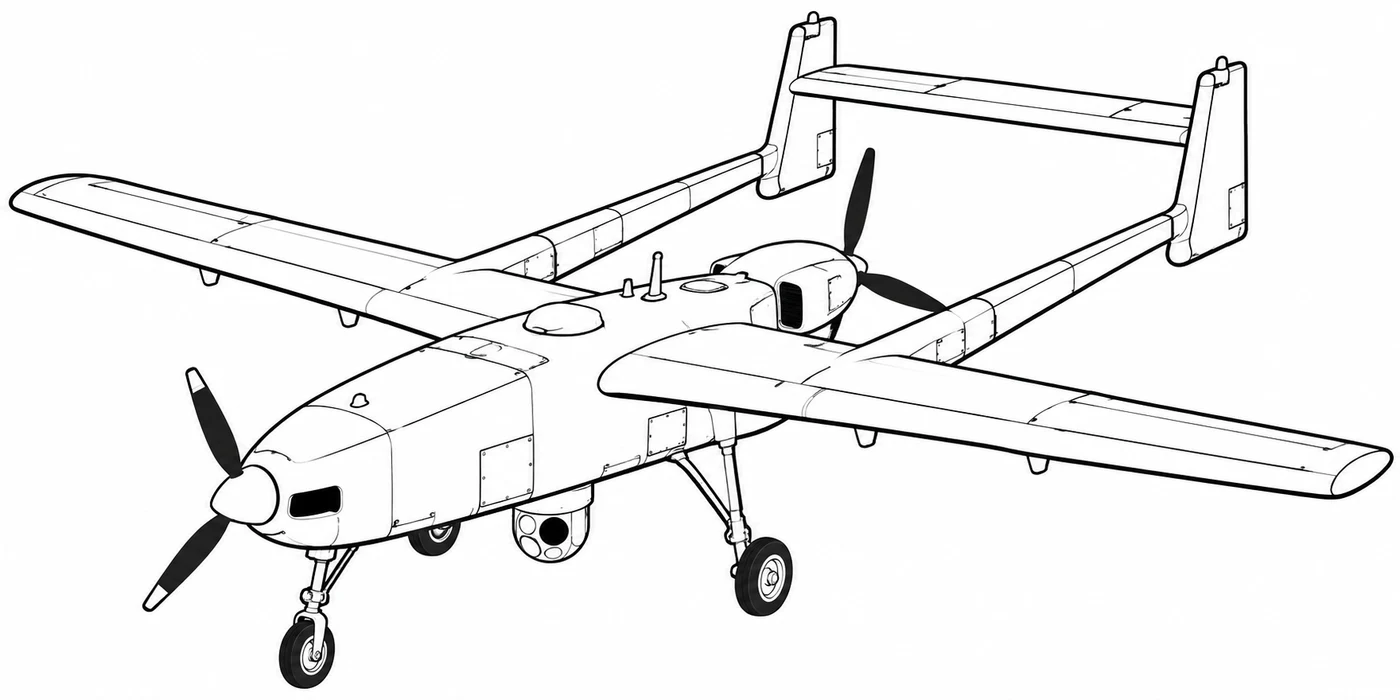
RQ-5 Hunter overview
Last reviewed:
RQ-5 Hunter is the original reconnaissance member of a tactical unmanned aircraft family developed by Israel Aircraft Industries and TRW, later supported by Northrop Grumman. It gave U.S. Army division and corps commanders a way to obtain their own airborne imagery rather than rely entirely on higher-level aviation assets. The aircraft's distinctive twin-boom layout and two engines, one pulling and one pushing, distinguish it from the single-engine RQ-2 Pioneer. This profile centers on RQ-5A while explaining the later MQ-5B, rather than combining every Hunter variant into one specification.
The baseline RQ-5A is commonly reported as approximately 7.01 m long with an 8.84 m wingspan and a maximum takeoff weight around 725 kg. Specialist sources describe an approximately 125 kg payload and endurance in the 12–15 hour class, depending on the configuration and mission. These historical figures are not the performance envelope of the larger-wing, heavy-fuel MQ-5B. A control-link radius is also different from total distance flown: aircraft could remain over an area for hours without traveling continuously outward from the control station.
Hunter carried stabilized electro-optical and infrared sensors for reconnaissance, target acquisition, artillery support and battle-damage assessment. Its airborne relay mode was particularly valuable in mountainous terrain, allowing one aircraft to help maintain contact with another beyond intervening obstacles. That arrangement expanded the system's practical coverage but required a second aircraft and supporting crews. It should not be described as unrestricted satellite-controlled operation or as proof that every Hunter could conduct an independent mission at the relay system's maximum advertised distance.
The program survived a difficult acquisition history. The Army's retrospective records an initial production order in 1993, fielding at Fort Hood in late 1995, and termination of full-rate production in 1996 after mishaps. Existing aircraft were retained and improved rather than immediately discarded. Deployments supporting NATO operations in Kosovo from 1999 demonstrated the value of persistent tactical imagery, followed by Iraq operations from 2003. The Army also documented a limited 2004 U.S. border-surveillance trial; that experiment was not an enduring domestic fleet deployment.
The MQ-5B introduced an extended fuel-carrying center wing, heavy-fuel propulsion and updated avionics. Armed Hunter work included Viper Strike, but that later integration should not be retroactively assigned to every original RQ-5A. In its 2015 farewell account, the Army described MQ-5B endurance above 20 hours, a range beyond 200 km and altitude above 18,000 ft. Those numbers belong to the upgraded aircraft and reported mission configuration, not to a baseline specification assembled from the best figure in each generation.
On December 16, 2015, a ceremonial final Hunter flight marked the end of the Fort Hood unit's operation and its transition toward MQ-1C Gray Eagle. The official account explicitly says aircraft were being transferred to government-owned, contractor-operated units supporting overseas operations. Consequently, 'retired in 2015' needs that qualification: it does not prove that every Hunter everywhere stopped flying on that date. The RQ-7 Shadow offers another useful comparison in the evolution of Army tactical reconnaissance, but its size, unit role and retirement history are separate.
At the November 21, 2026 editorial review, the linked record supports Hunter's historical fielding, operational deployments and the 2015 organizational transition. It does not establish a newly introduced 2026 Hunter variant or a verified current inventory across contractor and foreign fleets. Hunter remains important as an early operational system that demonstrated how airborne sensors, communications relays, ground control stations and trained exploitation teams work together. Its contribution is best assessed through that documented operational history rather than unsupported claims of present-day frontline expansion.
Armament
Unarmed baseline RQ-5A; Viper Strike belongs to later armed Hunter work
Development and operational timeline
- Initial production order for seven eight-aircraft systems recorded in the Army's historical account
- Army records initial fielding at Fort Hood and Fort Huachuca; late-1995 mishaps precede production restrictions
- Full-rate production terminated; existing aircraft retained for training, improvement and later operational use
- Hunter deployed in support of NATO operations in Kosovo, demonstrating the value of airborne relay in mountainous terrain
- Hunter supports Operation Iraqi Freedom; later upgrades sustain repeated deployments
- Specialist history records the first flight of the improved MQ-5B, a distinct heavy-fuel variant
- Fort Hood farewell flight marks transition toward Gray Eagle; Army describes transfers to contractor-operated units
- Editorial status review: historical variants and contractor transfers distinguished; no new 2026 fleet total or service expansion verified