Air system · Legacy Tactical Reconnaissance UAV
RQ-2 Pioneer
Reconnaissance / Naval Gunfire Spotting
Also known as: RQ-2A / RQ-2B / Pioneer UAV / IAI/AAI Pioneer
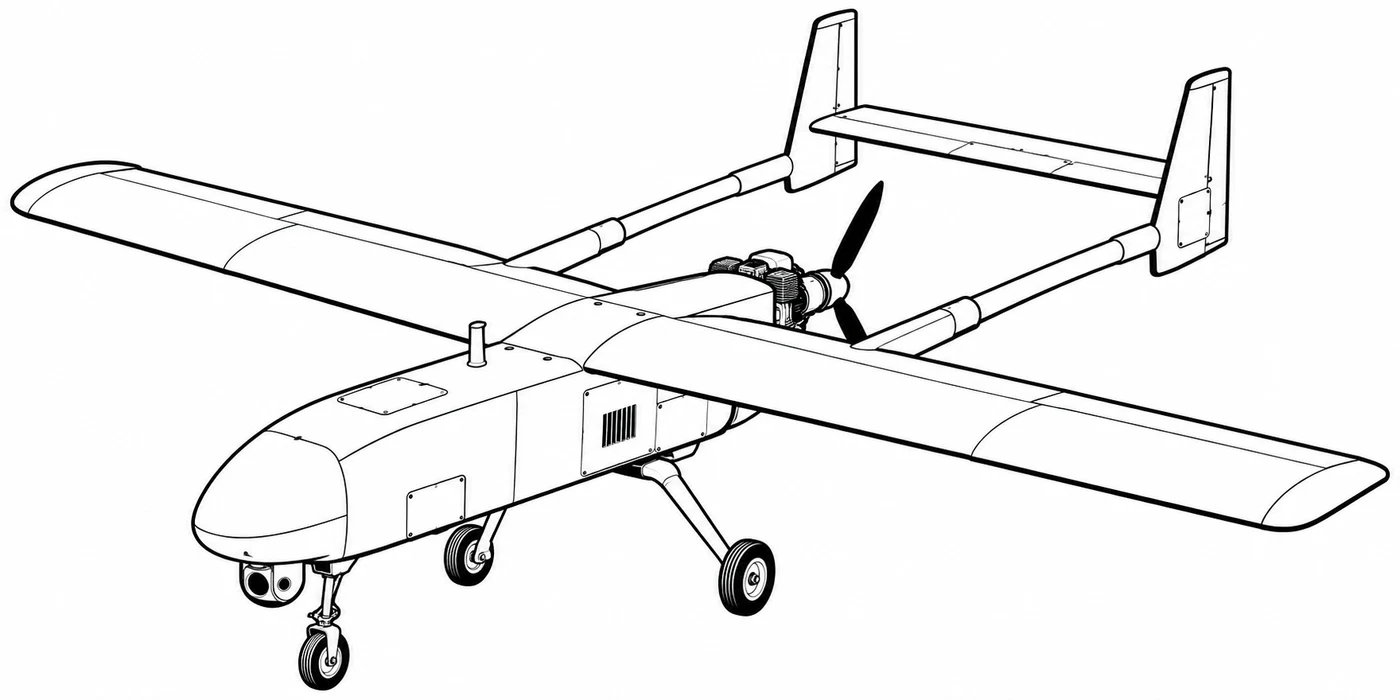
RQ-2 Pioneer overview
Last reviewed:
RQ-2 Pioneer is a small tactical reconnaissance aircraft developed from Israeli unmanned-aircraft experience and supplied in the United States through the IAI–AAI Pioneer partnership. It became closely associated with naval gunfire spotting, battlefield reconnaissance and the 1991 Gulf War. A rear-mounted piston engine drives its pusher propeller, leaving the forward fuselage available for sensors. Although it could operate from ships, it is an Air-domain aircraft rather than an uncrewed surface vessel, and its shipboard service should not be confused with autonomous maritime navigation.
Historical RQ-2A reference figures describe an aircraft about 4.27 m long, with a 5.15 m wingspan, approximately 205 kg maximum weight and a service ceiling near 4,570 m. A specialist reference gives maximum speed around 204 km/h, a five-hour endurance and a line-of-sight data-link range of 185 km. Published figures vary by version and payload. The Navy describes payloads of 65–100 lb, approximately 29–45 kg, and patrols exceeding five hours; neither the maximum payload nor the longest endurance should be assumed for every sortie.
Pioneer's principal value was the video and intelligence it returned to people directing operations. Electro-optical and infrared imagery supported reconnaissance, surveillance, target acquisition and battle-damage assessment. An aircraft observing artillery effects was part of a human-directed targeting process, not itself an armed strike platform. Operators, communications equipment, maintenance and intelligence exploitation were essential parts of the complete system. The familiar airframe alone does not represent all the equipment or personnel required to provide continuous coverage.
Shipboard operation required unusual launch and recovery arrangements. Pioneer could use a rocket-assisted or pneumatic launch, while recovery at sea involved flying into a large net. On land, it could recover on a suitable strip, including use of arresting equipment. The net arrangement let ships operate a fixed-wing aircraft without a conventional runway, but it still demanded deck space and a trained team. The later RQ-21 Blackjack and ScanEagle provide useful points of comparison for compact naval reconnaissance, though their recovery methods and operational generations differ.
The Navy's official history records a 1985 acquisition initiative, first deliveries in July 1986 and deployment aboard USS Iowa in December 1986. Marine Corps systems followed in 1987. During the Gulf War, Pioneer supported battleship gunfire and reconnaissance around Kuwait. Smithsonian collection material records the well-known incident in which Iraqi soldiers signaled surrender to a Pioneer associated with USS Wisconsin. This is evidence of the aircraft's psychological and observational effect in a specific incident, not evidence that it independently accepted prisoners or carried weapons.
Subsequent operations included the Balkans, Somalia and Iraq, while avionics and recovery improvements produced distinctions between RQ-2A and RQ-2B. Historical specialist coverage places the last operational U.S. Pioneer retirement in 2007 and notes later target-drone conversions of some airframes. Earlier plans for an RQ-2C upgrade or longer service life should not be mistaken for proof that the entire proposed upgrade fleet was delivered. Likewise, an official fact file retaining old references to ongoing Iraq operations is a historical description, not a current deployment report.
As of the November 21, 2026 editorial review, Pioneer is presented here as a legacy reconnaissance system with a documented museum and operational history, not a newly fielded aircraft. There is no verified 2026 production restart or renewed U.S. operational deployment in the linked record. Its significance lies in making tactical uncrewed aviation useful aboard ships and to ground commanders before today's larger fleets existed. Reading it alongside RQ-5 Hunter and RQ-7 Shadow shows both the continuity of the reconnaissance mission and the considerable changes in sensors, automation and support requirements.
Armament
Unarmed reconnaissance and spotting payloads
Development and operational timeline
- Navy directs rapid acquisition of an inexpensive over-the-horizon reconnaissance UAV capability
- Initial Pioneer system delivery recorded by the U.S. Navy
- Pioneer deploys aboard USS Iowa
- Additional systems delivered to the Marine Corps for shipboard and land-based operation
- Gulf War gunfire spotting and reconnaissance; Smithsonian documents soldiers signaling surrender to a Wisconsin-associated Pioneer
- RQ-2A designation and improved RQ-2B procurement described in specialist designation history
- Marine Pioneer units support Operation Iraqi Freedom
- Specialist history places retirement of the last operational U.S. Pioneers; some aircraft subsequently converted to targets
- Editorial status review: legacy reconnaissance and museum context retained; no 2026 service return or production restart established