Air system · Corps-Level Reconnaissance UAV
RQ-101 Songolmae
ISR / Target Acquisition
Also known as: KAI RQ-101 / Songgolmae / Night Intruder 300 / 송골매
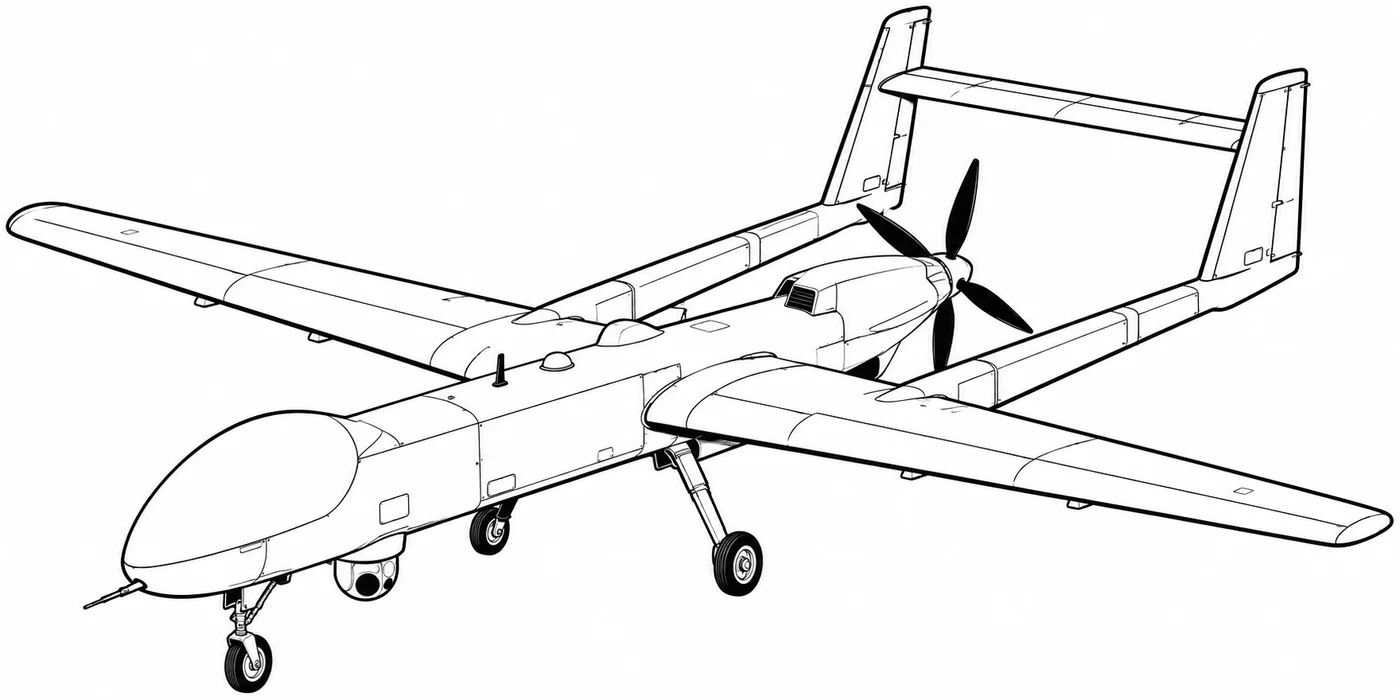
RQ-101 Songolmae overview
Last reviewed:
RQ-101 Songolmae is South Korea's domestically developed corps-level reconnaissance unmanned aircraft, produced by Korea Aerospace Industries and also known as Night Intruder 300. English transliterations include both Songolmae and Songgolmae. Its role is to provide tactical intelligence, surveillance, target-acquisition information and battle-damage assessment rather than carry a standard strike weapon. The aircraft and its ground system support commanders at a different level from the much larger RQ-4 Global Hawk, so the two should not be treated as interchangeable simply because both perform reconnaissance.
KAI's official public specifications list maximum speed of 100 knots, approximately 185 km/h, a 52 shaft-horsepower engine and six-hour endurance. Janes' January 2025 account gives a 4.8 m length, 6.4 m wingspan, 1.5 m height, approximately 300 kg maximum takeoff weight and a 45 kg payload capacity. It reports a ceiling of 14,760 ft, approximately 4,500 m. These figures describe the legacy corps-level aircraft; they should not be replaced by the 17 m wingspan and 1,700 kg mass displayed for a separate successor on the same KAI website.
The airframe uses a pusher propeller, twin tail booms and wheeled landing gear, carrying an observation payload beneath the forward fuselage. Stabilized visible-light and infrared sensors let crews observe during day and night, subject to atmospheric conditions and sensor capability. The value of such a system also depends on communications reliability, image exploitation and the operator's ability to interpret what is seen. A target location passed to another unit does not mean the reconnaissance aircraft itself has a guided-weapon capability or independent authority to engage.
The early-service record contains an important date distinction. KAI identifies deployment to the Republic of Korea Army in 2001, while Korean reporting commonly places full-scale production and broader fielding in 2002 after development completion around 2000. This profile retains the manufacturer's 2001 milestone and explains the later fielding phase rather than silently declaring one of the dates universally wrong. Development, first delivery, serial production and widespread operational use can legitimately occur in different years and should not be collapsed into a single ambiguous introduction claim.
An upgrade completed by early January 2025 addressed aging and obsolete components. DAPA's announcement, reported by Janes on January 8, describes new sensors, replacement of aging equipment, verified performance and flight-safety testing. Korean reporting also identifies airworthiness work on critical components such as propellers. That is evidence of a sustainment and capability-improvement program, not proof of an entirely new airframe or an undisclosed doubling of range and endurance. The exact sensor models were not fully disclosed in the cited specialist account.
October 2026 Korean reporting continues to discuss Songolmae as part of the Army's reconnaissance inventory, alongside division-level aircraft and separate Air Force assets. Such reporting provides current operational context but not a complete audited fleet count, sortie rate or retirement schedule. The existence of a next-generation corps-surveillance program also does not prove that every RQ-101 has already been replaced. As with RQ-7 Shadow and RQ-5 Hunter, modernization and fleet transition need to be examined through specific announcements rather than inferred from a newer aircraft appearing at an exhibition.
At the November 21, 2026 editorial review, the profile therefore presents RQ-101 as a legacy tactical system with a documented recent upgrade and continuing public relevance. It does not assign successor dimensions, invent a 2026 maiden flight or claim a verified expansion of operational numbers. The supplied illustration is a visual aid rather than proof of the upgraded sensor fit. Readers can use the timeline to distinguish early fielding, the 2025 sustainment milestone and later reporting, while the specifications remain tied to the aircraft actually identified by the sources.
Armament
Unarmed observation payload; target guidance is not onboard weapon carriage
Development and operational timeline
- Korean retrospective reporting places completion of the initial development effort around this period
- KAI identifies first deployment of Songolmae to the Republic of Korea Army
- Korean reporting identifies full-scale production and broader fielding following the initial deployment phase
- DAPA announces completion of an upgrade addressing obsolete equipment, sensors and flight safety
- Seoul Economic Daily discusses Songolmae among Army reconnaissance assets; reporting does not establish a fleet-wide replacement date
- Editorial status review: recent sustainment and current reporting retained; successor specifications and unverified fleet totals excluded