Air system · Kamikaze
Switchblade 300
Loitering Munition / Anti-Personnel
Also known as: Switchblade 300 / Lethal Miniature Aerial Munition System / LMAMS
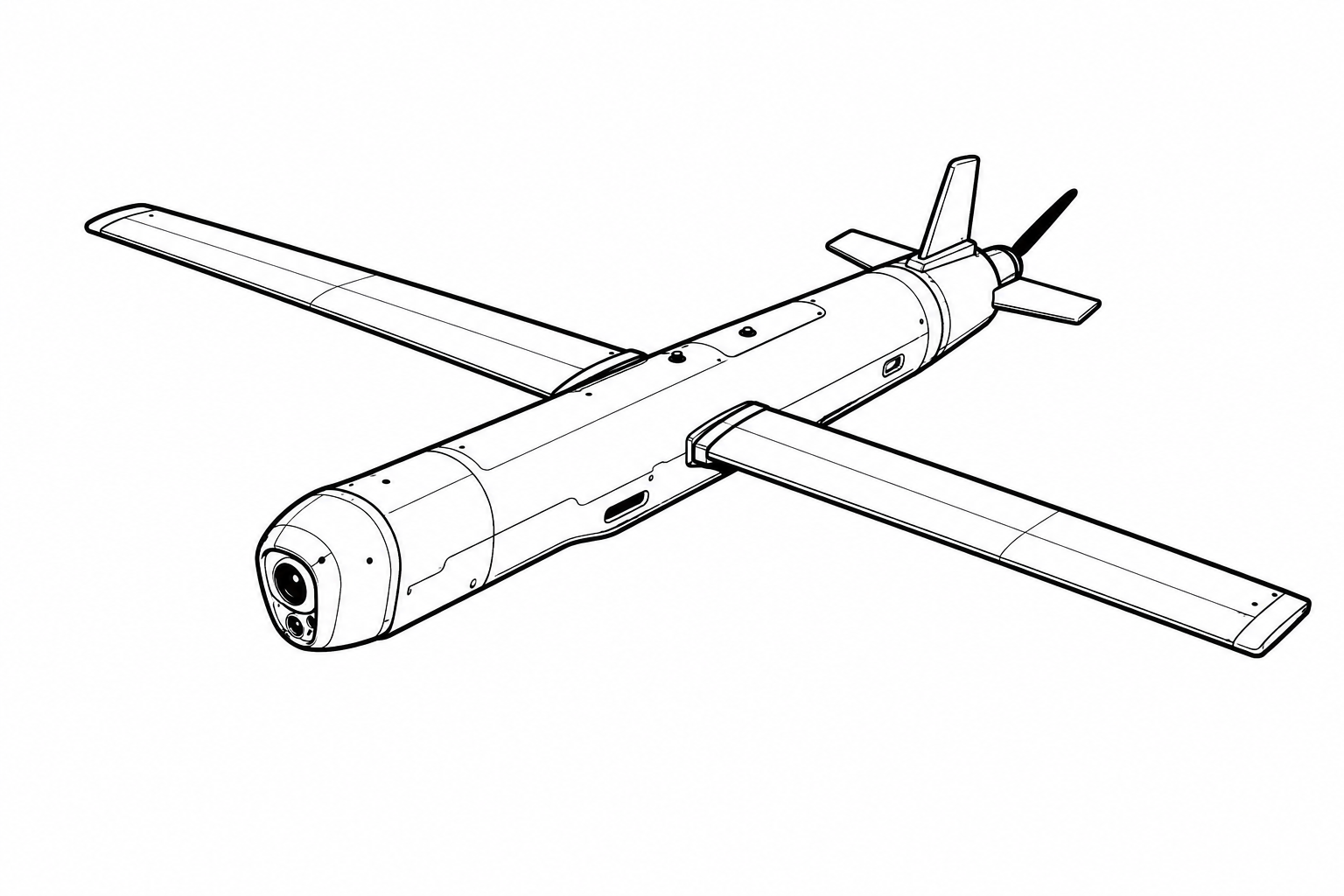
Switchblade 300 overview
The Switchblade 300 is a man-portable loitering munition developed by AeroVironment under the U.S. Army's Lethal Miniature Aerial Munition System (LMAMS) program, and represents one of the most consequential military technology developments of the 21st century — the miniaturization of precision strike to a capability that a single dismounted soldier can carry, deploy, and employ. At 2.5 kilograms and tube-launched in seconds with no assembly required, the Switchblade 300 places what would previously have been a call-for-fire or close air support capability directly in a squad leader's hands. The folding wing design deploys immediately after tube ejection, and the electric motor allows the vehicle to loiter silently over the target area for up to 15 minutes while the operator studies the live video feed from the nose-mounted camera, building situational awareness and waiting for the optimal engagement moment. The entire system — round, controller, and communications gear — weighs under 5.5 kilograms and fits in a standard military rucksack, enabling a two-soldier team to carry and employ precision strike capability on any patrol without dedicated fire support coordination.
The Switchblade 300's fragmentation warhead is sized to incapacitate personnel and lightly armored vehicles while minimizing collateral effects — a deliberate design choice that reflects the legal and ethical constraints of modern counterinsurgency and urban warfare environments, where distinguishing combatants from civilians is a constant operational challenge. The system's wave-off capability — the ability to abort an attack mid-flight and continue loitering — gives it a decisive advantage over conventional one-way munitions: if a target moves into an area where engagement would risk civilian casualties, the operator waves off and waits for a better angle, or redirects to a different target entirely, all while the round continues to loiter on electric power. A jam-resistant data link protects command and video signals in contested electronic environments, and the nearly silent electric motor at operating altitudes makes the Switchblade 300 extremely difficult for targets to detect acoustically before impact. The combination of these characteristics — precision, silence, wave-off, and man-portability — defined a new category of battlefield weapon and prompted virtually every major NATO military to either procure the system or develop a domestic equivalent.
The Switchblade 300 gained global prominence in 2022 when the United States began supplying large quantities to Ukraine, where Ukrainian forces employed them against Russian infantry positions, observation posts, and crew-served weapons teams along the Donbas and Zaporizhzhia front lines. The weapon's small size and electric propulsion made it difficult for Russian electronic warfare systems designed for larger munitions to reliably detect and jam, and its precision allowed Ukrainian operators to engage targets inside urban areas and tree lines without widespread collateral destruction. By 2025–2026, AeroVironment has become one of the fastest-growing defense manufacturers in the United States by volume, driven by the combined demand from U.S. Organic Precision Fires doctrine, sustained Ukrainian military assistance packages, and a wave of foreign military sales to NATO and Indo-Pacific allies. The U.S. Army has authorized platoon-level organic Switchblade 300 stocks across brigade combat teams — a doctrinal shift that fundamentally changes how company commanders plan direct-fire engagements beyond the range of organic weapons. A Block 30 variant confirmed in development features AI-assisted target tracking, a heavier warhead option, and terrain-referenced navigation for GPS-denied environments.
Armament
Fragmentation warhead (integral)
Development and operational timeline
- AeroVironment receives initial LMAMS contract from U.S. Army for squad-level precision strike requirement
- Switchblade 300 deployed to Afghanistan by Special Operations Forces — first combat use
- Block 10C upgrade delivers improved guidance, warhead effectiveness, and wave-off capability
- U.S. provides Switchblade 300 to Ukraine; first large-scale combat use against peer adversary
- Ukrainian forces report extensive Switchblade 300 use against Russian infantry in Kharkiv counteroffensive
- AeroVironment scales production 3x; combined U.S., allied, and Ukraine assistance orders drive expansion
- Block 20 variant with extended range and multi-band jam-resistant datalink delivered to U.S. forces
- Switchblade 300 added to FMS catalog; UK, Norway, Australia finalize procurement agreements
- U.S. Army authorizes platoon-level organic Switchblade 300 stocks across all brigade combat teams
- Japan, Philippines, South Korea initiate formal procurement evaluations under Indo-Pacific security cooperation
- Block 30 development confirmed — AI target tracking, GPS-denied navigation, heavier warhead option
- Switchblade 300 surpasses 10,000 units delivered across U.S. military and allied customers