Air system · FPV Strike Drone
Izdeliye-98 (Product 98)
Close-Range Precision Strike / Anti-Personnel / Anti-Armor
Also known as: Product 98 / Izdeliye 98 / Russian 9-inch FPV
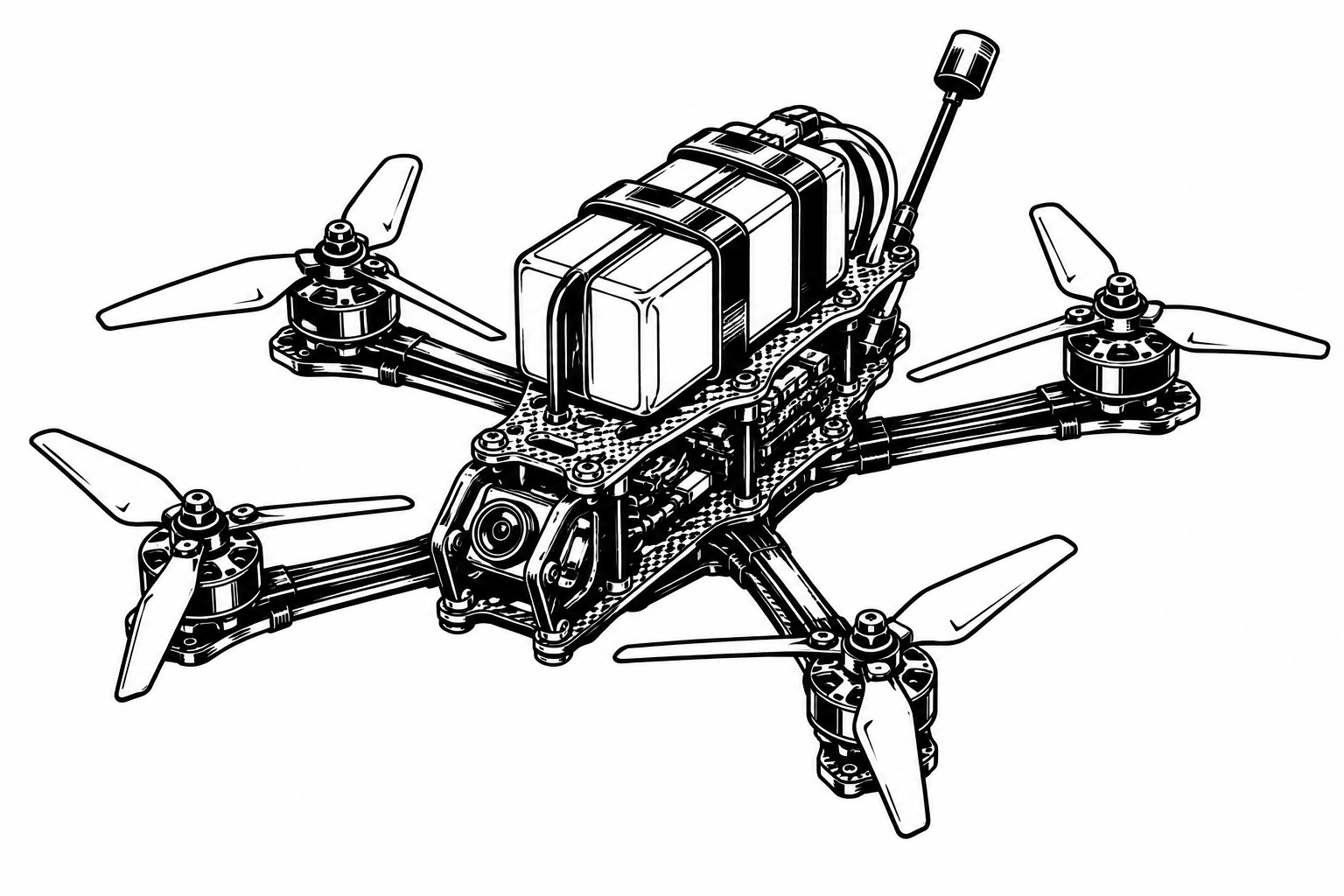
Izdeliye-98 (Product 98) overview
The Izdeliye-98, or 'Product 98,' represents Russia's systematic effort to move beyond improvised racing-drone FPV systems toward purpose-built military-specification kamikaze drones with standardized components and predictable performance. Earlier Russian FPV drones were largely sourced from commercial racing drone parts — motors, frames, and electronic speed controllers designed for competitive racing that happened to be cheap and widely available. While functional, these commercial-origin components varied in quality, required skilled assembly, and degraded rapidly under harsh field conditions. The Izdeliye-98 was designed by the Russian firm ALPHA to replace ad-hoc procurement with an industrial product.
The 9-inch propeller configuration was chosen as a deliberate compromise: larger than the 5-inch props used on racing-class FPVs, the 9-inch format dramatically increases payload capacity — allowing the Izdeliye-98 to carry shaped charges capable of penetrating light armor and disabling armored personnel carriers, which 5-inch FPVs generally cannot defeat. The larger frame also improves stability in wind and allows heavier batteries for marginally extended range. ALPHA sourced components from Russian manufacturers following Western sanctions that disrupted supplies of Taiwanese and Chinese electronics, though analysts noted that some components still appeared to originate from sanctioned suppliers through intermediaries.
First deployed on the Zaporizhzhia front in July 2026, the Izdeliye-98 arrived as Russia was dramatically scaling FPV production across multiple firms under a state-directed drone industrialization program. The Kremlin's target of producing millions of strike drones annually required standardized designs that could be manufactured at multiple facilities simultaneously, with interchangeable parts and consistent quality control — exactly what the Izdeliye-98's engineered specification provides over improvised commercial builds. Ukrainian electronic warfare teams quickly began adapting their jamming and detection systems to the Izdeliye-98's specific signal characteristics.
Armament
Shaped-charge anti-armor warhead or fragmentation warhead; single-use kamikaze profile
Development and operational timeline
- ALPHA firm begins development of Izdeliye-98 as military-specification 9-inch FPV strike drone
- Prototype testing completed; 9-inch frame, Russian-sourced components, and shaped-charge warhead validated
- Russian Ministry of Defence evaluation; Izdeliye-98 selected for state procurement alongside other standardized FPV designs
- Production at Alabuga and secondary facilities begins; initial rate 1,000 units per month
- First battlefield deployment in Donetsk sector; Izdeliye-98 used in combined FPV swarm attacks
- Production rate doubled to 2,000 units per month; second ALPHA facility begins manufacturing
- Anti-armor warhead variant with tandem shaped charge developed; effective against Ukrainian IFVs
- Zaporizhzhia front deployment confirmed; Izdeliye-98 identified in wreckage by Ukrainian forces
- Production rate reaches 5,000 units per month as part of broader Russian drone industrialization push