Air system · Medical Evacuation Hexacopter
StarGate
Casualty Evacuation / Heavy-Lift Transport
Also known as: SkyFall StarGate / StarGate medevac UAV
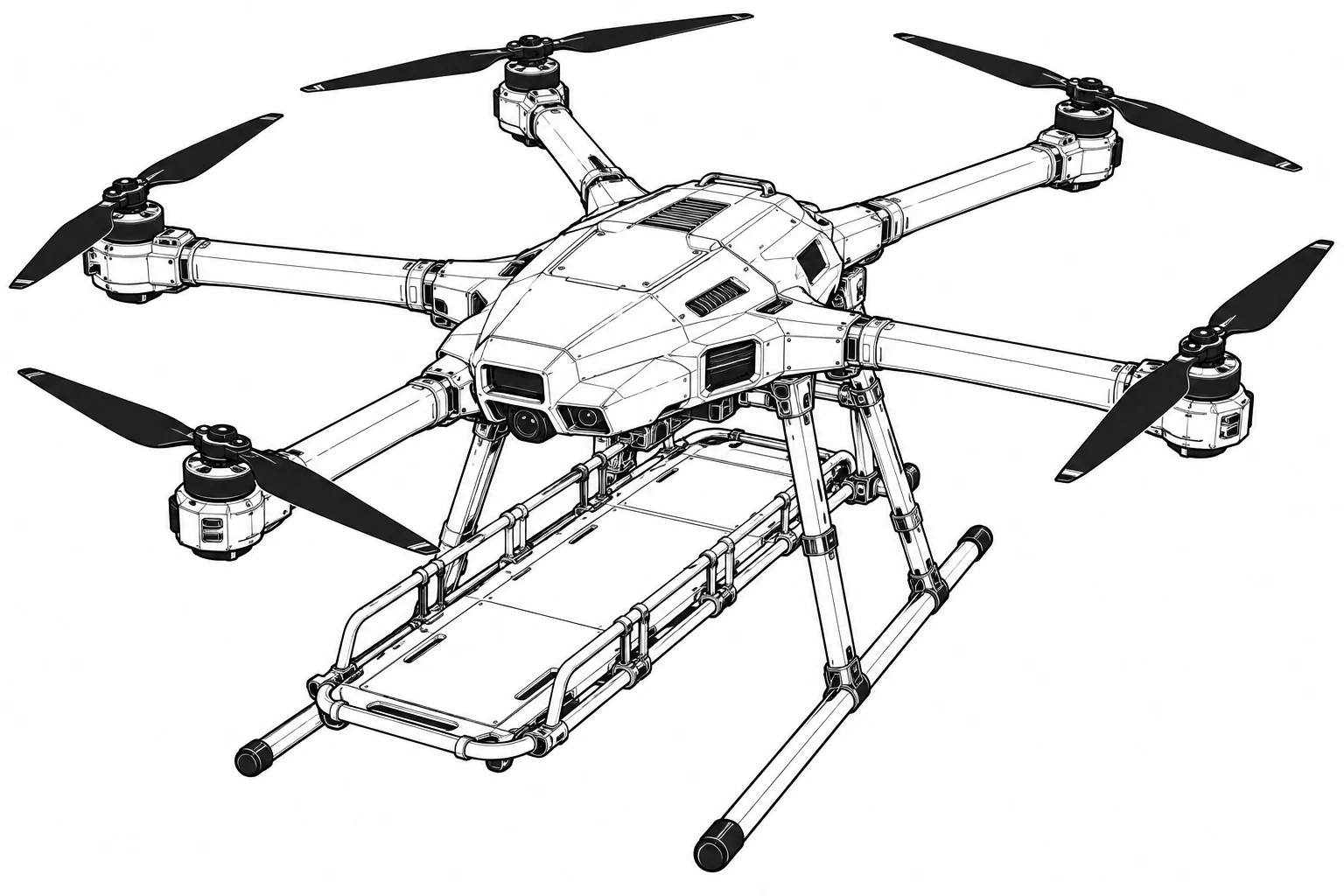
StarGate overview
Last reviewed:
StarGate is a six-rotor medical-evacuation UAV developed by Ukraine's SkyFall to transport a wounded person away from positions that are difficult or dangerous to reach by ground vehicle. It is a casualty-evacuation experiment, not an armed strike drone and not an established civilian air ambulance. October 2026 reporting describes a stretcher-centered medical compartment designed to accommodate one soldier with equipment. Its emergence reflects the danger that FPV attacks and damaged roads pose to medical teams and the time needed for a ground robot to negotiate the same route.
The project reportedly began after a 2025 request from the commander of the 475th Separate Assault Regiment, known as Code 9.2. Associated Press attended an October 14, 2026 field demonstration, and subsequent reporting said a platform had been handed to the regiment for evaluation under front-line conditions. The unit's commander cautioned that at least a month of use would be needed before drawing useful conclusions. That makes an early testing classification more accurate than claims of routine patient evacuation, proven combat safety or an established operational rescue record.
SkyFall's figures, reported in October, include a payload up to 150 kg, a one-way range of 15 km, a cruise speed around 65 km/h and a maximum speed up to 105 km/h. Preparation is said to take approximately ten minutes. The 15 km figure is specifically one-way; it is not a confirmed loaded round-trip radius, and it cannot responsibly be converted into a flight endurance without additional data. The published sources reviewed do not provide reliable overall dimensions, empty mass, maximum takeoff weight or a full payload-versus-range curve.
The reported communications architecture combines Starlink with SkyFall's L-Link system. Developers describe manual flight with assistance for navigation when satellite positioning is denied or spoofed, thermal imaging for night use and a return-to-safe-area function following loss of communications. Reporting also describes tests of protective measures, including a net launcher against approaching FPV drones. These are developer claims and demonstration accounts. In particular, claims of surviving the loss of a motor-carrying arm do not establish a certified passenger-carrying failure envelope or an acceptable medical risk under battlefield conditions.
The distinction between transporting a test load and transporting an injured person is central to understanding StarGate. A practical evacuation service must account for loading and restraint, the patient's condition, landing-site security, weather, electrical endurance, communications and the availability of medical staff at both ends. Removing a driver from an exposed route does not remove all risk to the casualty or to the people who place them aboard. The October demonstrations establish a potentially useful approach, but not broad clinical or operational validation.
SkyFall indicated a starting price of about US$50,000 depending on configuration and an ambition to produce up to 1,000 systems per month by the end of 2026 if testing supports the program. Neither the stated price nor the production ambition is a confirmed bulk contract or realized factory output. At the October 24 review date, StarGate should therefore be described as a heavy-lift medevac UAV in early military evaluation, with performance claimed by its developer and important questions about casualty outcomes, survivability and sustainable field operations still unanswered.
Armament
No offensive armament reported; optional protective measures described during testing
Development and operational timeline
- Code 9.2's commander requests a safer aerial evacuation option, according to October 2026 reporting on the project's origins
- Associated Press observes a StarGate field demonstration in Ukraine; demonstration imagery documents a test rather than a verified patient rescue
- AP's first-look reporting describes a handover for front-line evaluation during the week of the demonstration
- Follow-up coverage details the claimed 150 kg payload, 15 km one-way range, communications and planned medical-evacuation role
- Reported year-end output of up to 1,000 per month remains a conditional manufacturer production target, not achieved output
- Editorial status review: early brigade/regiment-level evaluation; routine casualty evacuation and effectiveness statistics are not established