Air system · VTOL Autonomous ISR Drone
Shield AI V-BAT
Autonomous Reconnaissance / Force Protection / SIGINT
Also known as: V-BAT / Shield AI VTOL / tail-sitter drone
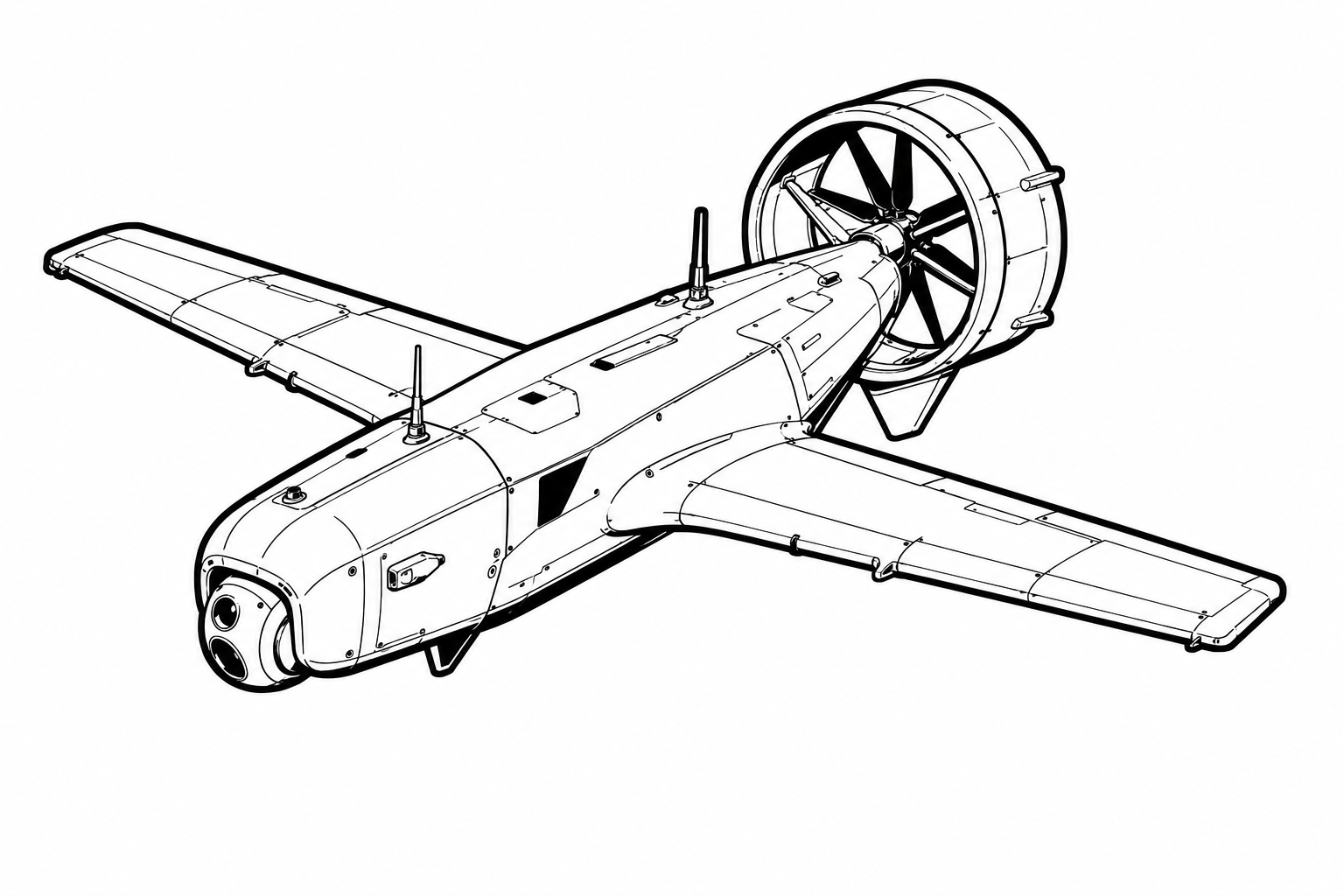
Shield AI V-BAT overview
The Shield AI V-BAT is a tail-sitter VTOL unmanned aircraft that takes off and lands vertically on its tail — standing upright like a rocket at rest, then pitching to horizontal flight for efficient cruise — and is made operationally distinctive by Shield AI's Hivemind AI pilot software that enables fully autonomous flight without GPS. While other VTOL UAS still rely heavily on satellite navigation for positioning and autopilot functions, the V-BAT's Hivemind system uses visual odometry, inertial navigation, and machine learning-based environment modeling to maintain precise position knowledge and flight control in environments where GPS has been jammed, spoofed, or is simply unavailable due to terrain masking.
This GPS-independence is the V-BAT's defining military advantage. In any conflict against an adversary with serious electronic warfare capability — Russia, China, Iran, North Korea — GPS jamming and spoofing are baseline expected threats, not exotic capabilities. Drone systems that depend on GPS for basic flight stability become unreliable or unflyable when GPS is disrupted; the Hivemind-equipped V-BAT maintains full autonomous capability through the same conditions. This allows V-BAT deployments in the contested electromagnetic environments where ISR needs are greatest — directly over the front lines where jamming is most intense — rather than being pushed back to ranges where GPS reliability can be maintained.
The V-BAT's tail-sitter configuration provides extraordinary launch flexibility: the aircraft stands on its tail using four small stabilizing feet and can take off from any flat surface roughly the size of a parking space. This allows deployment from ship decks without catapults, from building rooftops, from vehicle rooftops, and from tiny forest clearings. The footprint is substantially smaller than any runway-requiring system and smaller than most quadcopter systems of equivalent endurance. Shield AI's expanding DoD and international contracts through 2026 reflected growing recognition that GPS resilience and launch flexibility together constitute a combination that no competing platform fully replicates.
Armament
None (ISR); EO/IR, SIGINT, or communications relay payloads
Development and operational timeline
- Martin UAV develops V-BAT prototype; tail-sitter VTOL configuration selected for minimal launch footprint
- Shield AI acquires Martin UAV; Hivemind AI pilot software integration with V-BAT begins
- Hivemind-enabled GPS-denied flight demonstrated; V-BAT maintains autonomous flight in simulated jamming environment
- U.S. Navy ship-deck evaluation; V-BAT launches and recovers from destroyer deck without catapult
- SOCOM evaluation; V-BAT deployed from concealed position in forested environment
- First operational contracts; V-BAT delivered to Navy and SOCOM units for deployed ISR
- International sales begin; allied nation deliveries under U.S. FMS
- Hivemind update; V-BAT adds terrain-following autonomous routing for low-altitude threat avoidance
- EW environment exercise; V-BAT operates through active jamming scenario without GPS for 8 hours
- U.S. Army adopts V-BAT for Brigade VTOL ISR requirement; significant contract awarded
- SIGINT payload integration; V-BAT with signals intelligence sensor deployed to Pacific theater
- Expanded DoD contract; additional V-BAT units for Air Force special operations and Navy patrol